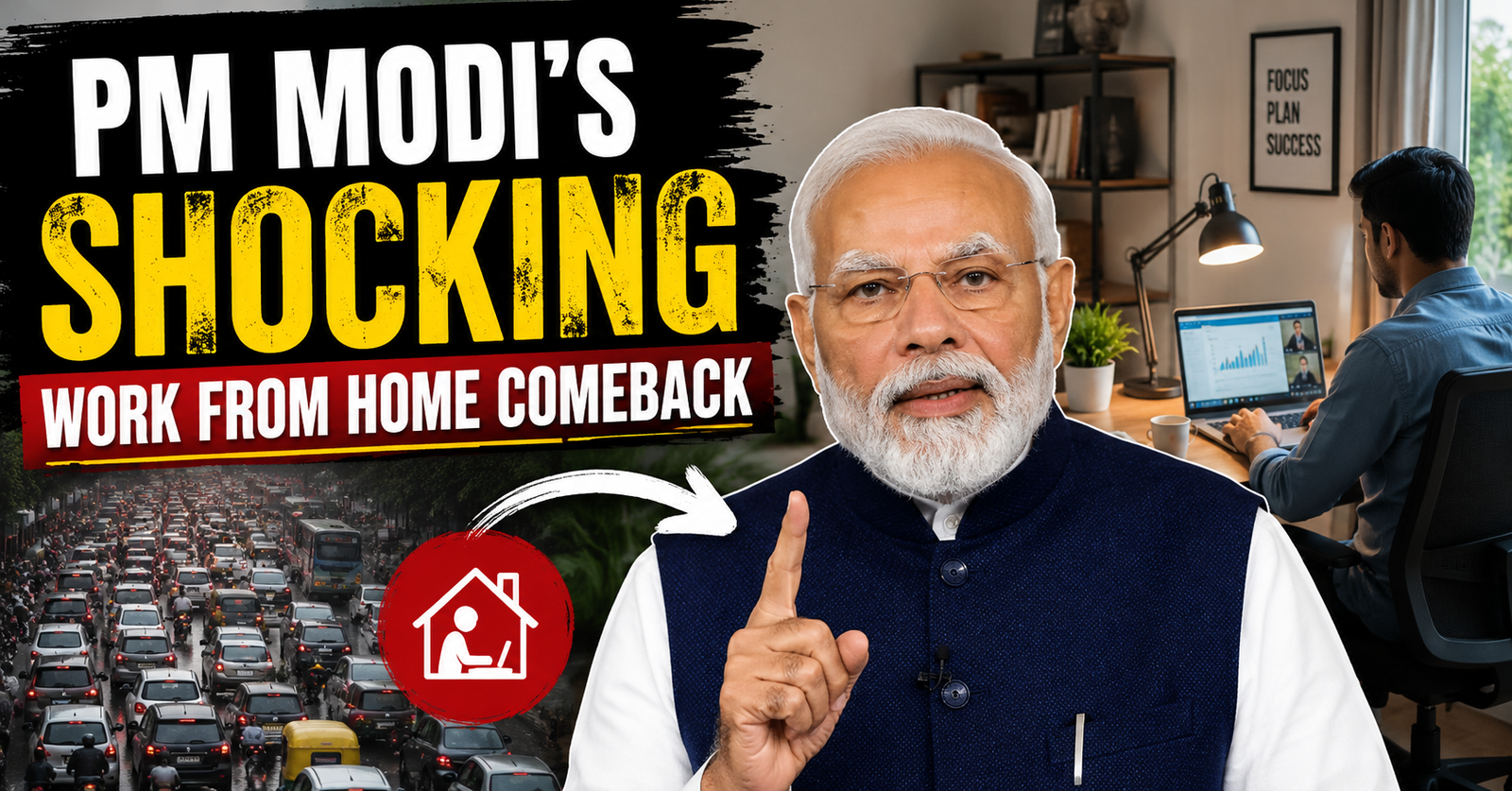
Why PM Modi Is Talking About Work From Home Again
When most people heard PM Modi mention Work From Home again, many assumed it was just another temporary suggestion linked to global tensions and rising oil prices. But the deeper reason behind it is far more interesting.
This time, Work From Home is not being discussed as an employee benefit. It is being discussed as an economic tool.
That shift matters.
During the pandemic years, remote work became a survival model. Offices were shut, cities were under restrictions, and companies had no option but to adapt. But in 2026, the situation is completely different. Offices are open, travel is normal again, and most companies have already pushed employees back to physical workplaces.
So why bring WFH back into the national conversation now?
The answer may have less to do with productivity and more to do with fuel, imports, and economic pressure.
The Bigger Concern Behind the Speech
A significant amount of India’s crude oil is imported. Whenever tensions rise in the Middle East, oil prices become unstable almost immediately. Even small increases in global crude prices can affect transport costs, inflation, delivery charges, airline tickets, and eventually household budgets.
That is the context in which PM Modi’s comments become important.
When millions of people travel daily for work, cities consume enormous amounts of petrol and diesel. Traffic congestion itself burns fuel. Long commutes, office transport systems, and commercial energy usage all contribute to higher consumption.
Now imagine even a small percentage of office workers staying home two or three days a week.
The reduction in fuel demand would be significant.
This is probably why the government’s messaging feels different this time. It is less about workplace flexibility and more about economic preparedness.
Work From Home Is No Longer Just an HR Policy
For years, discussions around remote work focused mainly on employee comfort.
People talked about:
- better work-life balance
- flexible schedules
- avoiding traffic
- saving commute time
Those benefits still exist, but the national conversation has shifted.
Now the discussion includes:
- reducing fuel dependency
- lowering urban congestion
- cutting operational costs
- managing energy consumption during global uncertainty
That is a completely different framework.
In a way, Work From Home has moved from being a corporate trend to becoming part of economic planning.
A Simple Example Shows Why This Matters
Consider a professional living in Noida and commuting daily to Gurugram.
A round trip can easily cross 60–70 kilometers depending on traffic and route. Multiply that by five working days every week, and the monthly fuel usage becomes substantial.
Now multiply that by lakhs of workers across Delhi NCR, Mumbai, Bengaluru, Pune, and Hyderabad.
The numbers become massive very quickly.
Even partial remote work can reduce:
- fuel consumption
- traffic jams
- pressure on public transport
- air pollution
- travel stress
And unlike many large-scale economic reforms, this does not require years of infrastructure building. Companies already know how to operate remotely because they did it for years during COVID.
That makes WFH one of the fastest tools available during uncertain economic periods.
Companies May Also Quietly Benefit
One interesting part of this discussion is that many businesses may not strongly oppose hybrid work anymore.
Commercial rent in major Indian cities is expensive. Electricity costs are rising. Office maintenance, employee transportation, cafeteria services, and energy consumption all add up.
Some companies already discovered during the pandemic that hybrid work models can reduce expenses without completely affecting output.
Of course, not every industry can function remotely. Manufacturing, retail, healthcare, logistics, hospitality, and factory-based work still require physical presence. But sectors like IT, consulting, marketing, media, finance, and customer support have more flexibility.
That means even limited adoption can create noticeable economic impact at scale.
The Real Change Is Psychological
Perhaps the most important part of PM Modi’s message is psychological.
For decades, economic patriotism in India was mostly associated with buying local products or supporting domestic industries. But now the definition appears broader.
Responsible consumption is becoming part of the conversation.
Using less fuel.
Avoiding unnecessary travel.
Reducing waste during global instability.
These actions are being framed not just as personal financial decisions, but as contributions to national economic stability.
That is a major shift in political messaging.
And honestly, many people may not have noticed it immediately because the phrase “Work From Home” sounds familiar and ordinary after the pandemic years.
But the intention behind it now feels very different.
Will India Actually Move Back to Hybrid Work?
Probably not fully.
The majority of businesses have already made significant investments to reopen their workplaces. Many managers still prefer in-person collaboration, especially for team coordination and company culture.
But a partial shift is possible.
Hybrid models may become more acceptable again if:
- oil prices continue rising
- global instability increases
- urban congestion worsens
- companies look for cost reductions
Even one or two remote workdays per week across major cities could create meaningful reductions in fuel usage.
That possibility alone explains why national leaders are talking about it again.
This Conversation Is Bigger Than Offices
At first glance, the Work From Home discussion may sound like a simple workplace issue. In reality, it connects to much larger concerns:
- energy security
- urban planning
- economic resilience
- fuel imports
- inflation management
That is why this topic deserves more attention than it is currently getting.
Most headlines focused only on the surface-level statement. But the more interesting story is how everyday habits are slowly becoming linked to national economic strategy.
And in 2026, that connection is becoming harder to ignore.

My name is Ankit Yadav, and I am a passionate digital journalist and content creator. I write about technology, entertainment, sports, and current affairs with the aim of delivering unique, accurate, and engaging information to my readers.
I believe news should not only inform but also provide clear insights and fresh perspectives. That’s why I focus on making my articles easy to read, reliable, and meaningful.
📌 I specialize in Tech Trends, Latest News, Cybersecurity, Digital Media, Sports, and Entertainment.
📌 My mission is to share fast, authentic, and valuable updates with every article I publish.