Patriotism in Modern India: PM Modi’s New National Vision
Understanding Why Patriotism Feels Different Today
For many Indians, patriotism once meant something simple and emotional — standing for the national anthem, celebrating Independence Day, respecting the flag, or supporting the armed forces. Those ideas still matter deeply, but over the last decade, the conversation around patriotism has clearly changed.
Prime Minister Narendra Modi has repeatedly framed patriotism not just as love for the country, but as participation in nation-building. Whether someone agrees with his politics or not, it is difficult to ignore how strongly this message has shaped public discussions in India.
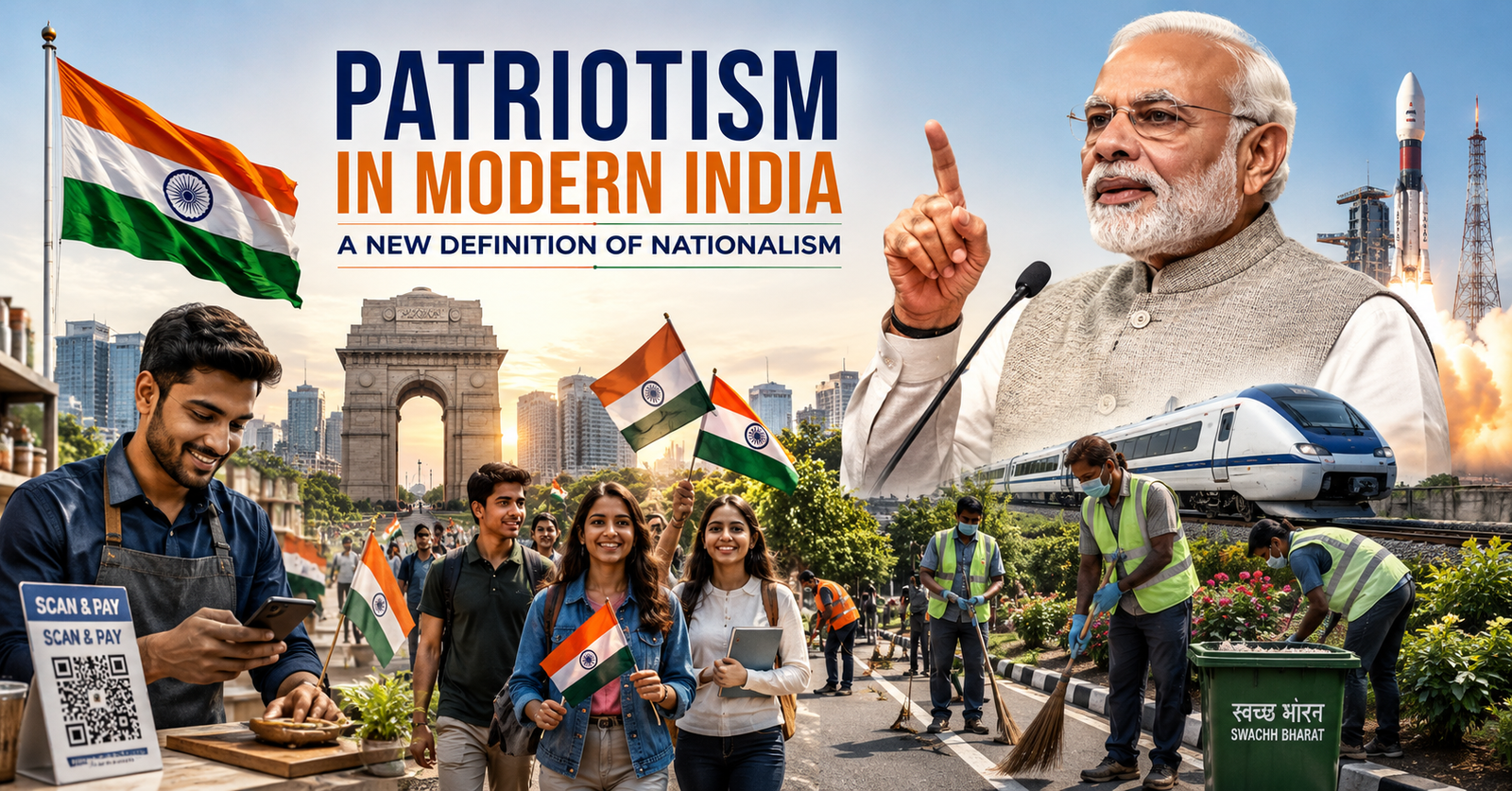
Today, patriotism is often linked with everyday actions: paying taxes honestly, supporting local products, keeping public spaces clean, promoting digital India, or contributing to India’s global image online. In many ways, nationalism has moved from ceremonial moments to daily behavior.
That shift is significant because it changes what people expect from citizens — and what citizens expect from themselves. (PM Modi)
The Move From Emotional Nationalism to Practical Nationalism
Patriotism Is No Longer Seen as Occasional
Earlier, expressions of patriotism mostly appeared during national events, military crises, or sports tournaments. But PM Modi’s messaging has pushed the idea that serving the nation is a continuous activity.
Campaigns like “Swachh Bharat,” “Vocal for Local,” and “Digital India” were not presented merely as government schemes. They were framed as patriotic participation.
This is where the definition changed. (PM Modi)
Under this approach, patriotism is not limited to sacrifice during war or emotional attachment to the country. It includes economic choices, social discipline, and even online behavior.
For example, buying locally made products is often presented as support for India’s growth and self-reliance. Similarly, promoting Indian achievements globally through social media is now commonly viewed as a form of national pride. (PM Modi)
Whether one supports this broader interpretation or questions it, the cultural impact is undeniable.
Why This Change Matters in Everyday Life
Patriotism Has Become More Personal
One reason this new form of patriotism resonates with many people is because it feels actionable. Not everyone can serve in the military or enter politics, but almost anyone can contribute in smaller ways.
A shopkeeper choosing digital payments, a student supporting Indian startups, or residents organizing a local cleanliness drive — these are increasingly described as patriotic acts.
This creates a stronger connection between citizenship and responsibility.
At the same time, it also raises an important question: does patriotism now come with social pressure?
In modern India, public expressions of national pride are more visible than before. Social media especially amplifies this. During national events, sporting victories, or geopolitical tensions, patriotism trends almost instantly online.
Sometimes this unity creates a positive collective energy. But in other situations, it can become performative, where people feel expected to display patriotism publicly rather than practice it meaningfully. (PM Modi)
That is one of the more interesting shifts happening today.
The Social Media Effect on Patriotism
National Identity Is Now Constantly Visible
Ten years ago, patriotism was mostly experienced through television, schools, or public ceremonies. Today, it exists in a 24-hour digital environment.
Every political statement, military update, Olympic medal, startup success, or international recognition quickly becomes part of a national conversation.
PM Modi’s communication style has adapted perfectly to this era. His speeches and campaigns are designed for participation — hashtags, public movements, citizen engagement, and emotional storytelling.
As a result, patriotism has become highly interactive.
A real-world example of this was the “Vocal for Local” movement during the pandemic. Many consumers consciously chose Indian brands over imported products. Some did it for economic reasons, while others saw it as supporting the country during a difficult time. (PM Modi)
That blend of economics and emotion reflects the modern version of patriotism India is experiencing.
Patriotism and Development Are Now Connected
Nation-Building Is Central to the Narrative
Another major difference is how development has become tied to nationalism.
Earlier political nationalism often focused on identity, history, or ideology. The current approach frequently connects patriotism with infrastructure, technology, manufacturing, defense production, and India’s global influence.
When India launches a successful space mission or expands digital payment systems internationally, many people now experience those achievements emotionally, almost personally.
This creates a form of “aspirational patriotism.”
People are not only proud of India’s past; they are increasingly proud of where they believe India is heading.
That emotional investment in progress may be one of the defining features of modern Indian nationalism.
But There Are Also Concerns
Can Patriotism Become Too Narrow?
While many appreciate the emphasis on national pride and responsibility, critics argue that patriotism should leave room for disagreement and debate.
This is where the discussion becomes more complicated.
Some people worry that political disagreement is sometimes treated as lack of patriotism. Others think that in a big, varied nation like India, unity requires a strong sense of nationalism.
The reality is probably somewhere in between.
Healthy patriotism usually strengthens institutions, encourages civic responsibility, and creates social confidence. But if patriotism becomes too rigid, it risks reducing complex discussions into simple “for or against” narratives.
That tension is visible not just in India, but across many countries today.
A New Generation Sees Patriotism Differently
Younger Indians Are Redefining National Pride
Interestingly, younger Indians often express patriotism differently from previous generations.
For many urban youth, national pride is connected to entrepreneurship, technology, global recognition, sports, culture, and economic growth rather than only political ideology.
An Indian startup becoming globally successful can trigger the same emotional reaction that earlier generations felt during major political moments.
This broader identity matters because it makes patriotism less about one single expression and more about participation in India’s progress.
And that may explain why the idea has evolved so quickly.
The Bigger Shift Behind the Debate
The most important change may not be political at all.
Patriotism in India is becoming more woven into ordinary life. It is appearing in shopping choices, workplace discussions, social media behavior, environmental campaigns, and even conversations about innovation.
PM Modi’s version of nationalism has accelerated that transformation by repeatedly connecting citizenship with contribution.
Some people fully embrace this model. Others remain cautious about how nationalism is interpreted publicly. But almost everyone recognizes that the definition of patriotism in India no longer feels limited to symbolic gestures alone.
It has become more active, visible, emotional, and deeply tied to the idea of India’s future.
And perhaps that is why the conversation around patriotism today feels far more personal than it did a decade ago.

My name is Ankit Yadav, and I am a passionate digital journalist and content creator. I write about technology, entertainment, sports, and current affairs with the aim of delivering unique, accurate, and engaging information to my readers.
I believe news should not only inform but also provide clear insights and fresh perspectives. That’s why I focus on making my articles easy to read, reliable, and meaningful.
📌 I specialize in Tech Trends, Latest News, Cybersecurity, Digital Media, Sports, and Entertainment.
📌 My mission is to share fast, authentic, and valuable updates with every article I publish.