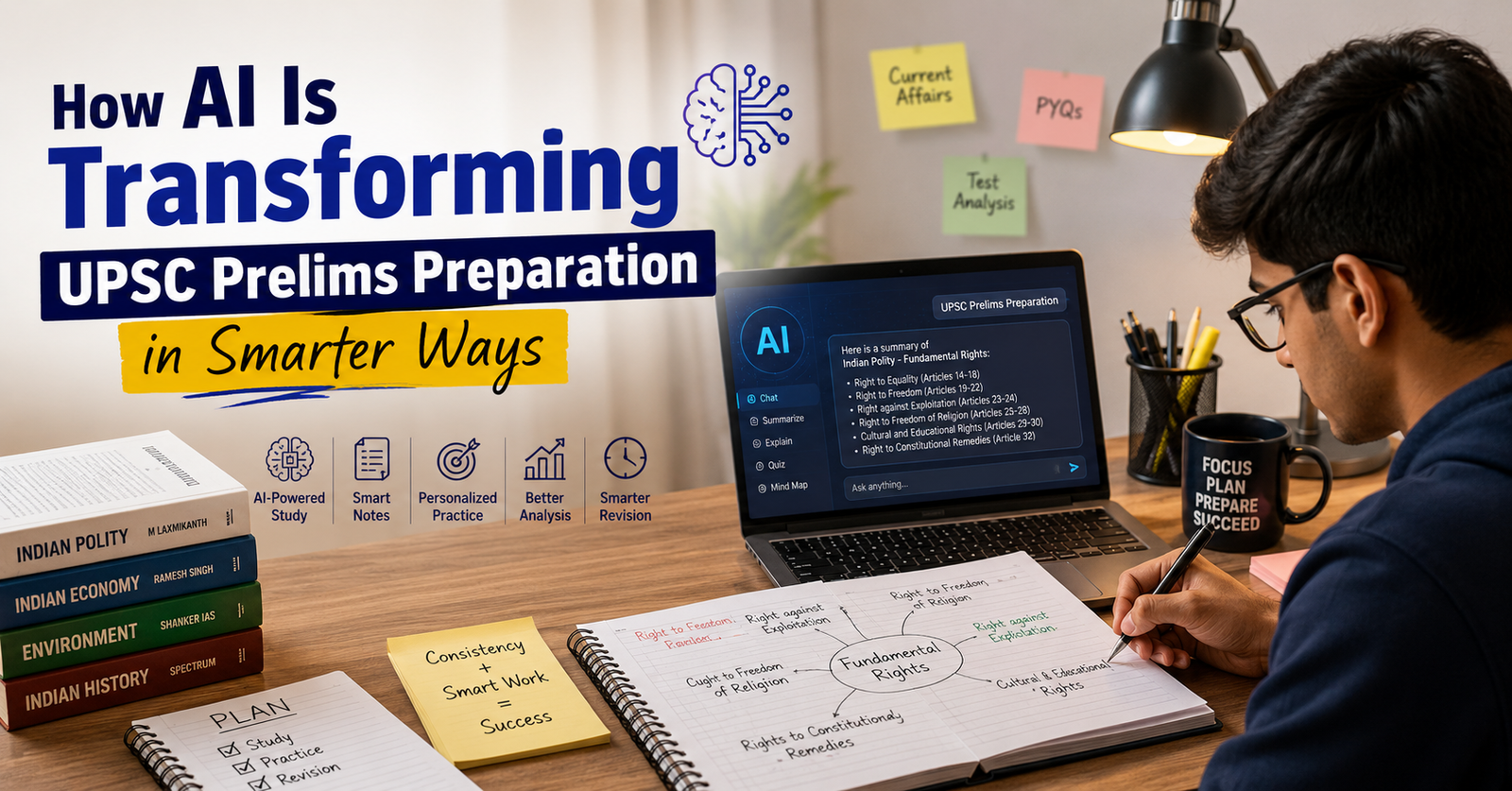
How AI Is Transforming UPSC Prelims Preparation in Smarter Ways
For years, UPSC preparation followed a familiar routine — thick books, handwritten notes, coaching classes, and endless revision cycles. Most aspirants accepted this as the only possible way to prepare for the exam. But in 2026, something noticeable has changed. More students preparing for UPSC Prelims are quietly adding AI tools into their daily study routine.
Not because AI can magically crack the exam for them, but because it helps solve some very real problems that aspirants struggle with every day.
The interesting part is that this shift is not happening only among tech-savvy students in metro cities. Even self-study aspirants from smaller towns are experimenting with tools like ChatGPT, AI note generators, and smart revision apps. The reason is simple: UPSC preparation today is less about finding information and more about managing it properly.
The Biggest Problem in UPSC Preparation Isn’t Lack of Content
Most aspirants already have too much material.
One student may have five current affairs magazines, multiple Telegram channels, coaching PDFs, YouTube playlists, and hundreds of bookmarked articles. The problem is that resources are no longer accessible. The real difficulty is deciding what actually matters for UPSC Prelims.
AI is starting to have an impact here.
Instead of spending hours organizing scattered notes, students are now using AI tools to summarize lengthy reports, create short revision points, and generate quick explanations for difficult topics. A task that previously took two hours can now be done in twenty minutes.
That saved time becomes revision time — which is often more important than collecting new material.
AI Is Changing the Way Students Revise
Revision has always been one of the hardest parts of UPSC Prelims preparation.
Many aspirants study extensively but struggle to revise consistently. By the time they complete one subject, they start forgetting another. AI tools are helping students build more personalized revision systems.
For example, some aspirants now paste their handwritten notes into AI-powered apps to create flashcards automatically. Others use AI to generate quiz questions based on previous year trends.
A student preparing Polity may ask an AI tool to explain the difference between constitutional and statutory bodies in simpler language. Another may use it to create a one-page summary of important environment conventions before mock tests.
These are small improvements individually, but together they reduce mental fatigue significantly.
A Real Example Many Aspirants Can Relate To
Imagine a student named Rohan preparing for UPSC Prelims while working a full-time job.
Earlier, he spent most of his weekday evenings watching long lectures because he didn’t have enough time to make proper notes. Revision became irregular, and current affairs kept piling up.
Now, he uses AI tools differently.
He asks an AI assistant to summarize newspaper editorials into short bullet points. During lunch breaks, he revises AI-generated flashcards on his phone. Before mock tests, he uses AI to identify weak areas based on previous mistakes.
The important thing is that AI did not replace his effort. It simply reduced unnecessary friction in the preparation process.
That distinction matters.
AI Cannot Replace UPSC Preparation — But It Can Improve It
There is also a misconception growing online that AI can somehow “hack” UPSC preparation. That idea is exaggerated.
UPSC still tests analytical ability, consistency, judgment, and conceptual understanding. No AI tool can replace disciplined study habits or genuine understanding of subjects.
In fact, overdependence on AI can become a problem.
Some students now consume endless AI-generated summaries without reading original sources properly. Others rely too heavily on shortcut explanations and lose depth in understanding. UPSC questions often test conceptual clarity in unpredictable ways, and shallow preparation usually gets exposed in the exam hall.
So the smarter aspirants are not using AI as a replacement for study. They are using it as an assistant.
That difference may define successful preparation in the coming years.
Why This Shift Matters in 2026
The competition level in UPSC Prelims keeps increasing every year. At the same time, distractions and information overload have also increased.
This is why efficiency is becoming more valuable than simply studying longer hours.
Aspirants who know how to revise faster, analyze mistakes quickly, and organize information better may gain a real advantage. AI tools are helping students improve exactly these areas.
There is another reason this trend matters.
Traditional coaching methods are slowly changing too. Many students no longer depend entirely on physical coaching centers because AI-powered learning tools provide personalized assistance at a much lower cost.
For aspirants who cannot afford expensive coaching programs, this shift could make quality preparation more accessible than before.
The Most Useful AI Applications for UPSC Aspirants Right Now
Some AI use cases are becoming especially popular among UPSC Prelims students:
Smart Current Affairs Summaries
Students use AI to simplify editorials and government reports into concise revision notes.
Personalized Mock Test Analysis
AI tools can identify patterns in mistakes instead of just showing scores.
Faster Note-Making
Long chapters can be converted into short revision-friendly points.
Doubt Solving
Complex concepts in Economy, Environment, or Science can be explained in simpler terms instantly.
Revision Planning
AI-based planners help aspirants schedule revision cycles more realistically.
Interestingly, students are finding these practical uses more valuable than flashy AI features.
One Important Observation Most People Are Ignoring
Many discussions about AI focus only on productivity. But the bigger impact may actually be psychological.
UPSC preparation often feels overwhelming because aspirants constantly feel “behind.” There is always another source to read or another topic to complete.
AI tools reduce some of this mental pressure by making preparation feel more manageable.
When students can organize information faster and revise more effectively, they feel slightly more in control of the process. That confidence itself can improve consistency.
And consistency matters far more in UPSC Prelims than occasional bursts of motivation.
The Future of UPSC Preparation Will Probably Look Different
The next generation of UPSC aspirants may prepare very differently from previous batches.
Handwritten notes and traditional books will still exist, but AI-assisted learning is likely to become normal rather than exceptional. Students who learn how to use these tools wisely may save time, reduce burnout, and focus more on understanding rather than endless information collection.
At the same time, the fundamentals of success in UPSC Prelims will remain unchanged: discipline, revision, and clarity of concepts.
AI can support those things.
It cannot replace them.

My name is Ankit Yadav, and I am a passionate digital journalist and content creator. I write about technology, entertainment, sports, and current affairs with the aim of delivering unique, accurate, and engaging information to my readers.
I believe news should not only inform but also provide clear insights and fresh perspectives. That’s why I focus on making my articles easy to read, reliable, and meaningful.
📌 I specialize in Tech Trends, Latest News, Cybersecurity, Digital Media, Sports, and Entertainment.
📌 My mission is to share fast, authentic, and valuable updates with every article I publish.