Gmail 5GB Test Shows How Free Internet Is Slowly Changing
For years, one thing about the internet felt almost guaranteed — big tech companies would keep giving users free services in exchange for attention, data, and ecosystem loyalty.
Free email. Free photo backups. Free cloud storage. Free video platforms.
That model shaped how millions of people use the internet today.
So when reports started appearing that Google may be testing a gmail 5gb storage limit for some new users instead of the usual 15GB, many people treated it like a small technical update. But the bigger story may not be about storage at all.
It could be a sign that the internet is entering a completely different phase.
The Gmail 5GB Test Is Small — But Symbolic
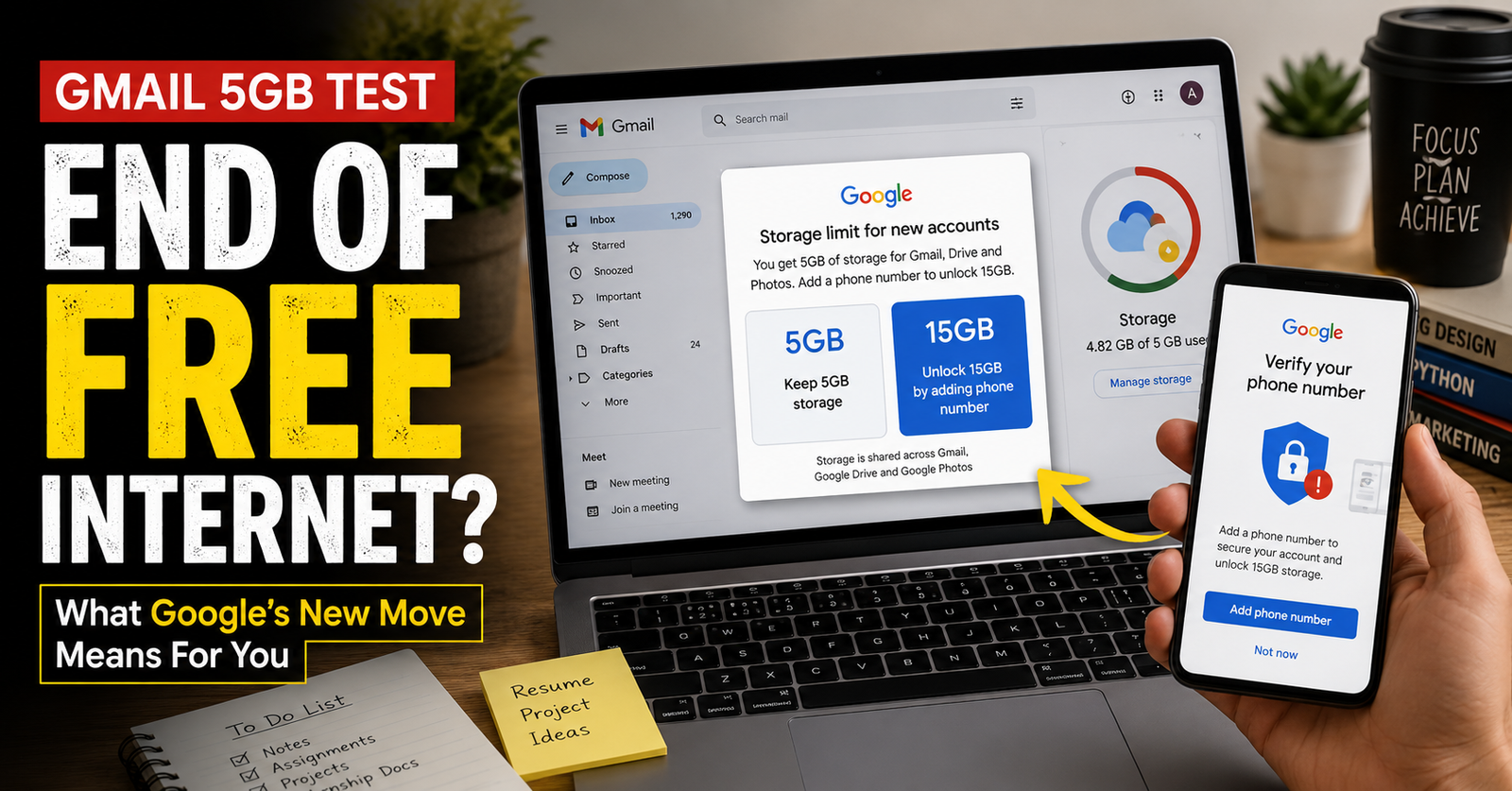
According to multiple reports, some users creating new Google accounts are seeing only 5GB of free storage unless they verify their phone number.
Google has not announced a full global rollout yet, and existing users still appear to keep their current storage. However, the move is noteworthy even as a limited test because Google’s free storage hasn’t altered much in years.
At first glance, reducing storage by 10GB may not sound dramatic.
But internet companies rarely make changes like this without a larger business reason behind them.
And when you look at what’s happening across the tech industry, the timing starts to make sense.
Free Internet Was Never Really Free
People often say, “If the product is free, you are the product.”
That phrase gets repeated a lot online, but the reality behind it is becoming more visible now.
For years, companies like Google could afford generous free services because the internet economy worked differently. Advertising was booming, cloud infrastructure was cheaper compared to today, and user growth mattered more than profitability.
Now the situation is changing.
AI systems require massive computing power. Cloud storage costs continue to rise. Spam accounts and automated bots are becoming harder to control. At the same time, investors expect tech companies to generate more direct revenue instead of endlessly expanding free offerings.
That changes the equation.
The gmail 5gb test may look like a storage experiment, but it also reflects a broader transition from “growth-first internet” to “monetized internet.”
Why Phone Verification Suddenly Matters So Much
One of the most interesting parts of this test is the phone number requirement.
Google reportedly allows users to unlock higher storage by verifying a phone number. On the surface, this sounds like a security feature. But it may also be connected to something bigger: identity verification.
Over the last two years, AI-generated spam, fake accounts, automated signups, and bot abuse have increased rapidly. Creating thousands of fake accounts has become easier than ever.
From Google’s perspective, giving 15GB of storage to unlimited anonymous accounts may no longer be sustainable.
Phone verification helps solve several problems at once:
- Reduces fake account creation
- Limits storage abuse
- Improves ad targeting reliability
- Strengthens account recovery systems
- Creates a more identity-linked internet ecosystem
In simple terms, tech companies increasingly want to know that a real person exists behind every account.
And that changes how “free access” works online.
The Bigger Trend Most People Are Ignoring
The Gmail situation is not happening in isolation.
Over the last few years, users have already seen similar changes across the internet:
Streaming platforms added more ads
Even paid services now include ad-supported plans or restricted features.
Cloud services pushed subscriptions harder
Free storage tiers across many platforms stopped growing while premium plans became more aggressive.
AI features became locked behind paywalls
Many tools that launched as free experiments are quickly shifting toward subscription models.
Platforms started rewarding verified identities
Verification systems are no longer just about celebrities. They are becoming part of platform trust systems.
When you connect all these dots together, the gmail 5gb test starts looking less like a random experiment and more like part of a larger shift in how the modern internet operates.
A Student Uploading Notes Might Feel This First
Imagine a college student using Google Drive for lecture PDFs, assignments, internship resumes, and photo backups.
Earlier, 15GB was usually enough for casual use. But with only 5GB, storage fills much faster than most people realize.
A few semesters of documents, WhatsApp backups, shared folders, and photos can easily push users toward paid plans.
The same applies to freelancers who rely on cloud storage for portfolios, invoices, client assets, or project backups.
For heavy users, this may simply become another subscription cost. But for students and users in price-sensitive regions, even small changes matter.
That is why this discussion is larger than “just storage.”
It affects how accessible the internet remains for ordinary users.
Google Is Probably Testing User Psychology Too
There’s another interesting possibility here.
Google may not only be testing storage limits — it may also be testing user behavior.
How many people will add a phone number just to unlock extra storage?
How many will eventually upgrade to Google One?
How much free access are users still expecting in 2026 compared to five years ago?
Tech companies constantly run small experiments like this to measure reactions before making larger decisions.
And sometimes the biggest value is not the feature itself, but the data collected from user responses.
Does This Mean Free Internet Is Ending?
Not completely.
Free services are unlikely to disappear entirely because they still help companies attract new users into their ecosystems.
But the definition of “free” is clearly changing.
Instead of unlimited anonymous access, the future internet may increasingly require:
- identity verification
- subscriptions
- ecosystem lock-in
- ad engagement
- data exchange
The internet is slowly moving from open abundance toward controlled access models.
The conversation around Gmail 5GB just makes that change more apparent.
What Users Should Actually Do
There’s no need to panic yet, especially because Google has not confirmed a universal rollout.
But this is a good reminder to manage digital storage more intentionally.
A few practical steps can help:
Clean unnecessary backups
Old videos, duplicate photos, and unused Drive files consume space quickly.
Avoid depending on one platform
Using multiple cloud services can reduce storage pressure.
Keep local backups
Important documents should not exist only inside one company ecosystem.
Watch future policy changes carefully
Storage limits today could influence other free services tomorrow.
Final Thoughts
The biggest takeaway from the gmail 5gb test is not whether users lose 10GB of storage.
It’s what the change represents.
For years, the internet trained users to expect massive free services forever. But the economics of AI, cloud infrastructure, digital identity, and platform monetization are changing that model.
Google’s storage experiment may ultimately succeed, fail, or remain limited.
Either way, it reveals something important:
The era of unlimited free internet services may slowly be coming to an end.

My name is Ankit Yadav, and I am a passionate digital journalist and content creator. I write about technology, entertainment, sports, and current affairs with the aim of delivering unique, accurate, and engaging information to my readers.
I believe news should not only inform but also provide clear insights and fresh perspectives. That’s why I focus on making my articles easy to read, reliable, and meaningful.
📌 I specialize in Tech Trends, Latest News, Cybersecurity, Digital Media, Sports, and Entertainment.
📌 My mission is to share fast, authentic, and valuable updates with every article I publish.