Introduction
Class 6 History Chapter 2, “On the Trail of the Earliest People,” takes us very far back in human history.
Today, we have supermarkets, restaurants, farms, refrigerators and many other ways to get food. But the earliest people did not have these facilities. They had to depend directly on nature for their food and survival. (Class 6 History Chapter 2)
This chapter explains how these early people lived, where they stayed, why they moved from one place to another, how they made stone tools, how they used fire, and what archaeologists have discovered about them.
The chapter also introduces important ideas such as Palaeolithic (पुरापाषाण काल), Mesolithic (मध्य पाषाण काल), microliths (सूक्ष्म पाषाण उपकरण), archaeological sites, rock paintings and early human settlements.
1. The Earliest People: Who Were They?
People lived in the Indian subcontinent as early as two million years ago.
We call many of these early people hunter-gatherers (आखेटक-संग्राहक).
The name tells us how they obtained their food.
What did hunter-gatherers eat?
They obtained food from different sources.
They:
- hunted wild animals,
- caught fish,
- caught birds,
- collected fruits,
- gathered roots,
- collected nuts,
- gathered seeds and leaves,
- collected stalks,
- collected eggs.
Plant foods were especially important because the Indian subcontinent had a large variety of plants.
Why was getting food difficult?
Finding food was not simple.
Many animals were faster or stronger than humans. So hunting required people to be alert (सतर्क), quick and careful. (Class 6 History Chapter 2)
Gathering plants also needed knowledge. People had to know:
- which plants were safe to eat,
- which parts of a plant could be eaten,
- which plants could be poisonous,
- when fruits became ready to eat.
This means early people developed a good understanding of their natural surroundings.
2. Why Did Hunter-Gatherers Relocate?
One of the most important questions in Class 6 History Chapter 2 is why hunter-gatherers were always moving.
They did not normally stay permanently in one place.
There were several reasons.
Reason 1: Food Resources Could Become Limited
If people stayed in one place for a long time, they could use up many of the available plants and animals.
So they had to move somewhere else in search of food.
Reason 2: Animals Moved
Animals also moved from one place to another. (Class 6 History Chapter 2)
For example, deer and wild cattle could move in search of grass and leaves.
People who hunted these animals therefore had to follow them.
Reason 3: Different Seasons
Plants do not produce fruits at the same time throughout the year.
Different plants become useful in different seasons.
Therefore, people could move from place to place depending on where particular foods were available.
Reason 4: Water
Humans, plants and animals all need water.
Water could be found in:
- rivers,
- lakes,
- streams.
Some water sources were available throughout the year, while others were seasonal (मौसमी).
During dry periods, people living near seasonal water sources might have to move in search of water.
People could also travel to meet friends and relatives. (Class 6 History Chapter 2)
The chapter notes that these journeys were made on foot (पैदल).
Easy formula to remember:
Food + Animals + Seasons + Water = Main reasons for movement
3. How Do We Know About the Earliest People?
Now comes an important question:
If these people lived millions of years ago, how do we know about them?
We cannot ask them directly because they lived long before written records.
So we depend on archaeology (पुरातत्व).
Archaeologists have discovered objects that early people made and used.
These objects can tell us about their lifestyle.
Early people probably used materials such as:
- stone,
- wood,
- bone.
However, wood and bone can decay more easily. Stone survives much better.
Therefore, stone tools are some of the most important evidence for studying early people.

4. Choosing a Place to Live
Early people did not choose their living places randomly. (Class 6 History Chapter 2)
Many archaeological sites are found near sources of water such as rivers and lakes.

Caves and Rock Shelters
Some early people lived in:
- caves,
- rock shelters.
A rock shelter (प्राकृतिक चट्टानी आश्रय) is a naturally protected space formed by rocks.
These places were useful because they could protect people from:
- rain,
- heat,
- wind.
Rock shelters and natural caves were found in regions such as the Vindhyas and the Deccan Plateau, close to the Narmada Valley. (Class 6 History Chapter 2)

Bhimbetka
Bhimbetka, in present-day Madhya Pradesh, is an important example of a place associated with early human habitation.
It contains rock shelters that provide evidence about the lives of early people.
5. What Is an Archaeological Site?
A site (स्थल) is a place where archaeologists find remains of things that people made, used or left behind.
These remains could include:
- tools,
- pots,
- buildings,
- other objects.
They may be found:
- on the surface,
- buried underground,
- sometimes even underwater.
These remains provide clues about human activity in the past.
6. Factory Sites and Habitation Sites
Stone tools were extremely important to early people. (Class 6 History Chapter 2)
Therefore, they looked for places where good-quality stone was easily available.
Factory Sites
A factory site (औजार बनाने का स्थल) is a place where suitable stone was available and people made stone tools.
Archaeologists may find:
- large pieces of stone,
- partly made tools,
- imperfect tools that were discarded,
- small pieces of waste stone.
These clues suggest that tools were being made there.
Habitation-cum-Factory Sites
Sometimes people stayed at the same place where they made tools.
Such places are called habitation-cum-factory sites (रहने और औजार बनाने दोनों के स्थल).
So remember:
Factory site → tools were made
Habitation site → people lived
Habitation-cum-factory site → people lived + tools were made
7. Making Stone Tools
Stone tools were probably made using different techniques.
Two important techniques are described in the chapter. (Class 6 History Chapter 2)

Technique 1: Stone-on-Stone
A stone called the core (मुख्य पत्थर) was held in one hand.
Another stone was used like a hammer.
The second stone was struck against the core, causing pieces called flakes (पत्थर के टुकड़े/परतें) to come off.
The flakes could then be shaped into tools.
Technique 2: Pressure Flaking
In this method, the core was placed on a firm surface.
Pressure was applied using a piece of bone or stone. (Class 6 History Chapter 2)
Small flakes were removed and shaped into useful tools.
8. What Were Stone Tools Used For?
Stone tools had many possible uses.
They could be used for:
- cutting meat,
- cutting bone,
- scraping tree bark,
- scraping animal hides,
- chopping fruits,
- cutting roots,
- cutting wood.
Some tools could be attached to handles made of bone or wood.
These could be used to make:
- spears,
- arrows.
Wood itself was also useful for making:
- huts,
- tools,
- firewood.
7. Making Stone Tools
Stone tools were probably made using different techniques.
Two important techniques are described in the chapter.
Technique 1: Stone-on-Stone
A stone called the core (मुख्य पत्थर) was held in one hand.
Another stone was used like a hammer.
The second stone was struck against the core, causing pieces called flakes (पत्थर के टुकड़े/परतें) to come off.
The flakes could then be shaped into tools.
Technique 2: Pressure Flaking
In this method, the core was placed on a firm surface.
Pressure was applied using a piece of bone or stone.
Small flakes were removed and shaped into useful tools. (Class 6 History Chapter 2)
8. What Were Stone Tools Used For?
Stone tools had many possible uses.
They could be used for:
- cutting meat,
- cutting bone,
- scraping tree bark,
- scraping animal hides,
- chopping fruits,
- cutting roots,
- cutting wood.
Some tools could be attached to handles made of bone or wood.
These could be used to make:
- spears,
- arrows.
Wood itself was also useful for making:
- huts,
- tools,
- firewood.
9. Finding Out About Fire
Fire was another important discovery in the life of early humans.
Archaeologists found traces of ash (राख) in the Kurnool caves.
This suggests that people living there were familiar with the use of fire.
What could fire be used for?
The chapter suggests at least three important uses:
🔥 1. Light
Fire could provide light when it was dark.
🍖 2. Roasting Meat
People could use fire to roast meat.
🐅 3. Scaring Away Animals
Fire could help keep dangerous animals away. (Class 6 History Chapter 2)
10. A Changing Environment
Around 12,000 years ago, major changes took place in the world’s climate.
The climate became relatively warmer.
In many areas, this helped grasslands (घास के मैदान) develop.
As grasslands increased, the number of animals that depended on grass also increased.
These included:
- deer,
- antelope,
- goats,
- sheep,
- cattle.
Hunters followed these animals and learned about:
- their food habits,
- their breeding seasons.
This knowledge may have helped people begin thinking about herding (पशुपालन) and keeping animals themselves.
Fishing also became increasingly important.
At the same time, grain-producing grasses such as wheat, barley and rice grew naturally in different parts of the subcontinent.
People collected these grains and learned about where they grew and when they ripened. This may have encouraged them to think about growing plants themselves. (Class 6 History Chapter 2)
11. Rock Paintings and What They Tell Us
Many caves where early people lived contain paintings on their walls.
Some important examples are found in:
- Madhya Pradesh
- Southern Uttar Pradesh
These paintings often show wild animals.
The animals were sometimes drawn with impressive accuracy and skill.
What can rock paintings tell us?
Rock paintings give us clues about the world that early people saw around them.
They can help us understand that animals were an important part of their surroundings and probably their lives as hunters. (Class 6 History Chapter 2)
However, we should be careful not to assume that every painting has a meaning we can know for certain.
The exact reasons why particular paintings were created are not always known.
12. Who Did What?
Early people performed many activities.
They:
- hunted,
- gathered plants,
- made stone tools,
- painted cave walls.
But an interesting question is:
Who performed which task?
Did only men hunt?
Did only women gather fruits and nuts?
Did only men make tools?
Did only women paint?
The honest answer is:
We do not really know.
It is possible that men and women often performed many activities together.
It is also possible that some tasks were performed mainly by men and others mainly by women.
Practices could also have differed between different communities and regions.
Therefore, historians should not make unsupported assumptions about the roles of men and women in early societies. (Class 6 History Chapter 2)
13. Ostriches in India
This is one of the most interesting facts in the chapter.
Ostriches (शुतुरमुर्ग) lived in India during the Palaeolithic period.
Large quantities of ostrich eggshells were found at Patne in Maharashtra.
Some pieces of eggshell had designs engraved on them.
People also made beads (मनके) from ostrich eggshell.
This shows that early people were not only concerned with food and survival; they also made objects that could have had decorative or other uses. (Class 6 History Chapter 2)
14. A Closer Look: Hunsgi
Hunsgi is an important archaeological area associated with the early Palaeolithic period.
Several early Palaeolithic sites have been found there.
At some sites, archaeologists discovered many tools that could have been used for different activities.
Some sites were located near springs.
Many tools were made from limestone (चूना पत्थर), which was available locally.
These findings help archaeologists understand how early people selected materials and made tools.
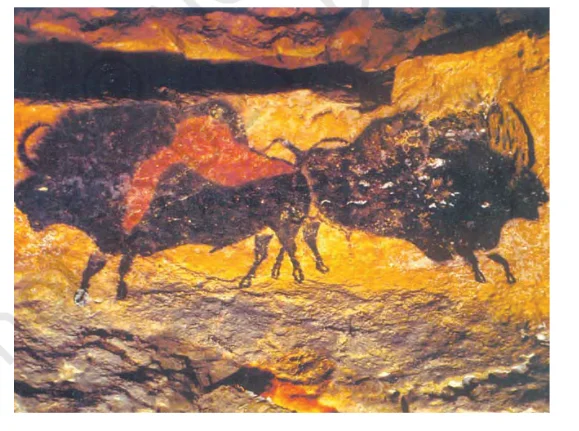
15. Elsewhere: Cave Paintings in France
The chapter also takes us outside India.
In France, an important cave-painting site was discovered by four schoolchildren more than a hundred years ago. (Class 6 History Chapter 2)
The paintings were made roughly between 20,000 and 10,000 years ago.
Many paintings show animals such as:
- wild horses,
- aurochs,
- bison,
- woolly rhinoceroses,
- reindeer,
- bears.
The colours were made using natural materials such as:
- ochre,
- iron ore,
- charcoal.
The exact purpose of these paintings is uncertain. They may have been connected with ceremonies or special rituals, but other explanations are also possible. (Class 6 History Chapter 2)
16. Palaeolithic, Mesolithic and Neolithic
These three names are very important for Class 6 History Chapter 2.
Palaeolithic — Old Stone Age
The word Palaeolithic comes from two Greek words:
- palaeo = old (पुराना)
- lithos = stone (पत्थर)
The Palaeolithic period extends from about 2 million years ago to around 12,000 years ago.
It is divided into:
- Lower Palaeolithic
- Middle Palaeolithic
- Upper Palaeolithic
This enormous period covers most of human history. (Class 6 History Chapter 2)
Mesolithic — Middle Stone Age
The period from about 12,000 to 10,000 years ago is called the Mesolithic.
The word means Middle Stone Age.
Stone tools from this period were generally very small.
These small tools are called:
Microliths (सूक्ष्म पाषाण उपकरण)
Microliths could be attached to handles made of bone or wood.
They could be used to make tools such as:
- saws,
- sickles.
Older types of tools continued to be used too. (Class 6 History Chapter 2)
Neolithic — New Stone Age
The next stage began around 10,000 years ago.
This period is called the Neolithic (नवपाषाण काल).
The detailed study of the Neolithic period continues in Chapter 3 of the textbook.
Easy Timeline
2 million years ago → 12,000 years ago
Palaeolithic
↓
12,000 → 10,000 years ago
Mesolithic
↓
Around 10,000 years ago
Neolithic
17. Important Keywords
| Keyword | Simple Meaning |
|---|---|
| Hunter-gatherer | A person who hunted animals and collected food from nature |
| Site | A place where remains of past human activity are found |
| Habitation | A place where people lived |
| Factory site | A place where stone tools were made |
| Habitation-cum-factory | A place where people lived and made tools |
| Palaeolithic | Old Stone Age |
| Mesolithic | Middle Stone Age |
| Microliths | Very small stone tools |
| Core | The main stone from which flakes were removed |
| Flakes | Pieces removed from a stone while making a tool |
| Archaeologist | A person who studies material remains of the past |
| Seasonal | Something that occurs or changes with a particular season |
| Grassland | Land mainly covered with grass |
| Herding | Keeping and looking after groups of animals |
18. Important Dates
Around 2 million years ago
People lived in the Indian subcontinent, and the earliest period discussed in the chapter begins.
Around 12,000 years ago
Major environmental and climatic changes occurred, and grasslands developed in many areas.
12,000–10,000 years ago
The Mesolithic period.
Around 10,000 years ago
The beginning of the Neolithic period.
Around 20,000–10,000 years ago
The chapter’s French cave-painting example dates to approximately this period.
19. Class 6 History Chapter 2 Questions and Answers
Q1. Who were hunter-gatherers?
Answer:
Hunter-gatherers were early people who obtained food mainly by hunting animals, catching fish and birds, and collecting fruits, roots, nuts, seeds, leaves and other plant products.
Q2. Why did hunter-gatherers move from place to place?
Answer:
They moved because food resources could become limited, animals moved around, different plants became available in different seasons, and they needed access to water. They also sometimes travelled to meet friends and relatives.
Q3. What is an archaeological site?
Answer:
An archaeological site is a place where remains of things made, used or left behind by people are found. These may include tools, pots and buildings.
Q4. Why are stone tools important for studying early people?
Answer:
Early people probably used stone, wood and bone for making tools. Wood and bone can decay more easily, while stone survives for much longer. Therefore, stone tools provide important evidence about early people.
Q5. What were the two techniques used to make stone tools?
Answer:
The two techniques described in the chapter are stone-on-stone and pressure flaking.
Q6. What were stone tools used for?
Answer:
Stone tools were used for activities such as cutting meat and bone, scraping bark and animal hides, chopping fruits and roots, cutting wood, and possibly making spears and arrows.
Q7. What were three uses of fire?
Answer:
Fire could be used for providing light, roasting meat and keeping dangerous animals away.
Q8. What happened to the environment around 12,000 years ago?
Answer:
The climate became relatively warmer in many parts of the world. Grasslands developed in many areas, which supported larger populations of grass-eating animals.
Q9. What are microliths?
Answer:
Microliths are very small stone tools associated with the Mesolithic period. They could be attached to handles made of bone or wood.
Q10. What do rock paintings tell us?
Answer:
Rock paintings provide evidence about the surroundings and activities of early people. Many paintings show wild animals, suggesting that animals were an important part of their environment. However, the exact purpose of every painting is not known.
Q11. What was found at Patne?
Answer:
Large quantities of ostrich eggshells were found at Patne in Maharashtra. Some pieces had designs engraved on them, and beads were also made from the eggshells.
Q12. Why is Hunsgi important?
Answer:
Hunsgi has several early Palaeolithic sites where archaeologists found many stone tools. Some sites were near springs, and many tools were made from locally available limestone.
20. Quick Revision
If you need to revise Class 6 History Chapter 2 quickly, remember these points:
👥 Hunter-Gatherers
They hunted, fished and collected food from nature.
🚶 Movement
They moved because of food, animals, seasons and water.
🏞️ Living Places
They used caves and rock shelters and often stayed near water sources.
🪨 Stone Tools
Stone tools are important archaeological evidence.
🏭 Factory Sites
Some places were used for making stone tools.
🏠 Habitation Sites
Some places were used for living.
🔥 Fire
Fire provided light, helped roast meat and could scare away animals.
🌱 Environmental Change
Around 12,000 years ago, warmer conditions helped grasslands develop in many areas.
🎨 Rock Paintings
Many paintings show wild animals.
🥚 Ostrich Eggs
Ostrich eggshells were found at Patne in Maharashtra.
📍 Hunsgi
An important group of early Palaeolithic sites.
⏳ Stone Age Timeline
Palaeolithic → Mesolithic → Neolithic
21. MCQs / Quiz
1. What does the term hunter-gatherer refer to?
A. People who only farmed
B. People who hunted and collected food
C. People who lived only in cities
D. People who traded metals
Answer: B. People who hunted and collected food
2. Which of these was an important source of food for hunter-gatherers?
A. Packaged food
B. Fruits and roots
C. Factory-made food
D. Bakery products
Answer: B. Fruits and roots
3. Why did hunter-gatherers follow animals?
A. Animals carried their tools
B. Animals moved in search of food
C. Animals built houses
D. Animals stored water
Answer: B. Animals moved in search of food
4. What is a habitation site?
A. A place where people lived
B. A place where only animals lived
C. A place where rivers began
D. A place where metals were sold
Answer: A. A place where people lived
5. What is a factory site in archaeology?
A. A modern factory
B. A place where ancient people made stone tools
C. A market
D. A farm
Answer: B. A place where ancient people made stone tools
6. Which material survived especially well as evidence of early tools?
A. Paper
B. Plastic
C. Stone
D. Cloth
Answer: C. Stone
7. Where were traces of ash found that suggest familiarity with fire?
A. Hunsgi
B. Kurnool caves
C. Patne
D. Bhimbetka
Answer: B. Kurnool caves
8. Which period is called the Old Stone Age?
A. Neolithic
B. Mesolithic
C. Palaeolithic
D. Modern Age
Answer: C. Palaeolithic
9. What are microliths?
A. Large metal tools
B. Small stone tools
C. Wooden houses
D. Clay pots
Answer: B. Small stone tools
10. Where were large quantities of ostrich eggshells found?
A. Patne
B. Hunsgi
C. Kurnool
D. France
Answer: A. Patne
11. Which place is associated with early Palaeolithic sites?
A. Hunsgi
B. Delhi
C. Kolkata
D. Mumbai
Answer: A. Hunsgi
12. Which period followed the Palaeolithic?
A. Mesolithic
B. Modern period
C. Medieval period
D. Iron Age
Answer: A. Mesolithic
22. Frequently Asked Questions
What is Class 6 History Chapter 2 about?
It explains the lives of the earliest people, especially hunter-gatherers, and discusses their food, movement, living places, stone tools, fire, rock paintings and archaeological evidence.
Who were the earliest people?
The chapter discusses people living in the Indian subcontinent as early as about two million years ago. Many of these early people are described as hunter-gatherers.
Why did hunter-gatherers move from place to place?
They moved because food resources could become limited, animals moved, plants became available in different seasons, and people needed water.
What did hunter-gatherers eat?
They hunted animals, caught fish and birds, and collected fruits, roots, nuts, seeds, leaves, stalks and eggs.
What is a factory site?
A factory site is a place where people made stone tools and where archaeologists may find stone blocks, unfinished tools and waste pieces.
What is Bhimbetka?
Bhimbetka, in present-day Madhya Pradesh, is an important area containing natural caves and rock shelters associated with early human habitation.
What is Palaeolithic?
Palaeolithic means Old Stone Age. The chapter places it from about two million years ago to around 12,000 years ago.
What is Mesolithic?
Mesolithic means Middle Stone Age. The chapter places it approximately between 12,000 and 10,000 years ago.
What are microliths?
Microliths are very small stone tools associated with the Mesolithic period.
What did early people use fire for?
Fire could be used for light, roasting meat and keeping animals away.
What do rock paintings show?
Many early rock paintings show wild animals. They provide clues about the environment and life of early people, although the exact purpose of the paintings is not always known.
What was discovered at Patne?
Large quantities of ostrich eggshells were found at Patne in Maharashtra. Some had engraved designs, and beads were made from e
Conclusion
Class 6 History Chapter 2: On the Trail of the Earliest People takes us into a very early stage of human history.
The chapter shows that early people depended heavily on nature. They hunted animals, collected plants, caught fish and birds, and moved from place to place as food, water, seasons and animals changed.
Archaeological evidence such as stone tools, caves, rock shelters, ash, paintings and ostrich eggshells helps us understand their lives. (Class 6 History Chapter 2)
The chapter also shows how human life changed over a very long period. The Palaeolithic period was followed by the Mesolithic, and later came the Neolithic period.
Most importantly, the chapter teaches us that even when written records do not exist, the remains left behind by people can provide valuable clues about their lives. (Class 6 History Chapter 2)
⭐ One-line takeaway
The earliest people survived by understanding nature, using available resources, making tools and adapting to changes in their environment.

My name is Ankit Yadav, and I am a passionate digital journalist and content creator. I write about technology, entertainment, sports, and current affairs with the aim of delivering unique, accurate, and engaging information to my readers.
I believe news should not only inform but also provide clear insights and fresh perspectives. That’s why I focus on making my articles easy to read, reliable, and meaningful.
📌 I specialize in Tech Trends, Latest News, Cybersecurity, Digital Media, Sports, and Entertainment.
📌 My mission is to share fast, authentic, and valuable updates with every article I publish.