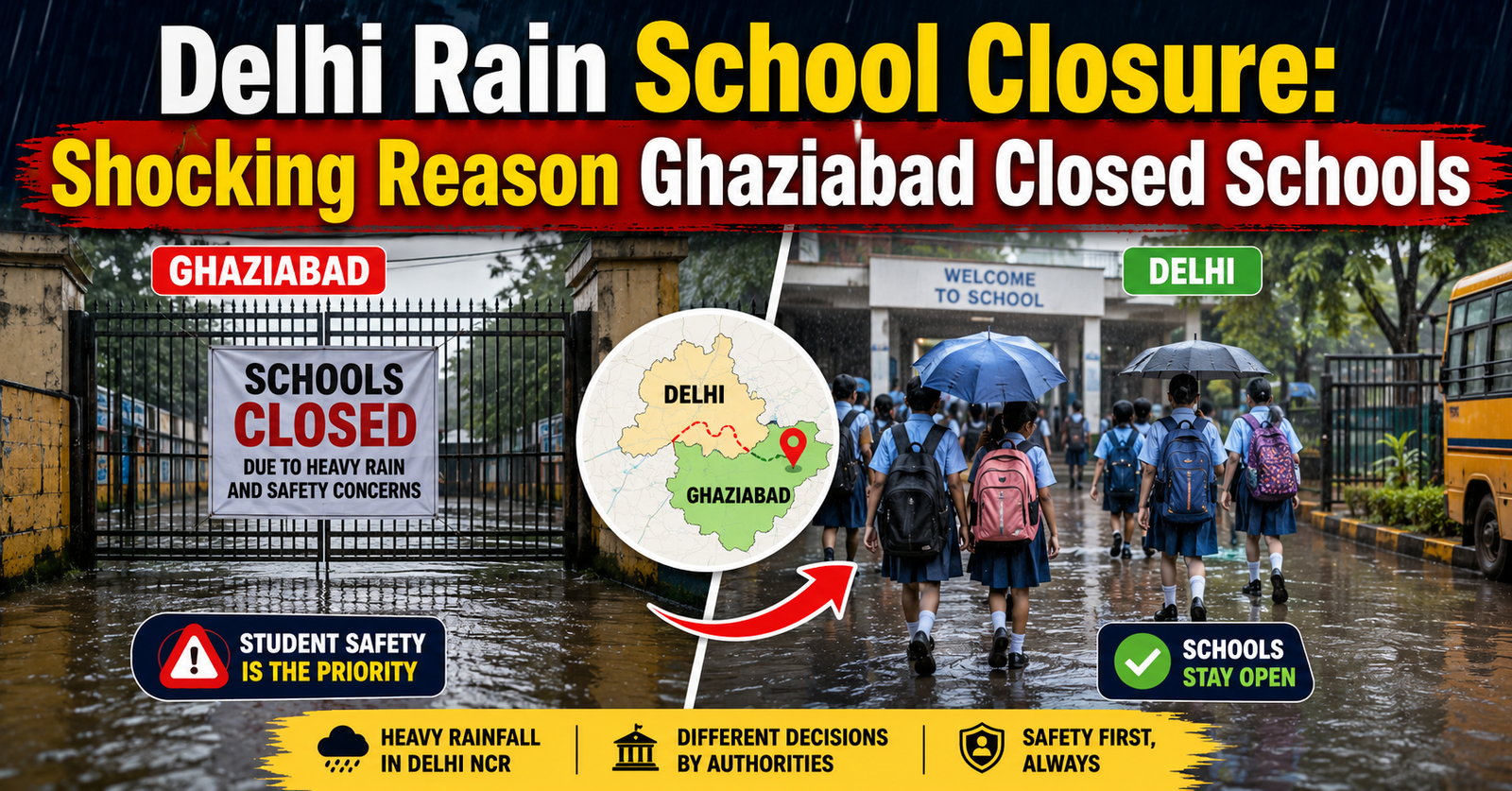
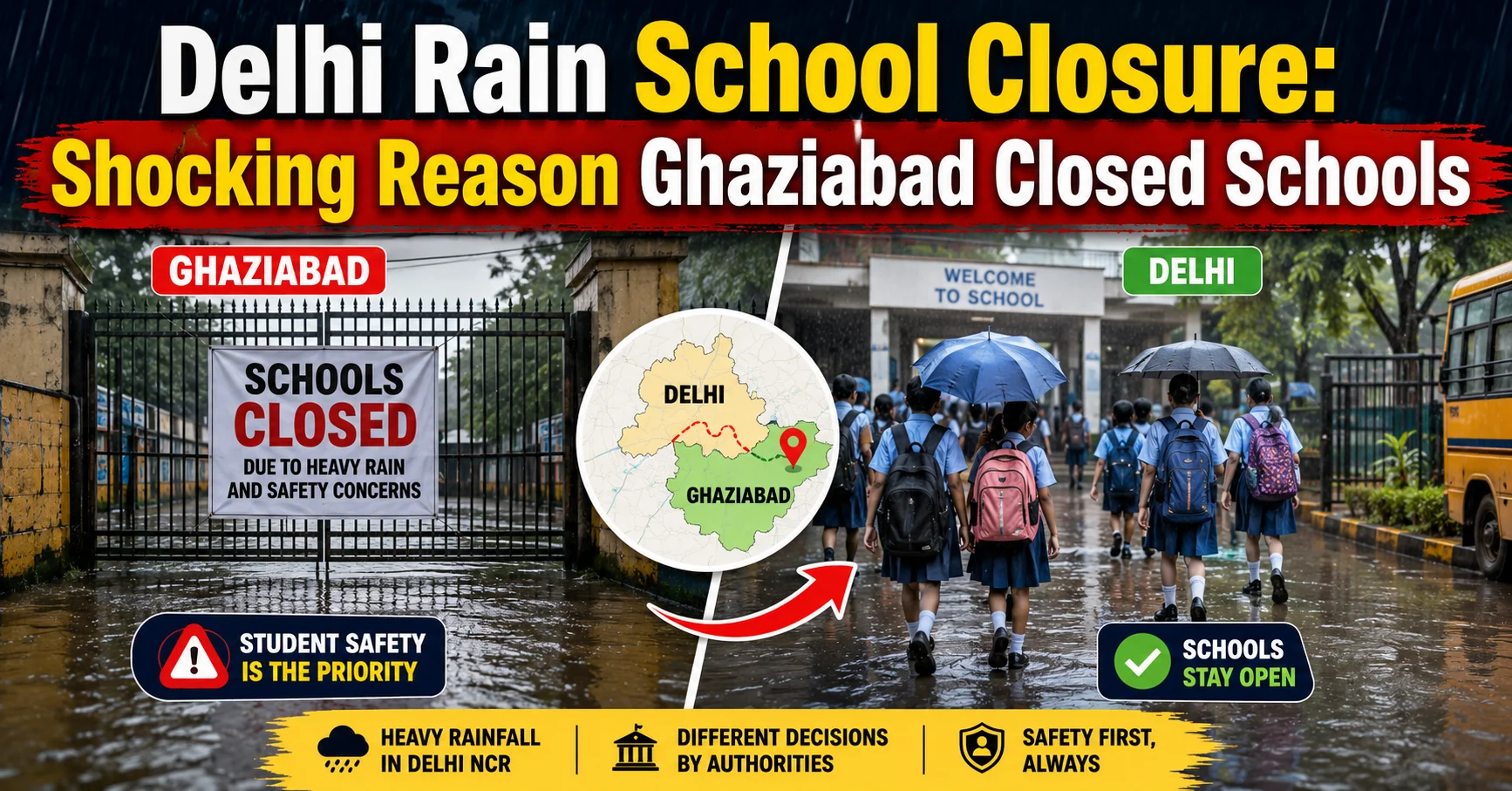
Delhi Rain School Closure: Why Ghaziabad Closed Schools While Delhi Stayed Open
When heavy monsoon rain swept across Delhi-NCR, thousands of parents woke up to an unexpected situation. Schools in Ghaziabad were declared closed, while many schools in Delhi continued operating as usual.
For many families, the decision seemed confusing.
Both cities received rainfall. Both experienced traffic congestion. Social media was filled with videos of waterlogged roads from different parts of NCR. Naturally, people started asking one question:
If the weather was almost the same, why were schools closed in Ghaziabad but not in Delhi?
The answer isn’t as simple as “more rain” or “less rain.”
In reality, the recent Delhi Rain School Closure discussion reveals how school holidays are decided during severe weather and why neighboring districts can make completely different decisions on the same day.
Understanding this process is important because similar situations occur almost every monsoon season, and misinformation often spreads faster than official announcements.
Rather than simply reporting whether schools are open or closed, this guide explains how these decisions are made, who has the authority to make them, and what parents should know before assuming that one city’s announcement applies to another. (Delhi Rain School Closure)
What Actually Happened?
Heavy rainfall affected several parts of Delhi-NCR, leading to waterlogging, slow-moving traffic, and disruptions to daily life.
Following a review of local conditions, the Ghaziabad district administration announced the closure of schools as a precautionary measure. The primary concern was student safety, especially in areas where flooded roads and traffic congestion could make school travel risky.
Delhi, however, did not issue a city-wide school closure order.
Although several areas experienced rain-related disruptions, authorities assessed that the overall situation did not require suspending classes across the entire city.
This difference immediately created confusion because many people consider Delhi-NCR as one region. Administratively, however, it is not. (Delhi Rain School Closure)
That distinction is the key to understanding why different decisions were made.
Timeline: How the Situation Developed
7 July
Weather agencies began indicating the possibility of active monsoon conditions across North India. Forecasts suggested that Delhi-NCR could receive moderate to heavy rainfall over the coming days.
8 July
Rainfall intensified in several parts of NCR. Local reports of waterlogging started increasing, particularly in low-lying areas and roads with poor drainage.
Authorities continued monitoring conditions instead of making immediate decisions.
9 July
District officials reviewed rainfall forecasts, traffic conditions, and local infrastructure reports.
Schools also remained in contact with education authorities while preparing for the next day’s situation.
10 July
Ground reports showed that conditions varied across NCR.
Ghaziabad administration announced school closure after evaluating local risks.
Delhi administration, after reviewing city-wide conditions, decided that schools could continue functioning while advising citizens to remain cautious during travel.
This sequence shows that school closure decisions are not made solely on weather forecasts. They depend on continuous monitoring and local assessments. (Delhi Rain School Closure)
Why Delhi and Ghaziabad Reached Different Decisions
This is perhaps the most important question.
Many people assume that weather decisions should be identical because Delhi and Ghaziabad are neighboring cities.
In practice, district administrations evaluate their own conditions rather than following a regional template.
Several factors influence these decisions.
1. Local Ground Conditions Matter More Than Regional Forecasts
A weather forecast may predict heavy rain across NCR, but rainfall is rarely distributed equally.
One district may experience severe flooding while another receives manageable showers.
Authorities rely heavily on reports from local officials, traffic departments, drainage agencies, and emergency teams. (Delhi Rain School Closure)
This means that decisions are based on actual ground conditions, not just forecasts.
2. Waterlogging Creates Different Levels of Risk
Rain itself is not always the biggest concern.
The larger issue is whether students can travel safely.
If school buses cannot reach residential areas or roads become submerged, even moderate rainfall can become a public safety concern.
District administrations therefore evaluate:
- Road accessibility
- Flood-prone areas
- Bus movement
- Pedestrian safety
- Emergency response capability
These practical considerations often carry more weight than rainfall totals.
3. Every District Has Its Own Administrative Responsibility
One of the biggest misconceptions is that Delhi-NCR operates under a single authority.
It does not.
Delhi, Ghaziabad, Noida, Gurugram, and Faridabad each have separate administrative systems.
Each district is responsible for protecting residents within its own jurisdiction.
As a result, one district may declare a holiday while another continues normal operations.
This is not inconsistency—it is local governance working as intended.
Who Actually Decides Whether Schools Should Close?
Another common misunderstanding is that schools close automatically whenever the India Meteorological Department issues an Orange or Red Alert.
That is not how the process works.
The weather department provides forecasts and alerts based on expected conditions.
The district authorities typically make the ultimate administrative decision after taking into account a number of variables, such as local emergency reports, transportation options, road conditions, and public safety. (Delhi Rain School Closure)
Government schools usually follow these official directions.
Private schools may also comply with district advisories, but they sometimes issue additional instructions depending on campus conditions, transport routes, or local circumstances.
This is why parents should always verify announcements through their school’s official communication channels rather than relying on forwarded messages. (Delhi Rain School Closure)
How a School Closure Decision Is Usually Made
Instead of imagining that a weather alert immediately results in a holiday, think of the process as a chain of decisions.
Weather Forecast
↓
Rainfall Monitoring
↓
Ground Reports from Local Authorities
↓
Traffic and Waterlogging Assessment
↓
Risk Review by District Administration
↓
Decision on School Operations
↓
Official Communication to Schools
↓
Schools Inform Parents Through Apps, SMS, Websites, or WhatsApp
This process explains why school closure announcements often come only after local authorities have reviewed conditions instead of immediately after a weather alert is issued. (Delhi Rain School Closure)
Delhi vs Ghaziabad: A Practical Comparison
Looking at the situation side by side makes it easier to understand why the decisions were different.
| Factor | Delhi | Ghaziabad |
|---|---|---|
| Rainfall Impact | Uneven across different areas | Higher impact in several locations |
| Waterlogging | Reported at selected spots | Reported in multiple areas |
| Traffic Conditions | Slow but largely manageable | Significant disruption in affected routes |
| Official School Holiday | No city-wide closure | District-wide closure announced |
| Decision Authority | Delhi Administration | Ghaziabad District Administration |
This comparison shows that weather alone does not determine whether schools remain open. Local infrastructure, road safety, and administrative assessment all play an important role.
Why This Decision Matters for Parents
For students, a school holiday often feels like an unexpected break. For parents, however, it creates several practical questions.
Should children still be sent to school if heavy rain continues?
Will the school bus operate normally?
What if the school remains open but the route to school is flooded?
These are real concerns that cannot always be answered by checking the weather forecast alone.
One useful habit is to think beyond rainfall. The actual question should be:
** “Can my child travel safely to and from school today?” **
That is the same principle district administrations usually consider before issuing a closure order.
A Real-Life Scenario
Imagine two families living less than 20 kilometres apart.
The Sharma family lives in Ghaziabad. Early in the morning, they receive an official message that schools will remain closed because of heavy rain and unsafe road conditions. (Delhi Rain School Closure)
Meanwhile, the Verma family lives in East Delhi. Their child’s school sends a message confirming that classes will continue as usual, although buses may arrive a little later due to traffic.
Both families experienced rainfall overnight.
Both families faced traffic delays.
Yet their daily routine turned out completely different.
This example highlights an important point: administrative boundaries often matter more than geographical distance when school closure decisions are made. (Delhi Rain School Closure)
What If Schools Had Remained Open Everywhere?
Considering the alternative helps explain why authorities sometimes choose caution.
If schools in severely affected areas had remained open, several problems could have emerged:
- School buses getting stuck in waterlogged roads.
- Students arriving late after long traffic delays.
- Increased risk of road accidents in poor visibility.
- Parents struggling to reach schools during emergencies.
- Higher pressure on local traffic and emergency services.
Closing schools for a single day may inconvenience families, but in some situations it can also reduce avoidable risks. (Delhi Rain School Closure)
What About Private Schools?
Many parents believe that private schools always follow the same rules as government schools.
The reality is more nuanced. (Delhi Rain School Closure)
If a district administration issues an official closure order, schools are generally expected to follow it.
However, when no district-wide order exists, individual private schools may make their own operational decisions based on factors such as:
School Transport
If bus routes pass through flood-prone areas, schools may adjust timings or suspend transport services.
Campus Safety
Some campuses experience waterlogging while others remain unaffected.
Student Commute
Schools with students travelling long distances sometimes issue separate advisories if weather conditions worsen.
That is why parents should always read official messages from their child’s school rather than assuming every school will operate in the same way. (Delhi Rain School Closure)
What Parents Should Do During Heavy Rain
Instead of waiting for rumours on social media, a simple checklist can help families make informed decisions. (Delhi Rain School Closure)
Before Leaving Home
- Check the latest message from the school.
- Verify district administration updates.
- Look at road conditions around your area.
- Keep rain gear ready.
- Save important school contact numbers.
For Students
- Carry a waterproof school bag cover.
- Pack books in plastic folders if necessary.
- Wear non-slip footwear where possible.
- Keep an ID card easily accessible.
- Carry drinking water even during rainy weather.
If Conditions Suddenly Worsen
- Stay in contact with the school.
- Avoid unnecessary travel.
- Follow official advisories instead of social media forwards.
- Inform the school immediately if travelling becomes unsafe.
Myth vs Fact
Understanding a few common misconceptions can prevent unnecessary confusion.
| Myth | Fact |
|---|---|
| Orange Alert means schools automatically close. | Weather alerts indicate potential risk. School closure is an administrative decision. |
| If Ghaziabad schools are closed, Delhi schools must also close. | Each district makes independent decisions based on local conditions. |
| Heavy rain alone is enough to declare a holiday. | Authorities also assess road safety, transport, waterlogging and public safety. |
| Every private school follows the same schedule. | Individual schools may issue separate operational advisories depending on circumstances. |
An Important Observation
One noticeable change over the last few years is how quickly information spreads during bad weather.
Within minutes of one district announcing a school holiday, screenshots and forwarded messages begin circulating across neighbouring cities. (Delhi Rain School Closure)
Sometimes these messages are accurate.
Sometimes they refer to another district.
Sometimes they are already outdated.
This is why checking the original announcement remains one of the most reliable ways to avoid confusion.
Looking Beyond Today’s News
The recent Delhi Rain School Closure discussion is not just about one rainy day.
It reflects a larger challenge faced by rapidly growing cities. (Delhi Rain School Closure)
As urban areas expand, even neighbouring districts can experience very different levels of flooding, traffic congestion, and infrastructure pressure.
Future school closure decisions are therefore likely to become even more localised rather than uniform across an entire region.
Parents who understand this process will find it much easier to interpret future announcements.
Instead of asking, “Why did one city get a holiday and another did not?” the better question is, “What were the local conditions that influenced today’s decision?” (Delhi Rain School Closure)
That shift in thinking helps make sense of similar situations during every monsoon season.
Key Takeaways
- School closure decisions are based on local risk assessment rather than rainfall alone.
- Weather alerts provide guidance but do not automatically suspend classes.
- Delhi and Ghaziabad have separate administrative authorities.
- Ground conditions, transport, waterlogging, and student safety influence final decisions.
- Parents should always verify updates through official school and district communication channels.
Frequently Asked Questions
Why were Ghaziabad schools closed while Delhi schools stayed open?
Because both districts assessed local conditions independently. Ghaziabad determined that road safety and weather conditions justified a school holiday, while Delhi did not announce a city-wide closure.
Does an Orange Alert automatically mean schools will close?
No. An Orange Alert is a weather warning. The final decision on school operations is taken by the concerned administration after reviewing local conditions.
Who has the authority to close schools during heavy rain?
The decision is generally taken by the relevant district administration in coordination with education authorities and other departments responsible for public safety.
Can private schools declare a holiday even if government schools remain open?
Yes. Depending on transport routes, campus conditions, or safety concerns, private schools may issue their own advisories where appropriate.
How should parents verify school closure information?
Always check the official school app, SMS, email, website, or verified district administration announcements. Avoid relying solely on forwarded messages.
Is waterlogging more important than rainfall?
In many cases, yes. Even moderate rainfall can create unsafe conditions if roads are flooded or transport services are disrupted.
Why don’t all NCR cities follow the same rule?
Delhi-NCR consists of multiple administrative jurisdictions. Each authority evaluates local conditions before making a decision.
What should students carry during heavy rain?
A raincoat or umbrella, waterproof school bag cover, ID card, drinking water, and emergency contact details are practical essentials.
Can parents keep children at home if travel seems unsafe?
Parents should communicate with the school if travel conditions appear unsafe. Schools may have their own attendance policies during severe weather.
Will similar school closures happen again this monsoon?
If heavy rainfall significantly affects safety or transport, district authorities may review school operations again. Decisions will depend on the situation at that time.
Suggested Internal Links
- India Meteorological Department (IMD)
- Delhi Government (Official Portal)
- Ghaziabad District Administration
- Delhi Traffic Police (Traffic Advisories & Waterlogging Updates)

My name is Ankit Yadav, and I am a passionate digital journalist and content creator. I write about technology, entertainment, sports, and current affairs with the aim of delivering unique, accurate, and engaging information to my readers.
I believe news should not only inform but also provide clear insights and fresh perspectives. That’s why I focus on making my articles easy to read, reliable, and meaningful.
📌 I specialize in Tech Trends, Latest News, Cybersecurity, Digital Media, Sports, and Entertainment.
📌 My mission is to share fast, authentic, and valuable updates with every article I publish.