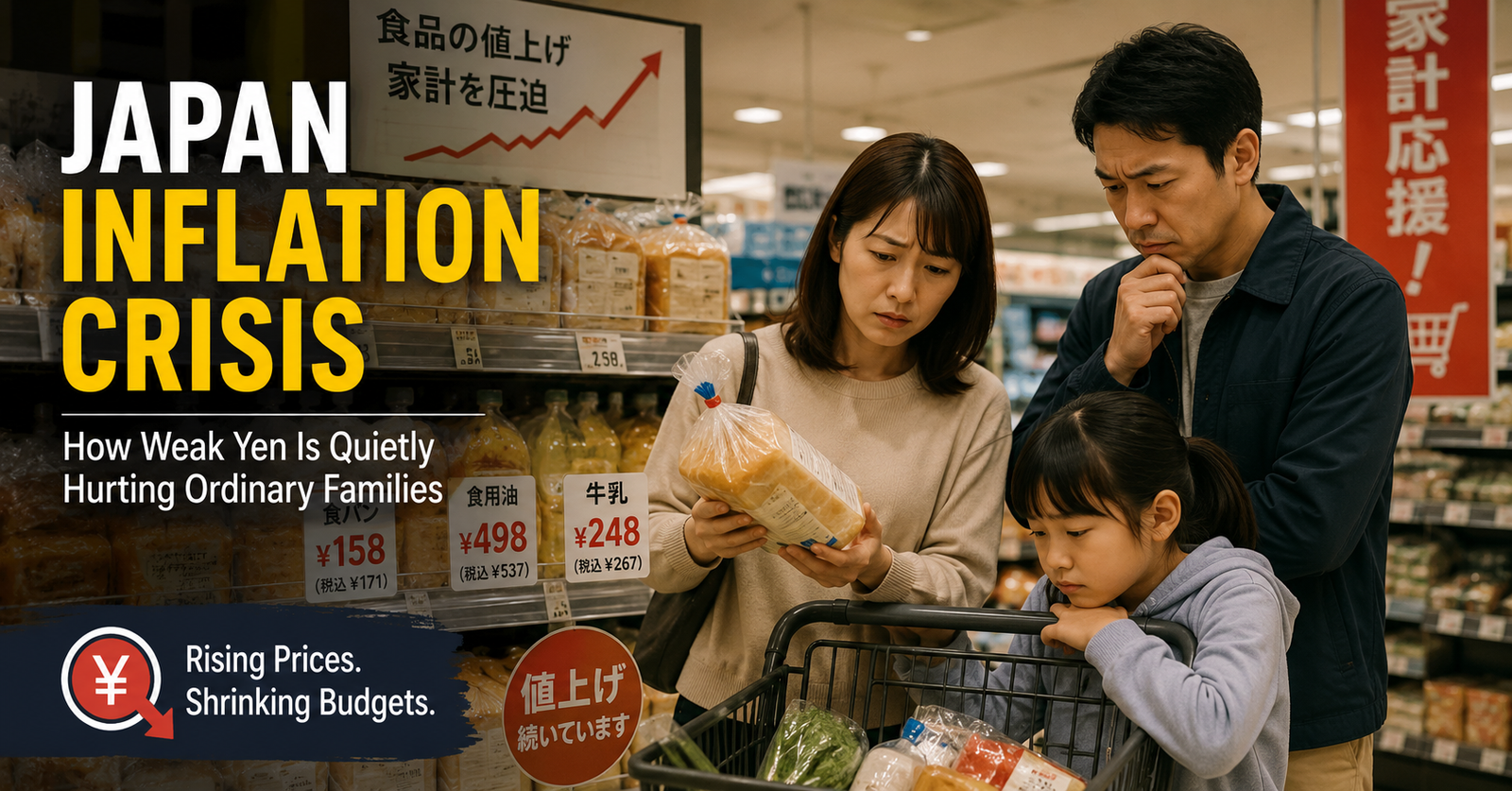
Japan Inflation Crisis Is Hurting Ordinary Families Quietly
Japan has long been seen as one of the world’s most stable economies. Prices stayed relatively calm for years, public transport remained affordable, and daily life felt predictable for most families. But recently, something has changed quietly in the background. (Japan Inflation Crisis)
Economists and traders are no longer the only ones discussing the weak yen. It is starting to affect ordinary people in very visible ways. Grocery bills are climbing, electricity costs are rising, and many households feel like their salaries are buying less every month.
That is why the current Japan Inflation Crisis matters far beyond financial markets.
For years, Japan struggled with the opposite problem — low inflation and weak consumer spending. Now the country is dealing with rising prices at a speed many households are not used to. And unlike in some countries where wages have increased alongside inflation, salary growth in Japan has been much slower.
The result is a growing pressure on middle-class families.
A Weak Yen Sounds Technical Until It Hits Your Wallet
When people hear that the Japanese yen is falling against the US dollar, it can sound like a distant financial issue. But the effect becomes very real once imported goods become more expensive.
Japan depends heavily on imports for energy, fuel, and food. When the yen weakens, the country has to pay more for these imports because they are priced in dollars.
That extra cost eventually reaches consumers. (Japan Inflation Crisis)
A simple supermarket visit now costs noticeably more than it did a few years ago. Cooking oil, bread, milk, coffee, and packaged foods have all become more expensive. Electricity bills have also increased because Japan imports much of its energy supply.
For a retired couple or a family with children, these changes add up quickly.
One Tokyo resident recently described how her monthly grocery spending increased even though she was buying fewer items. Instead of eating out on weekends, her family has started cooking at home more often. Small lifestyle adjustments like these are becoming increasingly common.
Why the Japan Inflation Crisis Feels Different
Inflation itself is not unusual around the world. But Japan’s situation feels different because many people spent decades living in a low-inflation environment.
For years, prices in Japan barely moved. Some products even became cheaper over time. Consumers got used to stability. Businesses also became cautious about raising prices because customers were sensitive to even small increases. (Japan Inflation Crisis)
Now the sudden shift is uncomfortable.
Many Japanese workers are not seeing salary increases large enough to match rising living costs. Even if wages rise slightly, inflation often moves faster.
That creates a quiet psychological effect.
People begin cutting unnecessary spending. Families postpone travel plans. Younger workers save less money. Retirees become more careful about healthcare and household expenses.
The problem is not just higher prices. It is uncertainty.

The Weak Yen Is Creating Winners Too
Interestingly, not everyone in Japan is struggling from the weak currency.
Large export companies are benefiting in some ways. Japanese products become cheaper overseas when the yen falls, helping businesses like Toyota, Sony, and Nintendo sell more globally.
Tourism has also exploded because Japan has become cheaper for foreign visitors. Hotels, restaurants, and shopping districts in cities like Tokyo, Osaka, and Kyoto are seeing strong demand from tourists.
But this creates an uneven economy.
Big corporations and tourist-heavy businesses may perform well, while ordinary households continue dealing with rising costs at home. That imbalance is one reason the Japan Inflation Crisis has become such a sensitive political issue.
Why the Government Cannot Fix It Quickly
Japanese officials have repeatedly warned about currency volatility and promised to protect households. But fixing the situation is much harder than issuing warnings.
The Bank of Japan has kept interest rates lower than many other countries for a long time. Meanwhile, the United States raised rates aggressively to fight inflation. That gap makes investors prefer the dollar over the yen.
As money flows toward the dollar, the yen weakens further.
Japan could raise interest rates more aggressively, but that comes with risks. Higher rates could slow economic growth and create pressure on businesses already dealing with weak domestic demand.
So policymakers are stuck balancing multiple problems at once.
This explains why many government responses appear cautious rather than dramatic.
Daily Life Is Slowly Changing
One of the most interesting parts of this situation is how quietly daily habits are changing.
Discount supermarkets are attracting more customers. Budget restaurants are seeing higher demand while premium dining slows down. Families are comparing electricity usage more carefully than before.
Even convenience stores — a major part of Japanese daily life — have started reducing portion sizes while increasing prices.
These small changes may not look dramatic individually, but together they show how inflation slowly reshapes behavior.
And unlike stock market headlines, these effects stay with people every day.
Could Things Get Worse?
The answer depends largely on energy prices, global interest rates, and whether Japanese wages continue rising.
If the yen weakens further, imported costs may continue increasing. Another major concern is that younger generations could become more financially cautious, reducing spending across the economy.
However, there is also a possibility that Japan finally escapes decades of weak economic activity if wage growth improves over time.
That is why the current moment feels so important.
Japan is trying to find balance between supporting growth, controlling inflation, and protecting households from rising living costs. But for many ordinary families, the pressure is already here.
The bigger lesson from the Japan Inflation Crisis is that currency movements are never just numbers on financial charts. Eventually, they shape how people shop, eat, travel, save, and plan their future.
And in Japan right now, that change is becoming impossible to ignore.

My name is Ankit Yadav, and I am a passionate digital journalist and content creator. I write about technology, entertainment, sports, and current affairs with the aim of delivering unique, accurate, and engaging information to my readers.
I believe news should not only inform but also provide clear insights and fresh perspectives. That’s why I focus on making my articles easy to read, reliable, and meaningful.
📌 I specialize in Tech Trends, Latest News, Cybersecurity, Digital Media, Sports, and Entertainment.
📌 My mission is to share fast, authentic, and valuable updates with every article I publish.