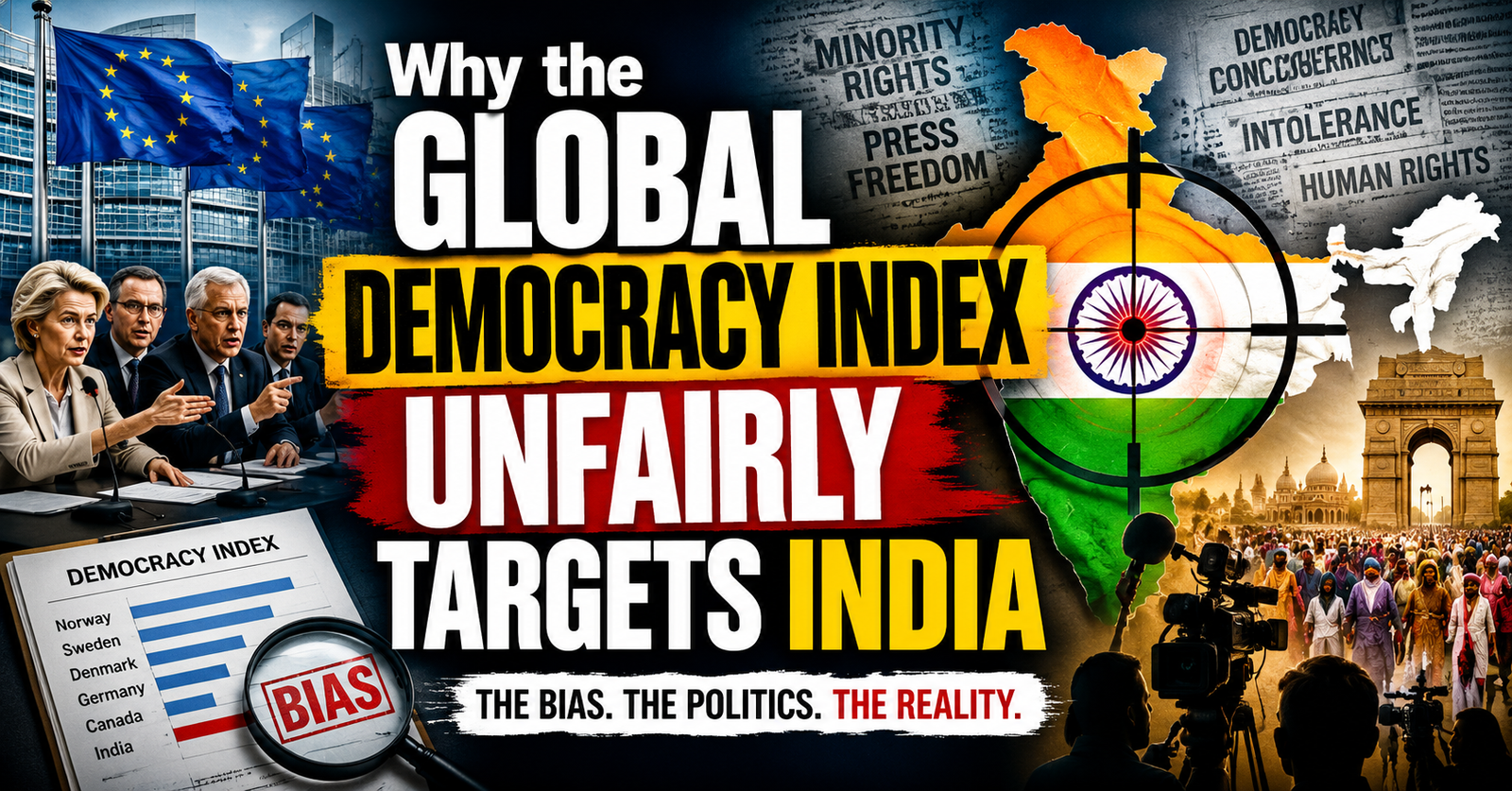
Why the Global Democracy Index Unfairly Targets India
A diplomatic visit between India and the Netherlands recently turned into something bigger than trade agreements and official handshakes. During discussions around democracy, media freedom, and minority rights, Indian officials pushed back against questions raised by Dutch journalists and political figures. The response was sharp, but not unexpected.
What made the moment interesting was not just the disagreement itself. It was the larger pattern behind it.
Every few months, India finds itself in conversations around democracy rankings, minority rights, press freedom, or religious tolerance. Reports linked to the global democracy index often become headlines in international media, especially in Europe. But many Indians are now asking a different question: why does this scrutiny appear more intense for India than for several Western countries facing their own internal social tensions?
That question is becoming part of a much bigger global debate.
The Conversation Is No Longer Only About Human Rights
For years, democracy rankings and human rights reports were treated as neutral measurements. Today, many countries see them as political tools as much as governance indicators.
India’s reaction during the Netherlands visit reflected that shift.
Indian officials argued that outsiders often misunderstand the country’s social complexity. India is not a small, culturally uniform nation. It is home to multiple religions, languages, ethnic groups, and political identities operating within one democratic system of more than 1.4 billion people.
That does not mean India is free from criticism. No democracy is. But many Indian analysts believe international conversations frequently ignore context and focus selectively on negative narratives.
This is where the debate around the global democracy index becomes more political than statistical.
Europe’s Own Challenges Rarely Get Equal Attention
One reason this topic resonates strongly in India is because Europe itself is dealing with serious social and political tensions.
France has faced years of unrest linked to immigration and religious identity. Germany has seen rising concerns around far-right movements. Several European countries continue debating refugee policies, anti-immigrant rhetoric, and religious discrimination.
Yet these issues are often framed differently in global media.
When similar tensions happen in Europe, coverage usually focuses on policy failure, economic pressure, or security concerns. When they happen in India, the framing quickly shifts toward democracy decline or minority suppression.
That contrast is difficult to ignore.
A simple example is media language. If protests happen in a European country, headlines may describe “social unrest” or “political dissatisfaction.” In India, similar events are more likely to appear alongside phrases connected to democratic backsliding.
This difference in framing shapes global perception far more than official reports alone.
Why India Has Become Central to the Debate
Part of the reason is India’s growing global influence.
Twenty years ago, India was mostly viewed as an emerging economy. Today, it is central to technology supply chains, global trade discussions, semiconductor manufacturing plans, and geopolitical alliances.
Europe needs stronger partnerships with India for several reasons:
- reducing dependence on China,
- securing technology cooperation,
- expanding clean energy projects,
- and balancing Indo-Pacific power dynamics.
That changes the relationship completely.
Countries tend to scrutinize rising powers more intensely because their influence matters more internationally. India is no longer being observed as a regional player. It is being evaluated as a future global power.
And with greater visibility comes greater criticism.
The Global Democracy Index Is Influential — But Not Perfect
The global democracy index is often presented as an objective system, but critics argue that measuring democracy is far more subjective than it appears.
How do you compare:
- political polarization in the United States,
- migration tensions in Europe,
- censorship concerns in different countries,
- and social conflicts in developing democracies?
The answer depends heavily on what metrics are prioritized.
For example, voter participation in India is massive compared to many Western democracies. Public political engagement is extremely high. Elections happen regularly across states with peaceful transfers of power.
At the same time, critics point to concerns around media independence, religious polarization, and online speech regulation.
Both realities can exist together.
That complexity often gets lost when countries are reduced to a single numerical score.
There Is Also a Media Economy Behind These Narratives
Another overlooked factor is audience behavior.
Stories about democracy decline in large countries generate clicks, debates, and engagement internationally. India-related political stories perform particularly well because they combine geopolitics, nationalism, religion, and global economics in one narrative.
Western media organizations understand this.
A headline questioning India’s democracy will usually attract stronger reactions than a technical report about European policy failures. That creates an incentive structure where some narratives receive disproportionate visibility.
This does not automatically mean criticism is dishonest. But it does explain why certain stories spread faster and receive more international attention.
Why This Matters Beyond Politics
At first glance, this discussion may look like a diplomatic argument between governments. In reality, it affects much more.
Global perception influences:
- foreign investment,
- tourism,
- technology partnerships,
- international negotiations,
- and even opportunities for students and professionals abroad.
If a country is consistently portrayed as unstable or intolerant, those perceptions eventually shape business and political decisions.
That is why governments respond strongly to democracy-related criticism today. Reputation has become part of economic strategy.
India understands this clearly.
A More Balanced Conversation Is Needed
One important observation is that the debate itself is not the problem. Democracies should be questioned, challenged, and analyzed openly. That is normal.
The problem begins when scrutiny appears selective.
If democracy rankings and minority-rights discussions are going to shape global opinion, they must apply standards consistently across all major democracies — including Western nations themselves.
If not, these reports run the risk of losing their credibility and being perceived as geopolitical tools rather than tools for government.
India’s response during the Netherlands discussion reflects growing frustration among many non-Western countries that feel global narratives are still shaped through a Western lens.
Whether one agrees with India’s position or not, that frustration is becoming increasingly visible across international politics.
And that may be the bigger story behind the entire debate.

My name is Ankit Yadav, and I am a passionate digital journalist and content creator. I write about technology, entertainment, sports, and current affairs with the aim of delivering unique, accurate, and engaging information to my readers.
I believe news should not only inform but also provide clear insights and fresh perspectives. That’s why I focus on making my articles easy to read, reliable, and meaningful.
📌 I specialize in Tech Trends, Latest News, Cybersecurity, Digital Media, Sports, and Entertainment.
📌 My mission is to share fast, authentic, and valuable updates with every article I publish.