
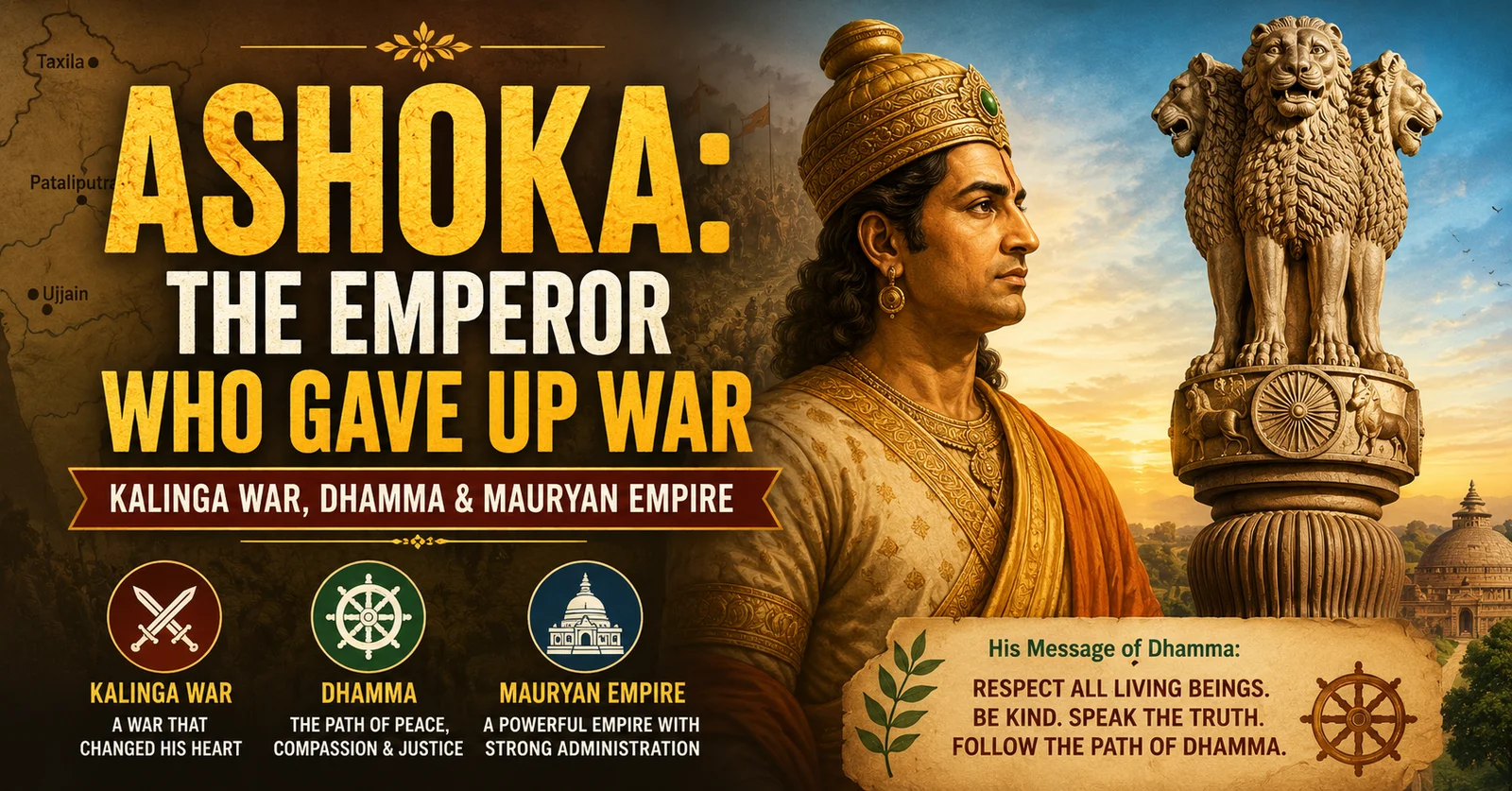
ASHOKA, THE EMPEROR WHO GAVE UP WAR
Chapter ka central idea:
Ashoka ek powerful Mauryan emperor tha. Usne Kalinga war ke baad war aur conquest ki violence ko dekhkar apna attitude change kiya aur dhamma ke ideas ko spread karna shuru kiya. Chapter mein Mauryan Empire, uska administration, Ashoka’s inscriptions, Kalinga War aur dhamma explain kiya gaya hai.
🧠 Sabse pehle Chapter ko ek story ki tarah samjho
Imagine karo…
Aaj hum apne ₹10, ₹20, ₹50, ₹100 ke notes par lions dekhte hain. 🦁
Chapter ki beginning mein Roshan naam ki girl apne grandfather se mile naye notes dekh rahi thi. Usne notes par Gandhiji ki picture ke saath lions dekhe aur socha:
Why are these lions shown on our currency?
Yahin se chapter humein Ashoka tak le jaata hai.
Ye lions actually Lion Capital of Ashoka se connected hain, jo Sarnath mein ek massive stone pillar ke top par placed tha. (Kalinga War)
1. WHO WAS ASHOKA?
Ashoka
Ashoka was one of the greatest rulers known to history.
Woh Mauryan dynasty (मौर्य वंश) ka ruler tha.
Usne ek bahut bada territory rule kiya.
Isliye uski state ko sirf kingdom nahi, balki:
Empire (साम्राज्य)
kaha jaata hai. (Kalinga War)
2. KINGDOM vs EMPIRE
Ye difference bahut important hai. ⭐
Kingdom
= relatively smaller area ruled by a king (राजा द्वारा शासित राज्य)
Empire
= a very large territory ruled by an emperor (सम्राट द्वारा शासित विशाल राज्य)
Easy trick:
King → Kingdom
Emperor → Empire
Why did an empire need more resources?
Empire bahut large hota tha. (Kalinga War)
Isliye emperor ko chahiye:
- Large army (बड़ी सेना)
- More officials (अधिक अधिकारी)
- More taxes (अधिक कर)
- More resources (अधिक संसाधन)
⭐ Remember:
Emperors needed more resources than kings because empires were larger and had to be protected by large armies.
3. THE MAURYAN EMPIRE
Ashoka jis empire ka ruler tha, us empire ki foundation uske grandfather ne rakhi thi:
Chandragupta Maurya
Chandragupta Maurya ne Mauryan Empire ko more than 2300 years ago establish kiya.
Unko support kiya tha ek very important person ne:
Chanakya / Kautilya
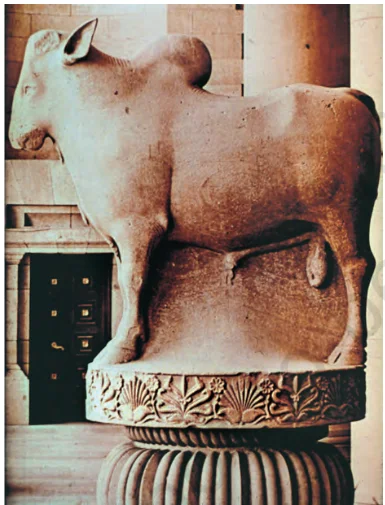
4. ARTHASHASTRA
Chanakya/Kautilya ki ideas ek famous book mein likhi gayi thi:
Arthashastra
Arthashastra
= state, administration, economy etc. se related ideas wali ancient text (प्राचीन ग्रंथ)
Important:
Chandragupta Maurya
⬇️
supported by Chanakya/Kautilya
⬇️
ideas associated with Arthashastra (Kalinga War)
5. MAURYAN DYNASTY
What is a dynasty?
When members of the same family become rulers one after another, the family is called a dynasty.
Dynasty
= ek hi family ke rulers ka succession (वंश)
Mauryan dynasty ke three important rulers:
1. Chandragupta Maurya
⬇️
2. Bindusara
⬇️
3. Ashoka
⭐ Memory trick:
C → B → A
Chandragupta → Bindusara → Ashoka
6. IMPORTANT CITIES OF THE MAURYAN EMPIRE 🏙️
Mauryan Empire mein several important cities thi.
Pataliputra
→ Capital city
Taxila
→ Gateway to the northwest
Ujjain
→ Route from north to south India
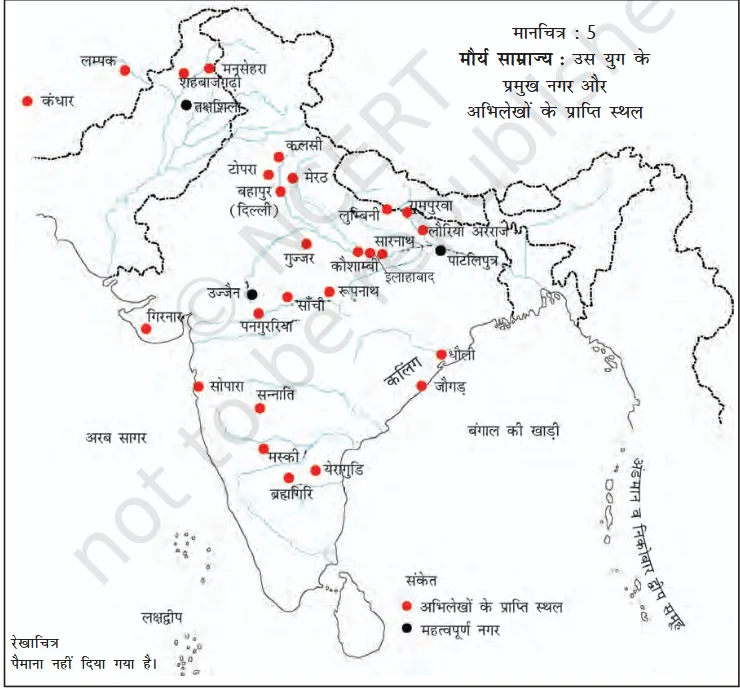
Pataliputra
Pataliputra was the capital of the Mauryan Empire.
Aaj ka modern city:
Patna
se connected hai. (Kalinga War)
Taxila
Taxila northwest ki taraf ek important gateway (प्रवेश द्वार) tha.
It connected the empire with areas including:
Central Asia
Ujjain
Ujjain north India se south India jaane wale route par important tha.
Easy map memory:
Pataliputra → Capital
Taxila → Northwest
Ujjain → North-South route
7. WHO LIVED IN THESE CITIES?
Different kinds of people cities mein rehte the.
For example:
- Merchants (व्यापारी)
- Officials (अधिकारी)
- Crafts persons (कारीगर)
Villages mein:
- Farmers (किसान)
- Herders (पशुपालक)
Aur central India ke kuch areas mein forests the.
Wahan people:
- Forest produce collect karte the
- Animals hunt karte the
8. PEOPLE WERE DIFFERENT IN DIFFERENT AREAS
Mauryan Empire bahut large tha.
Isliye different areas ke people:
- different languages bolte the
- different foods khate the
- different clothes pehente the
🧠 Hinglish
Empire ek huge area tha, toh naturally har jagah same lifestyle nahi ho sakti thi.
Different regions → different people → different languages, food and clothes.
9. HOW WAS THE MAURYAN EMPIRE RULED?
Ab chapter ka very important part:
Ruling the Empire
Itna huge empire ek hi way se rule karna possible nahi tha.
Isliye different areas ko different ways se control kiya jaata tha.
10. AREA AROUND PATALIPUTRA
Pataliputra ke surrounding area par emperor ka direct control tha.
Direct control
= ruler directly administration control karta tha (सीधा नियंत्रण)
Officials appoint kiye jaate the.
Unka kaam tha:
- Taxes collect karna
- Orders implement karna
- Disobedient people ko punish karna (Kalinga War)
11. OFFICIALS
Officials important administrative work karte the.
They collected taxes from:
- Farmers
- Herders
- Crafts persons
- Traders
Officials were paid salaries
Many officials ko:
Salaries (वेतन)
milti thi.
Aur emperor ke orders ko communicate karne ke liye:
Messengers (संदेशवाहक)
travel karte the. (Kalinga War)
12. SPIES 🕵️
Mauryan administration mein spies (जासूस) bhi the.
Their job was to:
keep a watch on the officials.
Hinglish:
Emperor ko ensure karna tha ki uske officials properly kaam kar rahe hain.
Isliye spies information provide kar sakte the. (Kalinga War)
13. WHO SUPERVISED EVERYONE?
Ultimately:
The Emperor
sabko supervise karta tha.
Uski help karte the:
- Members of royal family
- Senior ministers
Supervise
= निगरानी रखना / काम की देखरेख करना (Kalinga War)
14. PROVINCES
Empire ke kuch other areas ko:
Provinces (प्रांत)
mein divide kiya gaya tha.
Important provincial capitals:
- Taxila
- Ujjain
Royal princes ko often governors ke role mein bheja jaata tha.
Governor
= kisi province ko administer karne wala अधिकारी (प्रांतीय शासक/अधिकारी)
15. LOCAL CUSTOMS
Provincial areas mein Pataliputra ka kuch control tha.
Lekin:
Local customs and rules were probably followed.
Local customs
= local traditions and practices (स्थानीय परंपराएँ)
🧠 Hinglish
Matlab emperor ka overall control tha, lekin har jagah daily life ko exactly same rules se control karna zaroori nahi tha.
Local practices ko bhi continue kiya ja sakta tha. (Kalinga War)
16. ROADS AND RIVERS 🚣
Mauryan rulers tried to control:
Roads
Rivers
Why?
Because they were very important for:
Transport (यातायात)
Aur in routes se goods aur resources move karte the. (Kalinga War)
17. TAX AND TRIBUTE
Empire ke different areas se resources collect kiye jaate the.
Yahan do words important hain:
Tax
= नियमित रूप से लिया जाने वाला कर
Tribute
= समय-समय पर दिया जाने वाला कर/भेंट
18. TAX vs TRIBUTE ⭐⭐⭐
| Tax | Tribute |
|---|---|
| Collected regularly | Collected when possible |
| More systematic | Could be given more or less willingly |
| Paid as a regular obligation | Could consist of different goods |
Tribute mein kya mil sakta tha?
Different valuable resources.
For example:
- Gold
- Precious stones
- Blankets
- Elephants
- Timber
- Honey
- Wax
19. FORESTED REGIONS 🌳
Forest areas mein rehne wale people relatively independent the.
But they may have been expected to provide:
- Elephants 🐘
- Timber 🌲
- Honey 🍯
- Wax
to Mauryan officials. (Kalinga War)
20. MEGASTHENES
Ab ek important person:
Megasthenes
He was an:
Ambassador (राजदूत)
He was sent to the court of Chandragupta Maurya by:
Seleucus Nicator
who was a Greek ruler of West Asia.
21. WHAT DID MEGASTHENES WRITE?
Megasthenes wrote an account of what he saw.
He described:
- Emperor’s royal processions
- Golden palanquin
- Decorated elephants
- Armed guards
- Royal security
- Pataliputra city
22. WHY DID THE KING HAVE PEOPLE TASTE HIS FOOD?
Book tells us that special servants tasted the king’s food before he ate.
Why?
Most likely because the king feared:
Poisoning (ज़हर दिए जाने)
The king was afraid that someone might try to kill him.
So food tasting was a security measure.
23. PATALIPUTRA
Megasthenes described Pataliputra as a:
large and beautiful city.
It had:
- Massive wall
- 570 towers
- 64 gates
- Houses of two or three storeys
- Wood and mud-brick buildings
- A royal palace
- Gardens
- Enclosures for birds
⭐ Important
Pataliputra = modern Patna
24. ASHOKA — A UNIQUE RULER
Now chapter ka main character properly enter karta hai.
Ashoka
Ashoka was the most famous Mauryan ruler.
He was unique because:
He was the first ruler who tried to take his message to people through inscriptions.
25. ASHOKA’S INSCRIPTIONS
Ashoka got his messages written on:
🪨 Rocks
🪨 Pillars
Most Ashokan inscriptions were written in:
Prakrit
and:
Brahmi script
Remember:
Language → Prakrit
Script → Brahmi
Ye difference Chapter 1 mein bhi padha tha. 😉
26. KALINGA WAR ⚔️
Now comes the turning point of Ashoka’s life.
Kalinga
Kalinga was the ancient name of:
Coastal Orissa / present-day Odisha
Ashoka fought a war to:
conquer Kalinga.
But war ke baad jo hua, usne Ashoka ko completely change kar diya.
27. WHAT DID ASHOKA SEE AFTER THE WAR?
Ashoka saw:
- Violence (हिंसा)
- Bloodshed (खून-खराबा)
- Death
- People being captured
- Families losing loved ones
According to his inscription:
- About 1.5 lakh people were captured
- More than 1 lakh people were killed
This filled Ashoka with:
Sorrow (दुःख)
28. ASHOKA’S BIG CHANGE
This is the most important point of the entire chapter. ⭐⭐⭐
Before Kalinga:
Ashoka → conquest through war
After Kalinga:
Ashoka → rejected further conquest through war
He decided:
Not to fight any more wars.
🧠 Hinglish
Socho, ek ruler war jeet gaya.
Normally victory ke baad ruler proud feel kar sakta hai.
But Ashoka ne battlefield ki suffering dekhi aur realise kiya:
“Victory ke liye itni lives destroy karna right nahi hai.”
Isi realisation ne uska attitude toward war change kar diya.
29. ASHOKA’S NEW IDEA OF VICTORY
Ashoka believed:
❌ Winning people through force
was not the best way.
Instead:
✅ Winning people through dhamma
was better.
30. WHAT IS DHAMMA?
This is the most important word of Chapter 8.
Dhamma
Dhamma is the Prakrit form of the Sanskrit word:
Dharma
But Ashoka’s dhamma ko simply “religion” mat samajhna.
Ashoka’s dhamma was a set of ideas about:
- Good behaviour
- Respect
- Compassion
- Kindness
- Tolerance
- Good relations with others
31. DID ASHOKA’S DHAMMA INVOLVE WORSHIP?
No.
Ashoka’s dhamma did not involve:
- Worship of a god
- Performance of sacrifices
Instead, he wanted people to behave properly towards one another.
32. WHY DID ASHOKA WANT TO SPREAD DHAMMA?
Empire mein different religions follow karne wale people rehte the.
Sometimes:
Conflicts (संघर्ष)
hote the.
Ashoka also saw other social problems:
- Animals were sacrificed.
- Slaves and servants were ill-treated.
- Families had quarrels.
- Neighbours had quarrels.
Ashoka wanted to address these problems.
33. ASHOKA’S DHAMMA MAHAMATTAS
Ashoka appointed special officials called:
Dhamma Mahamatta
Their work:
They travelled from place to place and taught people about dhamma.
Mahamatta
= important official (महत्वपूर्ण अधिकारी)
34. ASHOKA USED INSCRIPTIONS TO SPREAD HIS MESSAGE
Ashoka got his messages written on:
- Rocks
- Pillars
Then officials were instructed to:
read the messages to people who could not read.
🧠 Important idea
Ashoka understood that not everyone could read.
So written inscriptions ke saath oral communication bhi important tha.
35. ASHOKA SENT MESSENGERS TO OTHER LANDS
Ashoka’s ideas were also sent to other regions.
The chapter mentions:
- Syria
- Egypt
- Greece
- Sri Lanka
Messenger
= संदेश लेकर जाने वाला व्यक्ति
36. ASHOKA DID MORE THAN JUST TALK
Ashoka’s dhamma sirf words nahi tha.
He also took practical steps.
He:
🛣️ Built roads
🕳️ Dug wells
🏠 Built rest houses
🏥 Arranged medical treatment
And importantly:
Medical treatment was arranged for both human beings and animals.
Compassion
= दया / करुणा
37. WHAT DID ASHOKA WANT PEOPLE TO DO?
Ashoka’s messages included several important practices.
1. Be gentle with slaves and servants
Gentle = नरम / दयालु व्यवहार करना
He wanted people to treat slaves and servants better.
2. Respect elders
Respect = सम्मान करना
People should respect:
- Parents
- Elders
- Older members of society
3. Treat all creatures with compassion
Creatures = जीव-जंतु / सभी प्राणी
Ashoka encouraged:
Compassion towards all living beings.
4. Give gifts to Brahmins and monks
He encouraged generosity towards:
- Brahmins
- Monks
38. RELIGIOUS TOLERANCE
Ashoka gave a very important message:
Do not praise your own religion while criticising another religion.
Instead:
People should:
- Respect other religions
- Understand their ideas
- Avoid unnecessary criticism
39. WHY IS THIS IDEA IMPORTANT?
Imagine:
Person A says:
“My religion is good and your religion is bad.”
This can create:
Argument → hatred → conflict
Ashoka wanted:
Respect → understanding → harmony
Harmony
= शांति और मेल-जोल
40. ASHOKA’S MESSAGE IN ONE LINE
Respect others, behave kindly, avoid unnecessary conflict, and care for living beings.
Ye line Ashoka ke dhamma ko simple way mein samajhne ke liye excellent hai.
41. THE LION CAPITAL 🦁
Ab starting ka mystery solve karte hain.
India ke currency notes par jo lions ka symbol hota hai, woh connected hai:
Lion Capital of Ashoka

Ye originally Sarnath mein ek massive stone pillar ke top par placed tha.
Ashoka ne pillars par inscriptions bhi karwaye.
Lion Capital isliye important hai because it has become a major national symbol.
42. RAMPURWA BULL
Chapter mein Rampurwa Bull ka picture bhi diya hai.
Ye:
- finely polished stone sculpture hai
- Mauryan sculptors ki skill ko show karta hai
It was found in:
Rampurwa, Bihar
Aur ab Rashtrapati Bhavan mein placed hai.
Finely polished
= bahut achhi tarah chamkaya/polish kiya hua
43. BRAHMI SCRIPT
Ashoka ke most inscriptions:
Prakrit language + Brahmi script
mein the.
Chapter mein Brahmi script ke development ka example bhi diya hai.
It shows:
Early Brahmi → later Indian scripts
Examples shown include:
- Devanagari
- Bengali
- Malayalam
- Tamil
Important idea
Modern Indian scripts have developed from older writing traditions over many centuries.
44. ASHOKA vs CHINESE EMPERORS
Chapter ke Elsewhere section mein China ka example diya hai.
About 2400 years ago, Chinese emperors began building:
The Great Wall of China
Its purpose was to protect the northern frontier from pastoral people.
Wall par:
- Stone
- Brick
- Road
- Watch towers
the.
It became extremely long, with additions made over around 2000 years.
Important comparison:
Chinese emperors focused heavily on protecting their frontier through a massive wall.
Ashoka, after the Kalinga War, adopted a different attitude toward conquest and neighbouring peoples, emphasising dhamma rather than continuing military conquest.
🧠 AB POORA CHAPTER EK FLOW MEIN
Ye flow 100% yaad karo:
Chandragupta Maurya
⬇️
Founded Mauryan Empire
⬇️
Bindusara
⬇️
Ashoka
⬇️
Powerful Mauryan Emperor
⬇️
Kalinga War
⬇️
Violence + Death + Suffering
⬇️
Ashoka felt Sorrow
⬇️
Gave up further wars
⬇️
Promoted Dhamma
⬇️
Inscriptions on rocks & pillars
⬇️
Dhamma Mahamattas
⬇️
Respect + Compassion + Tolerance
⬇️
Roads + Wells + Rest houses + Medical treatment
📚 SUPER IMPORTANT VOCABULARY
| English | Hindi Meaning |
|---|---|
| Emperor | सम्राट |
| Empire | साम्राज्य |
| Kingdom | राज्य |
| Dynasty | वंश |
| Ruler | शासक |
| Capital | राजधानी |
| Province | प्रांत |
| Official | अधिकारी |
| Governor | राज्य/प्रांत का प्रशासक |
| Tax | कर |
| Tribute | कर/भेंट |
| Resources | संसाधन |
| Administration | प्रशासन |
| Supervise | निगरानी करना |
| Messenger | संदेशवाहक |
| Spy | जासूस |
| Ambassador | राजदूत |
| Conquer | विजय प्राप्त करना |
| Conquest | विजय/अधिग्रहण |
| Violence | हिंसा |
| Bloodshed | खून-खराबा |
| Sorrow | दुःख |
| Dhamma | धर्म/नैतिक आचरण की शिक्षा |
| Compassion | करुणा/दया |
| Respect | सम्मान |
| Tolerance | सहनशीलता |
| Inscription | अभिलेख |
| Pillar | स्तंभ |
| Rock | चट्टान |
| Script | लिपि |
| Sculpture | मूर्ति/शिल्प |
| Sacrifice | बलिदान |
| Frontier | सीमा |
| Pastoral people | पशुपालक लोग |
| Flourish | विकसित/समृद्ध होना |
📝 EXAM READY NOTES
Q1. Who founded the Mauryan Empire?
Answer:
The Mauryan Empire was founded by Chandragupta Maurya more than 2300 years ago. He was supported by the wise man Chanakya or Kautilya.
Q2. Name the three important Mauryan rulers.
Answer:
The three important Mauryan rulers were:
- Chandragupta Maurya
- Bindusara
- Ashoka
Q3. Name three important cities of the Mauryan Empire.
Answer:
Three important cities were:
- Pataliputra
- Taxila
- Ujjain
Pataliputra was the capital, Taxila was a gateway to the northwest, and Ujjain lay on the route from north to south India.
Q4. What is the difference between tax and tribute?
Answer:
Taxes were collected regularly, whereas tribute was collected when possible and could consist of different goods given more or less willingly.
Q5. Who was Megasthenes?
Answer:
Megasthenes was an ambassador sent to the court of Chandragupta Maurya by the Greek ruler Seleucus Nicator. He wrote an account describing the emperor and Pataliputra.
⭐ Q6. Why is Ashoka considered a unique ruler?
Answer:
Ashoka is considered a unique ruler because after the Kalinga War he was deeply affected by the violence and suffering caused by the war. He decided to give up further wars of conquest and began spreading the message of dhamma through inscriptions on rocks and pillars.
⭐ Q7. What happened during the Kalinga War?
Answer:
Ashoka fought a war to conquer Kalinga. After seeing the large-scale death, destruction and suffering caused by the war, he felt deep sorrow. He decided not to fight any more wars and chose to win people through dhamma rather than force.
⭐ Q8. What was Ashoka’s dhamma?
Answer:
Ashoka’s dhamma was a set of ideas that encouraged people to live peacefully and behave well towards others. It included respecting elders, treating slaves and servants kindly, showing compassion towards all creatures, respecting other religions and avoiding unnecessary conflict.
⭐ Q9. What problems did Ashoka want to solve through dhamma?
Answer:
Ashoka wanted to address several problems:
- Conflicts between followers of different religions
- Animal sacrifices
- Ill-treatment of slaves and servants
- Quarrels within families
- Quarrels among neighbours
⭐ Q10. How did Ashoka spread the message of dhamma?
Answer:
Ashoka spread dhamma by:
- Inscribing messages on rocks and pillars.
- Appointing dhamma mahamattas.
- Sending messengers to other lands.
- Instructing officials to read inscriptions to people who could not read.
- Promoting welfare measures such as roads, wells, rest houses and medical treatment.
🧠 MOST IMPORTANT DIFFERENCES
KINGDOM vs EMPIRE
| Kingdom | Empire |
|---|---|
| Smaller | Larger |
| Ruled by a king | Ruled by an emperor |
| Fewer resources needed | More resources needed |
| Smaller army may be enough | Large army needed |
TAX vs TRIBUTE
| Tax | Tribute |
|---|---|
| Regular | Not necessarily regular |
| Collected systematically | Collected when possible |
| Regular obligation | Different goods could be offered |
BEFORE KALINGA vs AFTER KALINGA
| Before Kalinga | After Kalinga |
|---|---|
| Conquest through war | Gave up further wars |
| Military expansion | Dhamma |
| Force | Persuasion and moral conduct |
| War | Peace and welfare |
🔥 CHAPTER 8 KI MOST IMPORTANT DATES
More than 2300 years ago
→ Beginning of the Mauryan Empire
About 2300 years ago
→ Ashoka’s period
Kalinga War
→ Turning point in Ashoka’s attitude towards war
About 2400 years ago
→ Chinese emperors began building the Great Wall
🎯 15 THINGS YOU MUST REMEMBER
- Chandragupta Maurya founded the Mauryan Empire.
- Chanakya was also known as Kautilya.
- Arthashastra contains ideas associated with Kautilya.
- The Mauryan dynasty included Chandragupta, Bindusara and Ashoka.
- Pataliputra was the capital.
- Taxila was a gateway to the northwest.
- Ujjain lay on the north-south route.
- Megasthenes was an ambassador.
- Ashoka was the most famous Mauryan ruler.
- Ashoka fought the Kalinga War.
- The suffering caused by the war changed Ashoka.
- Ashoka gave up further wars of conquest.
- Ashoka promoted dhamma.
- Most Ashokan inscriptions were in Prakrit and Brahmi.
- Ashoka promoted respect, compassion, religious tolerance and welfare.
🗣️ ENGLISH SPEAKING PRACTICE
Ab tumhari English improve karne ke liye ye sentences loudly bolo:
Ashoka was one of the greatest rulers in Indian history.
He was a ruler of the Mauryan dynasty.
The Mauryan Empire was founded by Chandragupta Maurya.
Ashoka fought a war against Kalinga.
The Kalinga War changed Ashoka’s attitude towards war.
He decided to give up further wars of conquest.
Ashoka spread the message of dhamma through inscriptions.
He taught people to respect others and treat all creatures with compassion.
He also arranged medical treatment for humans and animals.
🧠 LAST-MINUTE REVISION TRICK
Agar exam se 5 minutes pehle Chapter 8 revise karna ho, bas ye dekho:
MAURYAN EMPIRE
↓
Chandragupta Maurya
↓
Bindusara
↓
Ashoka
↓
Kalinga War ⚔️
↓
Violence + Death + Sorrow
↓
Gave up War 🕊️
↓
DHAMMA
↓
Respect + Compassion + Tolerance
↓
Inscriptions 🪨
↓
Dhamma Mahamattas
↓
Roads + Wells + Rest Houses + Medical Treatment
❤️ Ek line mein poora Chapter:
Ashoka was a powerful Mauryan emperor who, after witnessing the suffering caused by the Kalinga War, gave up further wars of conquest and promoted dhamma, compassion, respect and religious tolerance through inscriptions and welfare measures.

My name is Ankit Yadav, and I am a passionate digital journalist and content creator. I write about technology, entertainment, sports, and current affairs with the aim of delivering unique, accurate, and engaging information to my readers.
I believe news should not only inform but also provide clear insights and fresh perspectives. That’s why I focus on making my articles easy to read, reliable, and meaningful.
📌 I specialize in Tech Trends, Latest News, Cybersecurity, Digital Media, Sports, and Entertainment.
📌 My mission is to share fast, authentic, and valuable updates with every article I publish.



1 thought on “Ashoka: The Emperor Who Gave Up War | Kalinga War, Dhamma & Mauryan Empire”