
Imagine living around 2,500 years ago.
Cities were growing, powerful kingdoms were emerging and people’s lives were changing. At the same time, many thinkers were asking some very deep questions:
What is the meaning of life? Why do people suffer? What happens after death? How should a person live?
It was during this period that two important teachers, Siddhartha Gautama (the Buddha) and Vardhamana Mahavira, shared ideas that influenced Indian history for centuries.
But were their teachings exactly the same?
No.
The easiest way to understand their ideas is through Buddha vs Mahavira.
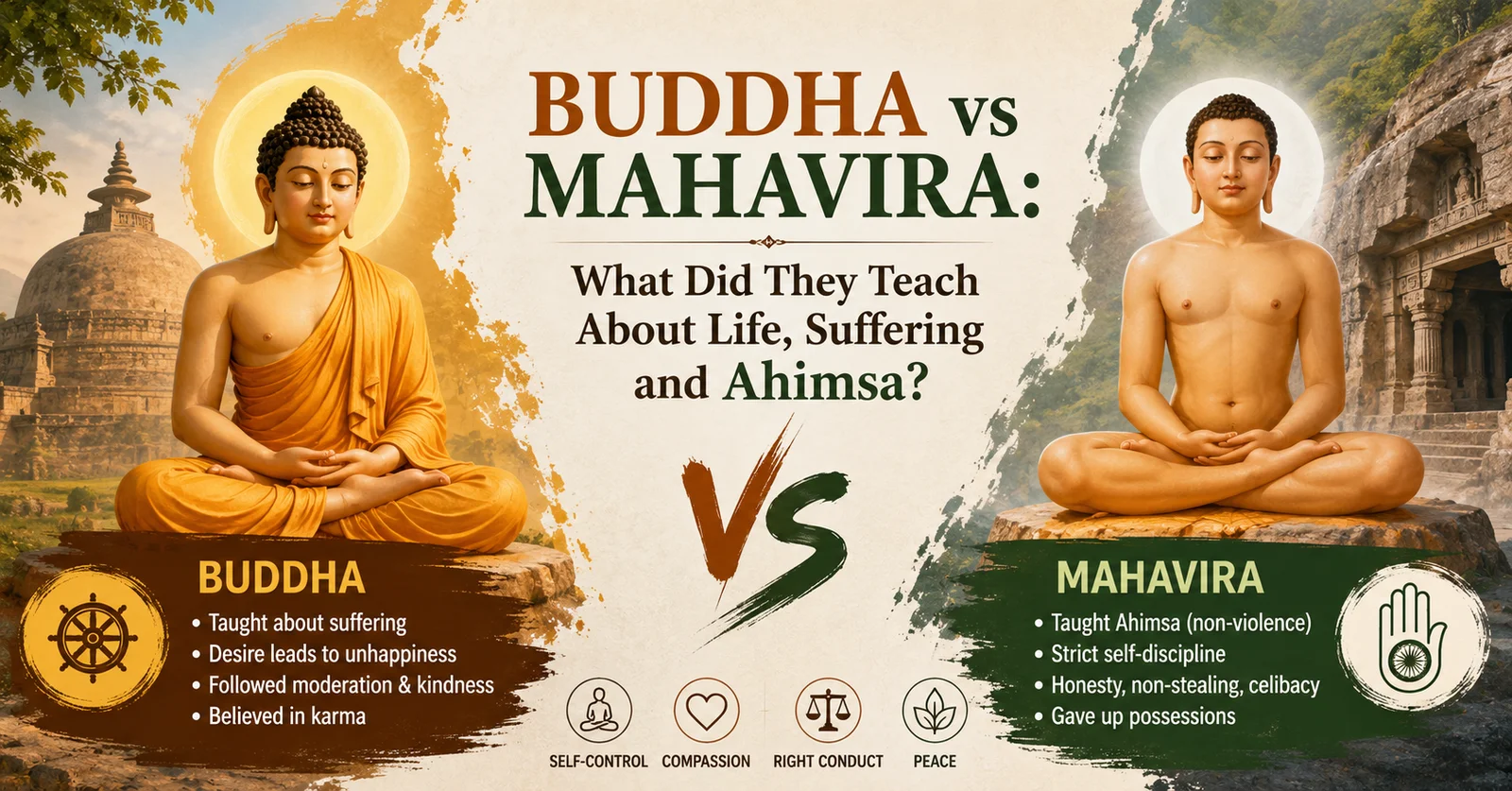
Both questioned existing ideas and encouraged people to think about how they lived. However, their teachings had important differences. Buddha focused strongly on suffering, desire, moderation and karma, while Mahavira placed a particularly strong emphasis on ahimsa (not hurting or killing living beings) and strict self-discipline.
So, let’s understand Buddha vs Mahavira in simple language.
Who Was Buddha?
Before making a Buddha vs Mahavira comparison, we first need to understand who Buddha was.
The Buddha was originally known as Siddhartha Gautama.
According to the chapter, he was born around 2,500 years ago and belonged to the Sakya gana. He was a Kshatriya (warrior/social group).
As a young man, Siddhartha left the comforts of his home because he wanted to search for knowledge (ज्ञान) and understand the meaning of life.
He travelled and discussed ideas with other thinkers.
Eventually, he decided to find his own path.
He meditated under a peepal tree at Bodh Gaya in Bihar and attained enlightenment (ज्ञान की प्राप्ति).
After this, he became known as the Buddha, meaning the Wise One.
He then travelled to Sarnath near Varanasi, where he taught for the first time.
He spent the rest of his life travelling from place to place and teaching people before passing away at Kusinara.

What Did Buddha Teach?
This is the most important part of Buddha vs Mahavira.
According to the chapter, Buddha taught that life contains suffering and unhappiness.
But why do people suffer?
One important reason, according to Buddha, is craving and desire (इच्छा और लालसा).
Think about a simple example.
You really want a new phone.
You don’t have it, so you feel unhappy.
Then you finally get it.
For a short time, you’re happy.
But after some time, you want something newer.
That constant wanting can continue.
Buddha described this constant craving as tanha (तृष्णा/लालसा).
He taught that this constant craving could be reduced by following moderation (संयम) in everything.
This is one of the biggest ideas to remember when studying Buddha vs Mahavira.
Buddha’s Idea of Karma
Buddha also taught about karma (कर्म).
The chapter explains that the results of our actions, whether good or bad, affect us in this life and the next.
So, according to this teaching, our actions matter.
Good actions and bad actions have consequences.
Buddha also encouraged people to be kind and respect the lives of others, including animals.
This gives us another important point in Buddha vs Mahavira:
Buddha Encouraged People to Think
One interesting part of Buddha’s teaching is that he encouraged people to think for themselves.
He did not simply want people to accept ideas without thinking.
He taught ordinary people in Prakrit, a language they could understand.
This helped his message reach more people.
So, if you are preparing a Buddha vs Mahavira answer for school, remember:
Buddha → suffering + desire + moderation + kindness + karma
That’s an easy memory trick.
Who Was Mahavira?
Now let’s look at the other side of Buddha vs Mahavira.
Mahavira’s name was Vardhamana Mahavira.
The chapter describes him as the 24th and last Tirthankara (तीर्थंकर) of the Jainas.
He lived around the same broad period as Buddha, about 2,500 years ago.
Mahavira was a Kshatriya prince of the Lichchhavis, a group that was part of the Vajji Sangha.
At around the age of 30, he left home and went to live in a forest.
For 12 years, he followed a hard and lonely life.
At the end of this period, he attained enlightenment.
His teachings became an important part of Jainism.
What Did Mahavira Teach?
The central idea in Mahavira’s teachings was:
Ahimsa (अहिंसा)
Ahimsa means not hurting or killing living beings.
This was a very strict principle.
Mahavira taught that all living beings want to live and that life is dear to everyone.
Therefore, his followers were expected to take great care not to harm living beings.
This is perhaps the most important point in a Buddha vs Mahavira comparison.
While Buddha also taught kindness and respect for life, Mahavira’s teachings placed especially strong emphasis on ahimsa.
How Did Mahavira’s Followers Live?
Mahavira’s followers, known as Jainas, were expected to lead very simple lives.
They had to:
- be completely honest,
- avoid stealing,
- observe celibacy (ब्रह्मचर्य),
- give up possessions,
- and follow ahimsa very strictly.
Some followers left their homes and lived as renouncers (सांसारिक जीवन छोड़ने वाले).
They begged for food and lived very simply.
This strict lifestyle is another important difference in Buddha vs Mahavira.
Buddha vs Mahavira: The Main Difference
Now let’s put the whole comparison together.
| Point | Buddha | Mahavira |
|---|---|---|
| Original name | Siddhartha Gautama | Vardhamana Mahavira |
| Main tradition | Buddhism | Jainism |
| Period | About 2,500 years ago | About 2,500 years ago |
| Enlightenment | Bodh Gaya | After 12 years of hard and lonely life |
| Important teaching | Suffering and desire | Ahimsa |
| Desire | Constant craving causes suffering | Strict self-control and renunciation |
| Karma | Actions have consequences | Jain teachings emphasised strict discipline and non-violence |
| Lifestyle | Simple life and moderation | Very strict/simple life |
| Language | Prakrit | Prakrit |
| Followers | Buddhist Sangha | Jainas |
This table gives you the easiest way to revise Buddha vs Mahavira before an exam.
Buddha vs Mahavira: Were Their Ideas Completely Different?
No.
This is where students sometimes make a mistake.
Buddha and Mahavira were not teaching exactly the same thing, but they also weren’t completely unrelated.
Both lived during a period when people were asking new questions about life.
Both left their homes in search of knowledge.
Both developed communities of followers.
Both used Prakrit so that ordinary people could understand their teachings.
Both encouraged a simple way of life for those who renounced the world.
And both became highly influential teachers.
Therefore, Buddha vs Mahavira is better understood as a comparison of two different paths toward understanding and improving life, rather than simply saying one was right and the other was wrong.
Buddha vs Mahavira on Suffering and Desire
This is probably the most interesting part of the comparison.
Buddha’s approach
Buddha directly discussed suffering and unhappiness.
He explained that craving and desire can make people unhappy.
Even when a person gets what they want, they may soon desire something else.
He therefore taught moderation as a way of dealing with constant craving.
Mahavira’s approach
Mahavira’s teachings focused strongly on ahimsa, honesty, non-stealing, celibacy and giving up possessions.
His followers were expected to follow these rules very strictly.
So, in simple language:
Buddha → Understand and reduce craving.
Mahavira → Practise strict discipline and ahimsa.
This is one of the easiest ways to remember Buddha vs Mahavira.
The Story of Kisagotami: Buddha’s Teaching Through a Story
The chapter includes a powerful story about Kisagotami.
Her son had died, and she was extremely sad.
She went around carrying her dead child and asking people for help.
Eventually, she was taken to Buddha.
Buddha asked her to bring a handful of mustard seeds from a family where nobody had ever died.
She went from house to house.
But everywhere she went, she discovered that someone in the family had died.
Through this experience, she understood something important about human life.
The story helps explain Buddha’s teaching about suffering, death and the difficulty of accepting what cannot be changed.
This story makes the Buddha vs Mahavira topic much easier to understand because Buddha often explained ideas through simple examples and teachings that ordinary people could understand.
Did Buddha and Mahavira Use Difficult Languages?
Interestingly, no.
Both traditions used Prakrit, which helped ordinary people understand their teachings.
The chapter specifically says Buddha taught in Prakrit so that everybody could understand his message.
Mahavira and his followers also used Prakrit.
There were different forms of Prakrit in different regions. For example, the form spoken in Magadha was known as Magadhi.
This language choice helped these teachings reach beyond a small group of highly educated people.
What Was the Sangha?
Another important connection in Buddha vs Mahavira is the Sangha (संघ).
Both Buddha and Mahavira believed that people who left their homes could seek true knowledge.
They arranged for such people to live together in a sangha, meaning an association or community of those who had renounced their homes.
The Buddhist Sangha included monks and nuns.
They lived simple lives, meditated and went to towns and villages to ask for food.
The Buddhist Sangha had separate branches for men and women, and its rules were recorded in the Vinaya Pitaka.
What Made Mahavira’s Path So Strict?
Mahavira’s followers had to follow several strict rules.
For example, they had to:
Follow Ahimsa
They should not hurt or kill living beings.
Be Honest
They were expected to be completely honest.
Not Steal
Stealing was specifically forbidden.
Practise Celibacy
They had to observe celibacy.
Give Up Possessions
Followers who renounced the world were expected to give up possessions.
The chapter notes that following these strict rules was difficult for many people. Nevertheless, thousands left their homes to learn and teach this way of life.
This makes Buddha vs Mahavira more than just a difference in names—it shows two different approaches to living a disciplined life.
Why Are Buddha and Mahavira Important in Chapter 7?
The title of Chapter 7 is “New Questions and Ideas.”
That’s actually the key to understanding why both teachers appear in the same chapter.
People were asking new questions about:
- life,
- death,
- suffering,
- desires,
- sacrifices,
- the soul,
- and the right way to live.
Buddha and Mahavira offered their own answers.
Other thinkers were also exploring these questions through the Upanishads. Some Upanishadic thinkers wondered about life after death and described atman (individual soul) and brahman (universal soul).
So Buddha vs Mahavira is actually part of a much larger intellectual change happening in ancient India.

Buddha vs Mahavira: Easy Memory Trick
If you’re a Class 6 student and want to remember the difference quickly, use this:
🧘 Buddha = Suffering
Think:
Buddha → Desire → Suffering → Moderation
🪷 Mahavira = Ahimsa
Think:
Mahavira → Ahimsa → Strict Rules → Simple Life
बस इतना याद रखोगे तो Buddha vs Mahavira का basic difference आसानी से याद रहेगा।
Important English Words and Their Hindi Meanings
| English Word | Hindi Meaning |
|---|---|
| Suffering | दुःख |
| Desire | इच्छा |
| Craving | लालसा / तृष्णा |
| Moderation | संयम |
| Enlightenment | ज्ञान की प्राप्ति |
| Knowledge | ज्ञान |
| Karma | कर्म |
| Ahimsa | अहिंसा |
| Renounce | त्याग करना |
| Follower | अनुयायी |
| Monk | भिक्षु |
| Nun | भिक्षुणी |
| Sangha | संघ / समुदाय |
| Celibacy | ब्रह्मचर्य |
| Possession | संपत्ति / सामान |
| Doctrine | सिद्धांत |
| Honest | ईमानदार |
| Wisdom | बुद्धिमत्ता / ज्ञान |
| Ordinary | सामान्य |
| Discipline | अनुशासन |
Frequently Asked Questions
Who was Buddha?
Buddha was originally known as Siddhartha Gautama. He was born about 2,500 years ago, attained enlightenment at Bodh Gaya and later taught at Sarnath.
Who was Mahavira?
Vardhamana Mahavira was the 24th and last Tirthankara of the Jainas. He lived around 2,500 years ago and taught a strict path based especially on ahimsa.
What was Buddha’s main teaching?
Buddha taught that suffering and unhappiness are connected with cravings and desires. He taught moderation and kindness and explained the importance of karma.
What was Mahavira’s main teaching?
Mahavira strongly emphasised ahimsa, meaning not hurting or killing living beings. His followers also followed strict rules of honesty, non-stealing, celibacy and giving up possessions.
What is the main difference between Buddha and Mahavira?
The simplest distinction is:
Buddha → suffering, desire, moderation and karma
Mahavira → ahimsa and strict self-discipline
Final Takeaway
The real lesson behind Buddha vs Mahavira is not simply about memorising two historical names.
About 2,500 years ago, people were asking new and difficult questions about life. Buddha and Mahavira were among the important teachers who offered new ideas.
Buddha taught that craving and desire can lead to suffering and unhappiness, and he encouraged moderation, kindness and respect for life. He also taught that karma, or the results of actions, affects people.
Mahavira followed a much stricter path, placing special emphasis on ahimsa and a simple life with strict rules such as honesty, non-stealing, celibacy and giving up possessions.
So, if you need to remember Buddha vs Mahavira in one line:
Buddha focused strongly on understanding suffering and controlling desire, while Mahavira placed special emphasis on ahimsa and strict self-discipline.
That simple difference can help you understand the heart of Chapter 7 – New Questions and Ideas without trying to memorise the entire chapter word-for-word.
Source Basis
This article is based primarily on NCERT, Our Pasts–I, Class 6 History, Chapter 7 – “New Questions and Ideas”, especially its sections on Siddhartha Gautama/Buddha, his teachings, Kisagotami, Jainism and Mahavira, and the Sangha.

My name is Ankit Yadav, and I am a passionate digital journalist and content creator. I write about technology, entertainment, sports, and current affairs with the aim of delivering unique, accurate, and engaging information to my readers.
I believe news should not only inform but also provide clear insights and fresh perspectives. That’s why I focus on making my articles easy to read, reliable, and meaningful.
📌 I specialize in Tech Trends, Latest News, Cybersecurity, Digital Media, Sports, and Entertainment.
📌 My mission is to share fast, authentic, and valuable updates with every article I publish.





1 thought on “Buddha vs Mahavira: What Did They Teach About Life, Suffering and Ahimsa?”