
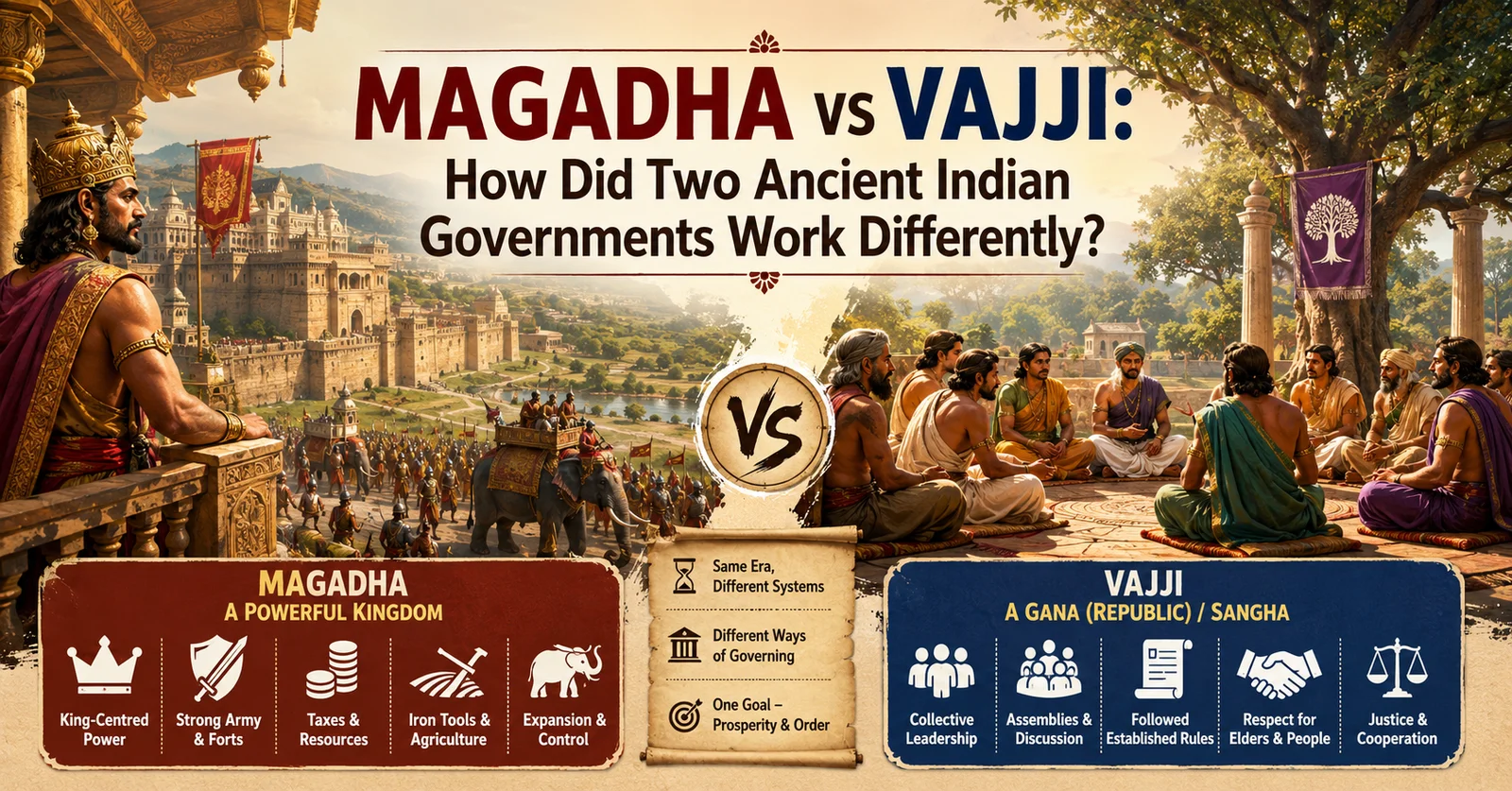
Imagine travelling back around 2,500 years.
You enter a region where powerful kingdoms are growing, armies are becoming larger, taxes are being collected and fortified cities are being built.
But then you reach another area where decisions are taken through assemblies (सभाएँ) and a group of rulers works together.
How could two such different political systems exist in ancient India at roughly the same time?
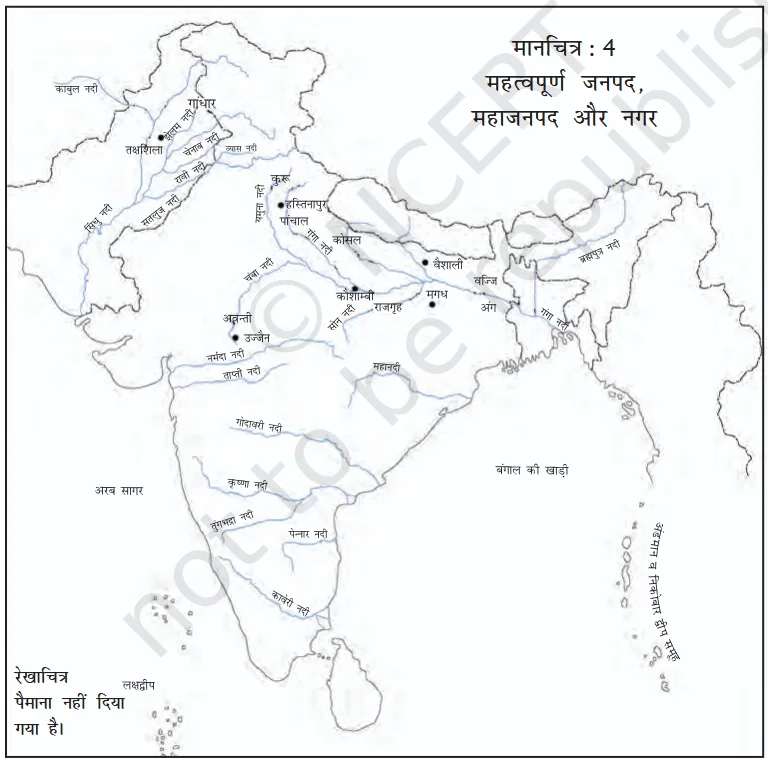
Magadha became one of the most powerful Mahajanapadas (बड़े और शक्तिशाली जनपद), while Vajji was an important Gana or Sangha (गण या संघ).
They were not simply two places on an ancient map. They represented different ways of organising political power.
In this article, we’ll understand Magadha vs Vajji in very simple language and see how their leadership, decision-making and political structures differed.
First, What Were Mahajanapadas?
Before understanding Magadha vs Vajji, we need to understand one important term: Mahajanapada.
Around 2,500 years ago, some Janapadas (जनपद) became more powerful than others.
These larger and more powerful territories were called Mahajanapadas.
The chapter mentions 16 Mahajanapadas.
Some important ones included:
- Magadha
- Vajji
- Kosala
- Avanti
- Vatsa
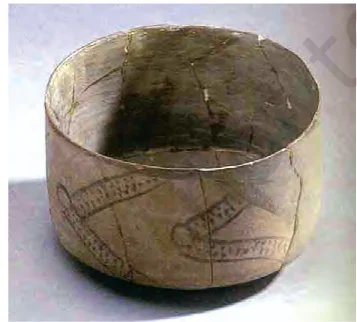
Many Mahajanapadas developed fortified cities.
Fortification (किलेबंदी)
Fortification means protecting a settlement with strong walls.
Why were these walls needed?
They could help protect important settlements from attacks and also demonstrate the power and wealth of the rulers.
This background is essential for understanding Magadha vs Vajji.
Magadha: A Powerful Kingdom
Let’s begin with Magadha.
Magadha was one of the most powerful Mahajanapadas.
It was located in an area corresponding mainly to present-day Bihar and surrounding regions.
Magadha gradually became very powerful because it had several advantages.
1. Fertile Land
Magadha had fertile land (उपजाऊ भूमि).
Fertile land could support agriculture and produce food.
More agricultural production meant more resources were available to support the growing kingdom.
2. Rivers
Magadha was located near important rivers.
Rivers were useful for:
- transportation (आवागमन),
- communication (संचार),
- agriculture,
- and access to water.
This geographical advantage helped Magadha grow.
3. Iron Resources
Iron ore (लौह अयस्क) was available in the region.
Iron could be used to make:
- tools,
- weapons,
- and agricultural equipment.
This was another important advantage.
4. Forests and Elephants
The forests around Magadha provided access to elephants.
Elephants could be captured and trained for use in armies.
This could give a powerful kingdom an important military advantage.
5. Powerful Rulers
Magadha also had ambitious and powerful rulers.
They built strong armies and expanded their influence.
Together, these factors helped Magadha become increasingly powerful.
And this is one of the biggest points to remember about Magadha vs Vajji:
But What Was Vajji?
Now let’s look at Vajji.
Vajji was also a powerful political entity, but its system was different.
Vajji was organised as a Gana or Sangha.
Gana/Sangha (गण/संघ)
A Gana or Sangha was a political system where many rulers or leaders participated in decision-making, rather than one king having complete authority.
The chapter uses Vajji as an important example of this type of system.
Its capital was Vaishali (वैशाली).
This is where the comparison of Magadha vs Vajji becomes especially interesting.
Magadha vs Vajji: The Biggest Difference
The easiest way to understand Magadha vs Vajji is to focus on who held political power.
Magadha
👑 A powerful king and his kingdom
Vajji
👥 A Gana/Sangha involving a group of rulers
In Magadha, the king was the central figure of political authority.
In Vajji, decisions involved assemblies and a group of rulers.
So, instead of remembering a complicated definition, remember:
Magadha = King-centred political power
Vajji = Group-based political decision-making
This is the foundation of Magadha vs Vajji.
Magadha vs Vajji: How Did Decision-Making Differ?
Decision-making is one of the most important differences.
In a kingdom like Magadha, the raja (राजा) was the central ruler.
The king could make important decisions and control the administration and army.
In a Gana/Sangha like Vajji, several rulers participated in assemblies.
They met and discussed important matters.
This means that Magadha vs Vajji was not simply about two different rulers. It was about two different approaches to political organisation.
What Do We Know About the Vajji Assembly?
A Buddhist text gives us information about how the Vajjis conducted themselves.
It says that the Vajjis:
- met frequently in full and well-attended assemblies,
- met and conducted business together,
- followed established rules,
- respected elders,
- protected women from being forcibly taken or detained,
- maintained their religious places,
- and respected wise people.
These details provide clues about how the Vajji political system functioned.
Notice the word “clues.”
Historical sources do not always provide us with every detail.
We have to use the available evidence carefully.
Was Vajji a Modern Democracy?
This is an important question.
You might see the word “republic” (गणराज्य) and immediately think of modern democracy.
But we should be careful.
The Vajji system should not simply be treated as identical to today’s democracy.
The chapter explains that decisions were taken through assemblies involving rulers.
That does not mean every person in society had an equal vote or equal political power.
So, when discussing Magadha vs Vajji, it is more accurate to describe Vajji as an early republic-like Gana/Sangha system, rather than saying it was exactly like a modern democratic government.
This distinction makes the explanation historically more accurate.
Magadha vs Vajji: Kingdom vs Gana/Sangha
Let’s make the comparison easier.
| Feature | Magadha | Vajji |
|---|---|---|
| Political system | Kingdom | Gana/Sangha |
| Main political structure | King-centred | Group of rulers |
| Decision-making | Strong role of the king | Assemblies |
| Capital | Rajagriha initially; later Pataliputra | Vaishali |
| Military power | Strong army | Collective political organisation |
| Chapter connection | Rise of powerful kingdoms | Early republic |
| Important feature | Expansion and resources | Assemblies and rules |
The table makes the basic idea behind Magadha vs Vajji easy to revise.
Why Was Magadha So Powerful?
One of the most important questions in Chapter 6 is:

“Why did Magadha become so powerful?”
The answer isn’t just one thing.
It had a combination of geographical and political advantages.
🌾 Fertile Land
Good agricultural land helped produce food.
🌊 Rivers
Rivers supported transport and agriculture.
⛏️ Iron
Iron ore was available nearby and could be used for tools and weapons.
🐘 Elephants
Elephants from the surrounding forests could be used by the army.
👑 Strong Rulers
Powerful rulers helped expand and strengthen the kingdom.
This combination made Magadha extremely successful.
Therefore, when studying Magadha vs Vajji, don’t only remember “kingdom vs republic.” Also remember that Magadha’s geographical resources played an important role in its rise.
How Did Taxes Help Kings?
Another major development in this period was taxation.
A large kingdom required resources.
Kings needed resources to maintain:
- armies,
- forts,
- officials,
- and other activities.
Farmers could be required to give a part of their produce as tax (कर).
Other people could contribute in different forms.
This allowed rulers to collect resources without producing everything themselves.
So the growth of kingdoms was connected not only to military power but also to agriculture and taxation.
Iron and Agriculture
Agriculture was also changing.
One important development was the use of the iron ploughshare (लोहे का हल का फाल).
Iron was stronger than many earlier materials and could help farmers work the soil more effectively.
Another technique was transplantation (पौधों को एक जगह से दूसरी जगह लगाना).
In rice cultivation, young plants could first be grown separately and later transferred to the fields.
This could increase production, but it required considerable labour.
These agricultural developments helped provide the food resources needed by growing populations and kingdoms.
Magadha vs Vajji: Did Both Have Armies?
Political power in ancient India was closely connected with military strength.
A powerful kingdom such as Magadha could use its army to expand its territory.
The chapter also explains that rulers of large kingdoms tried to conquer Ganas or Sanghas.
This shows that political competition existed between different systems.
The existence of Gana/Sangha did not mean these communities were completely protected from powerful kingdoms.
In fact, some Ganas and Sanghas were eventually conquered.
The Vajji Sangha and Its Rules
The Vajji example is particularly useful because it gives us a glimpse into collective political life.
According to the Buddhist text discussed in the chapter, the Vajjis valued:
Regular Meetings
They met frequently.
Following Established Rules
They respected existing practices and rules.
Respect for Elders
Older and respected members had an important position.
Protection of Women
The text says that women should not be forcibly taken or detained.
Religious Places
They maintained their chaityas (धार्मिक स्थल).
Wise People
They respected wise or spiritually advanced people.
These details make the Vajji system more understandable than simply calling it an “early republic.”
Could Magadha Conquer Vajji?
This is where the story becomes particularly interesting.
The rulers of powerful kingdoms attempted to conquer Ganas and Sanghas.
The chapter describes how Ajatasattu, the ruler of Magadha, wanted to conquer the Vajjis.
But before attacking them, he asked his minister Vassakara to find out whether the Vajjis were strong or weak.
The Buddha’s response focused on the importance of the Vajjis meeting together, following their established traditions and maintaining unity.
The story highlights an important political idea:
A united group can be difficult to defeat.
This is one of the most interesting lessons from Magadha vs Vajji.
Political strength was not only about having weapons. Unity, organisation and cooperation also mattered.
What Happened to the Ganas and Sanghas?
Ganas and Sanghas survived for a long time, but they faced pressure from powerful kingdoms.
Eventually, many were conquered.
According to the chapter, the last of the Ganas and Sanghas were conquered by the Gupta rulers about 1,500 years ago.
This shows that the political history of ancient India was not a simple story where one type of government immediately replaced another.
Different political systems existed alongside one another for long periods.
Magadha vs Vajji: What Can We Learn From This Comparison?
The biggest lesson from Magadha vs Vajji is that ancient Indian political life was diverse.
There was no single political model everywhere.
Some places developed powerful kingdoms.
Others developed Gana/Sangha systems.
Magadha teaches us about:
- powerful kings,
- armies,
- taxation,
- agriculture,
- resources,
- territorial expansion.
Vajji teaches us about:
- assemblies,
- collective decisions,
- established rules,
- cooperation,
- group leadership.
This makes Chapter 6 much more interesting than simply memorising the names of ancient kingdoms.
Important English Words and Their Meanings
| English Word | Hindi Meaning |
|---|---|
| Kingdom | राज्य |
| Raja | राजा |
| Mahajanapada | बड़ा/शक्तिशाली जनपद |
| Gana | गण |
| Sangha | संघ |
| Republic | गणराज्य |
| Assembly | सभा |
| Decision-making | निर्णय लेना |
| Resources | संसाधन |
| Tax | कर |
| Fortification | किलेबंदी |
| Fertile | उपजाऊ |
| Agriculture | कृषि |
| Ploughshare | हल का फाल |
| Transplantation | पौधों को दूसरी जगह लगाना |
| Conquer | जीतकर अपने अधीन करना |
| Elder | बुजुर्ग/वरिष्ठ |
| Established rules | पहले से बने नियम |
| Collective | सामूहिक |
| Administration | प्रशासन |
Magadha vs Vajji: Quick Revision
अगर exam से पहले सिर्फ 1 minute है, तो ये points याद कर लो:
- Magadha एक शक्तिशाली Mahajanapada था।
- Magadha एक kingdom के रूप में विकसित हुआ।
- Vajji एक important Gana/Sangha था।
- Vajji की राजधानी Vaishali थी।
- Magadha में राजा political power का मुख्य केन्द्र था।
- Vajji में कई rulers assemblies में भाग लेते थे।
- Magadha की शक्ति में fertile land, rivers, iron, elephants और powerful rulers का योगदान था।
- Kings resources जुटाने के लिए taxes लेते थे।
- Iron ploughshare और transplantation ने agriculture को प्रभावित किया।
- Ganas/Sanghas को बाद में powerful kingdoms ने धीरे-धीरे conquer किया।
Final Takeaway
Magadha vs Vajji हमें ancient India की political diversity (राजनीतिक विविधता) समझने में मदद करता है।
Magadha एक शक्तिशाली kingdom के रूप में उभरा, जहाँ राजा political authority का मुख्य केन्द्र था। उसकी शक्ति को fertile land, rivers, iron resources, elephants, taxation और strong rulers जैसे factors ने बढ़ाया।
दूसरी ओर, Vajji एक Gana/Sangha था, जहाँ कई rulers assemblies में मिलकर decisions लेते थे और established rules का पालन करते थे.
इसलिए Magadha vs Vajji को केवल “kingdom vs republic” के रूप में याद करना पर्याप्त नहीं है।
इसे ऐसे याद करो:
Magadha = Strong king + resources + army + expansion
Vajji = Group of rulers + assemblies + rules + cooperation
और यही Chapter 6 का सबसे important idea है: प्राचीन भारत में सत्ता और शासन चलाने के एक से अधिक तरीके मौजूद थे।

My name is Ankit Yadav, and I am a passionate digital journalist and content creator. I write about technology, entertainment, sports, and current affairs with the aim of delivering unique, accurate, and engaging information to my readers.
I believe news should not only inform but also provide clear insights and fresh perspectives. That’s why I focus on making my articles easy to read, reliable, and meaningful.
📌 I specialize in Tech Trends, Latest News, Cybersecurity, Digital Media, Sports, and Entertainment.
📌 My mission is to share fast, authentic, and valuable updates with every article I publish.


1 thought on “Magadha vs Vajji: How Did Two Ancient Indian Governments Work Differently?”