
If you’ve spent any time with NCERT Class 6 History or you’re prepping for UPSC, you’ve probably run into this chapter and felt a little lost about how two completely different things — old poems and old graves — end up telling the same story. I get that confusion a lot, and honestly, it took me a few re-reads myself before it clicked. So let’s slow down and actually walk through it together, the way I’d explain it to a student sitting across the table from me, not the way a textbook dumps it on you in one paragraph.
I’ve been writing about history, exam prep, and research topics for over a decade now, and if there’s one thing I’ve learned, it’s this: the topic of books and burials isn’t just a chapter to memorize — it’s actually a lesson in how historians think. Once you understand that, half your UPSC prelims confusion around ancient India disappears on its own.
Why Books and Burials Matter for Understanding Ancient India
Here’s a question worth sitting with for a second: if archaeologists dug up your neighbourhood 3,500 years from now, what would they find? Probably your old phone, some clothing, maybe the foundation of your house, and — if you’re buried rather than cremated — your grave itself, along with whatever was placed in it.
That’s exactly the logic behind books and burials as historical evidence. Historians don’t get a video recording of the past. They get fragments — a hymn preserved by memory for generations, or a skeleton surrounded by pots and ornaments. Piecing together ancient Indian life from books and burials is detective work, not simple reading comprehension, and that’s the mindset this chapter wants you to build.
The Rigveda: India’s Oldest Book and a Window into Early Society

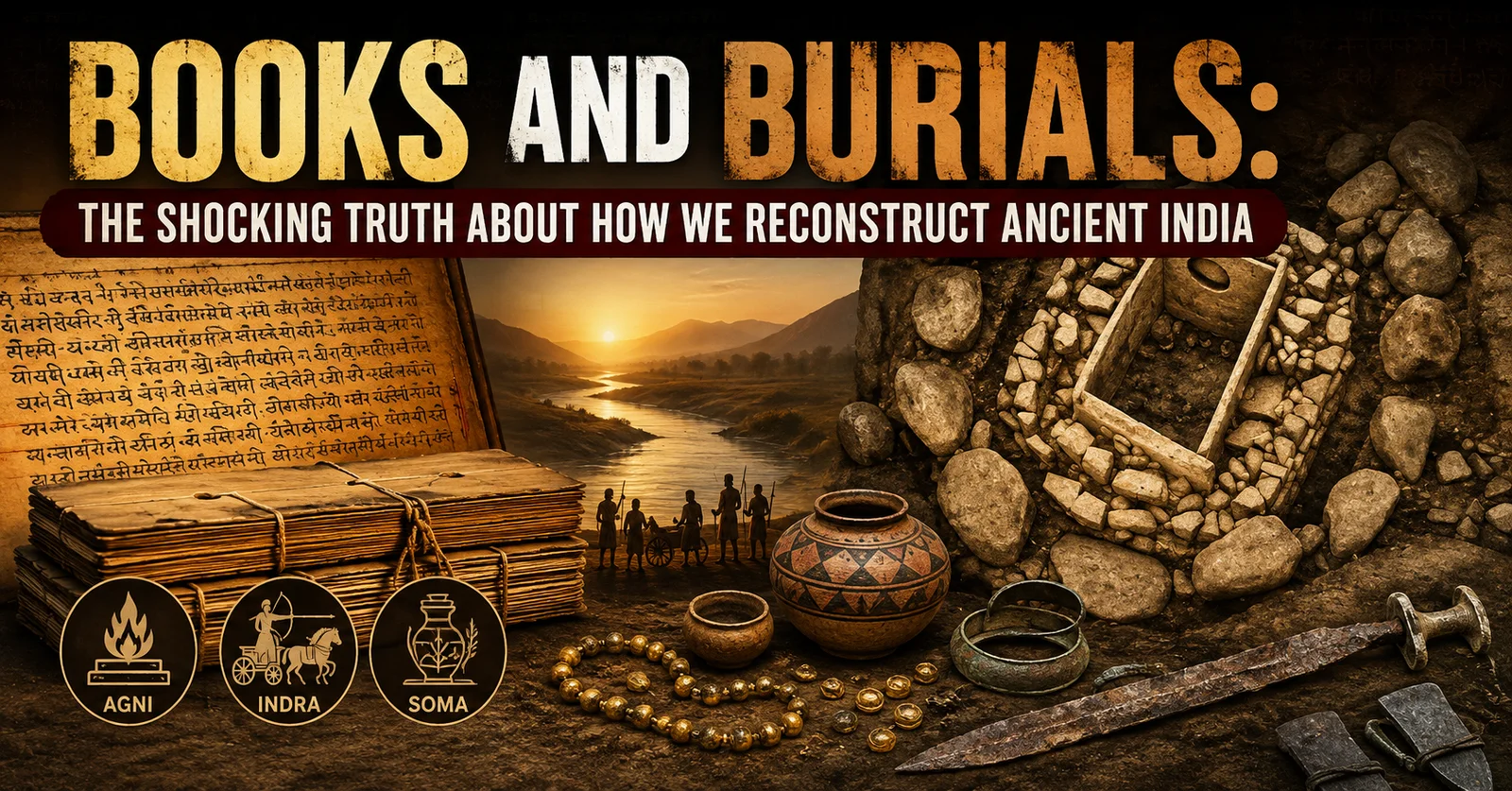
Let’s start with the “books” half of books and burials. The Rigveda is the oldest of the four Vedas — Rigveda, Samaveda, Yajurveda, and Atharvaveda — and it was composed roughly 3,500 years ago. It contains more than a thousand hymns, and these weren’t casually jotted down. There was no printing press, no paper as we know it today, so sages composed these hymns and priests trained students to memorise every syllable, word, and sentence with extraordinary precision, passing them down orally for centuries before they were ever written.
That single fact already tells you something a burial never could: it tells you what people believed and valued enough to preserve word-for-word for a thousand years.
The Gods of the Rigveda: Agni, Indra, and Soma
Three deities dominate the hymns:
- Agni — the god of fire, central to rituals and sacrifice.
- Indra — a warrior god, associated with strength and battle.
- Soma — a plant used to prepare a special ritual drink, and also worshipped as a deity.
The prominence of these three tells historians that fire rituals, warfare, and specific plant-based traditions were deeply woven into early society — again, a kind of clue you simply cannot get from a grave.
What the Rigveda Reveals About Rivers, Horses, and Chariots
One of my favourite parts of this chapter is the hymn where the sage Vishvamitra speaks directly to rivers, asking them to let chariots and wagons cross safely. It sounds almost poetic out of context, but for historians studying books and burials together, it’s gold. It tells us horses, cows, chariots, and rivers — especially the Indus and its tributaries — held real economic and cultural importance for the people composing these verses.
Rajas, Jana, and Early Political Life
The Rigveda also mentions rajas, but don’t picture a grand emperor sitting on a throne. A raja back then was usually the leader of a jana — a smaller community or tribe — and importantly, kingship wasn’t automatically hereditary. A son didn’t always inherit his father’s position simply by birth. That detail alone is a favourite trick question in competitive exams, so don’t skip past it.
Aryas and Dasas: A Society With Divisions
Some hymns describe the people composing them as “Aryas,” while their rivals were called “Dasas” or “Dasyus” — groups who may have spoken a different language or followed different religious practices. Over time, the word “dasa” came to mean slave. It’s a reminder that even our oldest book doesn’t give us a neutral, complete picture — it reflects the viewpoint of the people who composed and preserved it, which is a crucial limitation to remember when you’re relying on books and burials as your only sources.
Megaliths: What Burials Tell Us That Books Cannot

Now flip to the second half of the story. While the Rigveda was being memorised in one part of the subcontinent, very different communities — in the Deccan, South India, the north-east, and Kashmir — were burying their dead beneath massive stones called megaliths, a practice that began roughly 3,000 years ago.
This is where books and burials genuinely complement each other. The Rigveda tells you almost nothing about the Deccan or the far south during this period. Megaliths fill that gap.
How Megalithic Burials Were Built
Building one wasn’t a weekend project. People had to:
- Find a suitable stone
- Shape and break large boulders
- Transport the stones, often over real distance
- Dig a pit in the ground
- Position the stones correctly
- Finally bury the dead
That sequence alone tells historians something books can’t: it shows planning, cooperation, and organised labour within these communities — evidence of social coordination that predates written records in that region.
What Archaeologists Found Inside the Graves
Digging into megalithic sites, archaeologists have recovered Black and Red Ware pottery, iron tools, weapons, horse skeletons, ornaments, and gold objects. Each item is a clue, and when you study books and burials side by side, you start noticing how differently each source “speaks.”


Social Status Hidden in the Grave
Here’s the part that always grabs students’ attention. At Brahmagiri, one skeleton was found with 33 gold beads, 2 stone beads, 4 copper bangles, and a conch shell — while neighbouring skeletons had only a few plain pots. That contrast is exactly how historians infer inequality: some individuals were likely chiefs or wealthy figures, while others were followers with far fewer resources. No hymn tells you this directly; only the burial does.
Family Burials and Port-Holes
Some megaliths contain more than one skeleton, suggesting family members were buried at the same site over time. Certain burials even had port-holes — small openings possibly used to add later burials — while the stone circle above may have functioned as a signpost, helping families relocate the site years afterward.
Inamgaon: A Case Study Worth Remembering
Inamgaon, near the Ghod River, was occupied from roughly 3,600 to 2,700 years ago. Adults there were typically buried lying straight, head pointing north, sometimes right inside the house itself, with vessels of food and water placed alongside them. It’s a small but vivid detail that brings the whole chapter to life — and it’s a favourite for short-answer questions.
Why We Need Both: The Real Lesson Behind Books and Burials
This is the part I really want you to internalise, because it’s the actual exam-worthy insight, not just trivia. Books and burials each tell only part of the story, and neither is complete on its own.
- Books like the Rigveda reveal beliefs, language, values, and political ideas — but only from the perspective of those who composed and preserved them, mainly priests and elites.
- Burials reveal material life, social hierarchy, and regional diversity — but they can’t tell you what people believed or what language they spoke.
Put books and burials together, and you get a far richer, more balanced reconstruction of ancient Indian life than either source could offer alone. That’s the entire point of this chapter, and it’s a principle that shows up again and again across Indian history — you’ll see the same logic applied when you study the Harappan civilisation or early Buddhist sources later in your UPSC journey.
Quick Revision: Key Facts on Books and Burials
- Rigveda: oldest Veda, composed ~3,500 years ago, over 1,000 hymns
- Key gods: Agni (fire), Indra (war), Soma (ritual plant/drink)
- Language: Vedic Sanskrit, different from classical Sanskrit
- Rajas led a jana; kingship wasn’t strictly hereditary
- Aryas vs. Dasas/Dasyus reflected linguistic and cultural divisions
- Megaliths: large stones marking burial sites, practice began ~3,000 years ago
- Found across the Deccan, South India, north-east, and Kashmir
- Grave goods (gold, iron tools, Black and Red Ware) reveal social status
- Inamgaon: burials aligned north, sometimes inside homes
Final Thoughts on Books and Burials for UPSC Aspirants
If you remember one thing from this entire chapter, let it be this: books and burials are two different lenses pointed at the same past, and historians only get the full picture when they use both together. I’ve seen this exact concept tested in disguised forms across prelims papers — a question about Rigvedic society, or one about megalithic culture — and students who understood books and burials as complementary sources, rather than isolated facts, were the ones who could actually reason through unfamiliar options instead of just recalling memorised lines.
Study this chapter as a story of two very different communities being reconstructed through two very different kinds of evidence, and it’ll stick with you a lot longer than a list of dates ever could.

My name is Ankit Yadav, and I am a passionate digital journalist and content creator. I write about technology, entertainment, sports, and current affairs with the aim of delivering unique, accurate, and engaging information to my readers.
I believe news should not only inform but also provide clear insights and fresh perspectives. That’s why I focus on making my articles easy to read, reliable, and meaningful.
📌 I specialize in Tech Trends, Latest News, Cybersecurity, Digital Media, Sports, and Entertainment.
📌 My mission is to share fast, authentic, and valuable updates with every article I publish.


1 thought on “Books and Burials: The Shocking Truth About How We Reconstruct Ancient India”