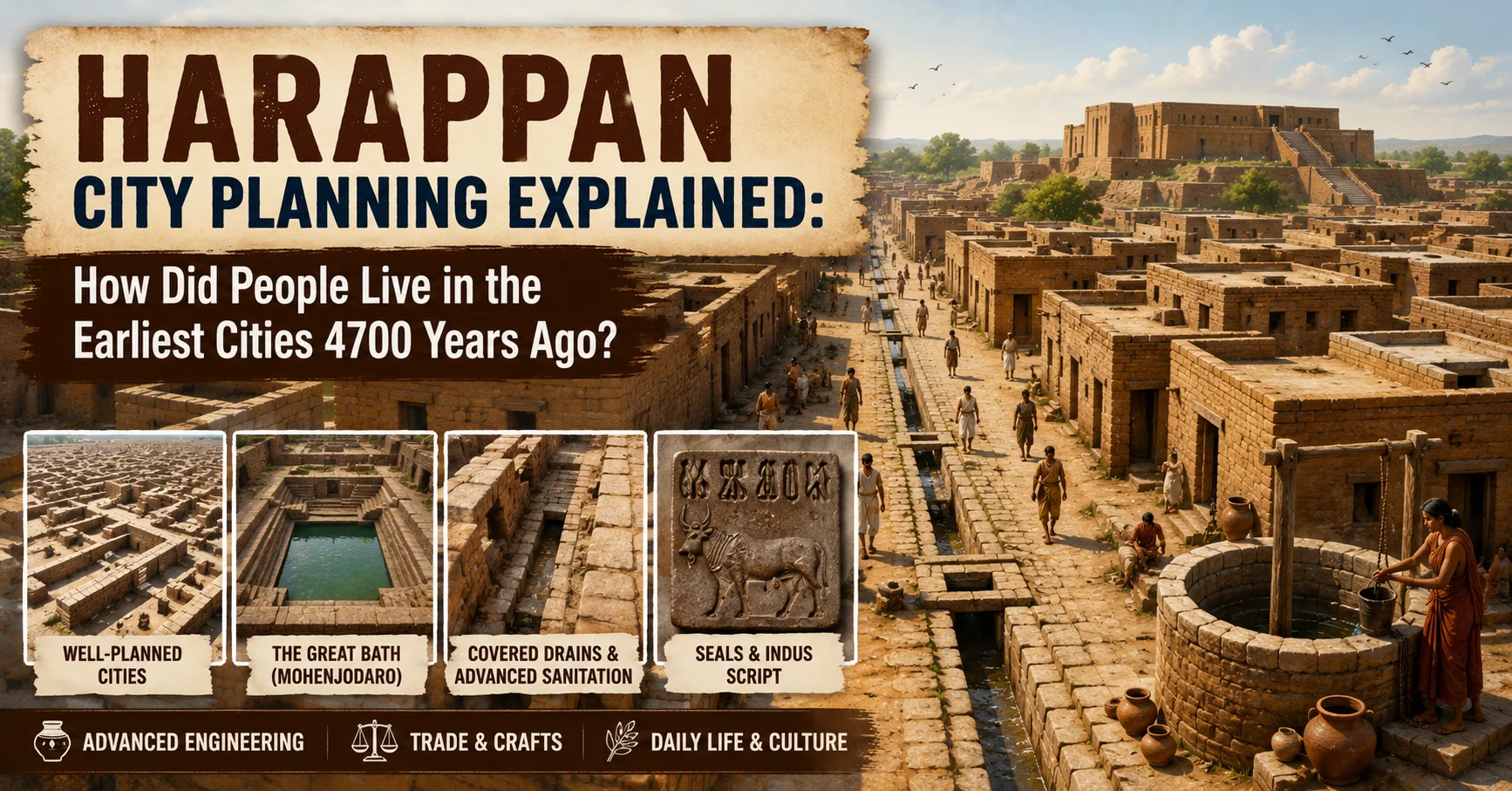
What would happen if you could walk into a city that existed about 4,700 years ago?
You would not see cars, tall modern buildings or electric lights. But you might notice something surprisingly familiar: planned streets, houses, bathing areas, wells, covered drains, workshops and special public buildings.
This is where the story of the Harappan Civilization becomes fascinating.
The earliest cities described in this chapter were not simply collections of houses. Archaeological evidence shows carefully organised settlements where different people performed different jobs, raw materials travelled long distances, craftspeople produced specialised goods and systems were created to manage water and waste.
But there is an important point to remember: historians do not know everything about these people. Much of what we know about the Harappan Civilization comes from archaeological evidence such as buildings, pottery, seals, tools, beads, bones and other remains.
So, instead of simply memorising facts, let’s understand how a Harappan city was planned and how people may have lived in it.
What Was the Harappan Civilization?
The Harappan Civilization refers to a group of ancient cities and settlements found across parts of present-day Pakistan and India.
Harappa was one of the first sites where archaeologists recognised the remains of these ancient cities. Because of this, similar sites are commonly described as Harappan.
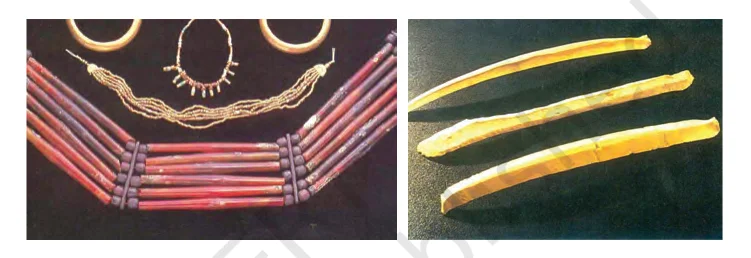
These cities were located across areas including Punjab and Sindh in present-day Pakistan and Gujarat, Rajasthan, Haryana and Punjab in India. Archaeologists have found a common collection of objects at many of these sites, including red pottery with black designs, stone weights, seals, special beads, copper tools and long stone blades.
The chapter’s timeline is particularly useful:
- Beginning of cities: about 4,700 years ago
- Beginning of the end of these cities: about 3,900 years ago
- Other cities began to appear around 2,500 years ago.
This gives us a broad picture of when these early urban settlements developed.
How Were Harappan Cities Planned?
One of the most interesting features of the Harappan Civilization was its city planning.
Numerous cities were split into two or more sections.
The western part was generally smaller but higher. Archaeologists call this area the citadel (ऊँचा और सुरक्षित भाग).
The eastern part was generally larger but lower and is known as the lower town (निचला नगर).
In many cities, walls made of baked bricks surrounded these sections. The bricks were carefully baked and placed in an interlocking pattern (एक-दूसरे में मजबूती से जुड़ने वाला तरीका), which made the walls strong.
This does not mean that every Harappan settlement looked exactly the same. Dholavira, for example, had a different layout. But the evidence clearly shows that city organisation was an important part of Harappan settlements.
Important Words
Citadel = ऊँचा सुरक्षित भाग
Lower Town = निचला नगर
Interlocking = आपस में मजबूती से जुड़ा हुआ
Baked brick = पकी हुई ईंट

The Great Bath: A Special Structure at Mohenjodaro
One of the most famous structures associated with the Harappan Civilization is the Great Bath at Mohenjodaro.
It was a large tank constructed in the citadel area.
The tank was carefully built using bricks, plaster and a layer of natural tar to make it water-tight (पानी को बाहर निकलने से रोकने वाला). There were steps leading down into the tank from two sides, and rooms were located around it.
Water was probably brought from a well and drained out after use. The textbook suggests that perhaps important people used the tank on special occasions. Notice the word “perhaps” here. We do not have enough evidence to state its exact purpose as a proven fact.
This is an excellent example of how historians should treat evidence: what we know and what we infer are not always the same thing.

Harappan Houses, Streets and Drains
If you want to understand everyday Harappan Civilization, look closely at the houses and drainage system.
Generally, houses were one or two storeys high. Rooms were often built around a courtyard (आँगन). Most houses had a separate bathing area, and some had wells that supplied water.
But the drainage system is perhaps even more impressive.
Many cities had covered drains laid out in straight lines. Each drain had a gentle slope, allowing water to flow through it.
House drains were often connected to street drains, while smaller drains led into larger ones. Because the drains were covered, inspection holes (जाँच और सफाई के लिए छेद) were provided at intervals.
The textbook makes an important observation: houses, drains and streets were probably planned and built at the same time.
That tells us something important about the Harappan Civilization.
The city was not simply built house by house without planning. Different parts of the settlement appear to have been considered together.


Why Was the Drainage System Important?
Imagine living in a city without proper drainage.
Wastewater could collect near houses. Streets could become dirty and unhealthy. During heavy rain, water could create additional problems.
The Harappan system appears to have addressed some of these challenges through connected drains and planned slopes.
This is why Harappan city planning is such an important part of understanding these ancient settlements.
Key Terms
Drainage = पानी और गंदे पानी को बाहर निकालने की व्यवस्था
Wastewater = इस्तेमाल किया हुआ गंदा पानी
Slope = ढलान
Inspection hole = जाँच/सफाई के लिए बनाया गया छेद
Who Lived in a Harappan City?
A city requires a wide variety of jobs.
The Harappan Civilization had people involved in different activities.
The chapter mentions:
- probable rulers,
- scribes,
- craftspeople,
- people travelling to distant lands,
- people bringing raw materials,
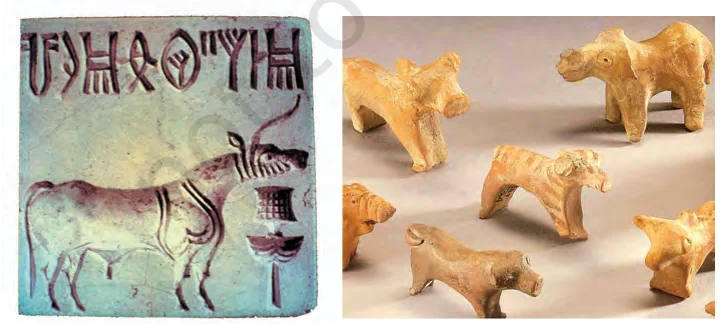
- and children who probably played with terracotta toys.
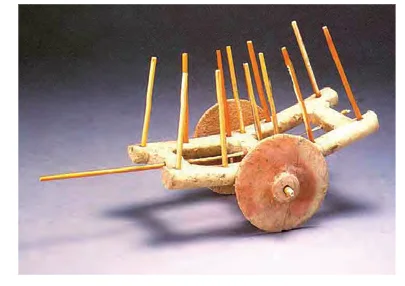
The people who planned the construction of special buildings were probably rulers. Scribes were people who knew how to write and may have helped prepare seals.
Craftspeople made objects either in their homes or in special workshops.
This tells us that city life involved specialisation (अलग-अलग काम में विशेषज्ञता).
Not everyone had to make everything.
What Did Harappan Craftspeople Make?
The Harappan Civilization was also known for its crafts.
Archaeologists have found objects made from:
- stone,
- shell,
- copper,
- bronze,
- gold,
- silver.
Copper and bronze were used for tools, weapons, ornaments and vessels. Gold and silver were used for ornaments and vessels.
Some particularly interesting discoveries include:
Beads
Many beads were made from carnelian (एक सुंदर लाल पत्थर).
The stone was cut, shaped and polished. Then a hole was carefully made through its centre so that a string could pass through it.
Stone Weights
Stone weights were carefully and precisely shaped and may have been used to weigh precious stones or metals.
Seals
Harappans also made seals from stone. These were generally rectangular and often had an animal carved on them.
These objects show the skill of craftspeople living in these cities.
What Is a Specialist?
The word specialist (किसी खास काम में प्रशिक्षित व्यक्ति) is important in this chapter.
A specialist is someone trained to perform a particular kind of work.
For example, a person might specialise in:
- cutting stone,
- polishing beads,
- carving seals.
The careful carving found on some objects suggests that highly skilled craftspeople were involved.
The textbook also makes an important point: we do not know whether only men or only women were specialists. It is possible that both men and women performed specialised work.
This is a good reminder that we should avoid making assumptions when archaeological evidence does not provide a clear answer.
Where Did Harappans Get Their Raw Materials?
A large city requires resources.
The Harappan Civilization used many raw materials that were available locally, but some important materials had to be brought from distant places.
Raw Material = कच्चा माल
A raw material is something used to make a finished product.
For example, cotton produced by farmers could be processed to make cloth.
Harappans needed materials such as:
- copper,
- tin,
- gold,
- silver,
- precious stones.
The textbook suggests that copper may have come from present-day Rajasthan and Oman, while other materials came from different distant regions.
This means Harappan cities were connected to areas far beyond their immediate surroundings.
Trade and the Movement of Goods
The movement of raw materials also tells us about trade.
People travelled to distant lands and returned with materials. Goods were produced in cities and probably moved between different regions.
Lothal is an interesting example.
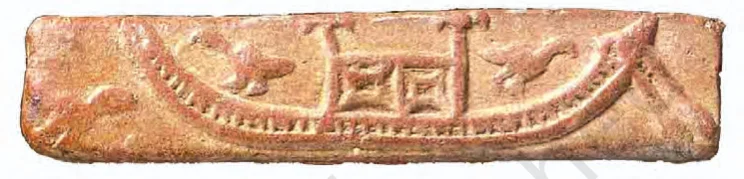
It stood near a tributary of the Sabarmati in Gujarat, close to the Gulf of Khambat. It became an important centre for making objects from stone, shell and metal.
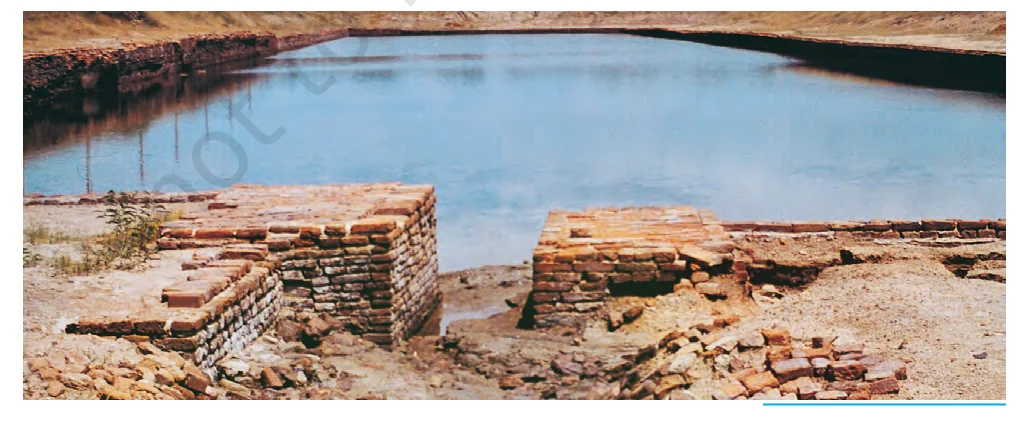
A storehouse was found there containing many seals and sealings (मिट्टी पर लगी मुहर की छाप). A huge tank at Lothal may have been a dockyard where boats and ships came through the river channel and goods were probably loaded and unloaded.
Dholavira: A Different Kind of Harappan City
Not every city in the Harappan Civilization followed exactly the same layout.
Dholavira was situated in the Rann of Kutch on Khadir Beyt.
Unlike some other Harappan cities that were divided into two parts, Dholavira was divided into three parts.
Massive stone walls encircled each area, with gates serving as entrances.
There was also a large open area where public ceremonies may have been held.
Another unusual discovery was large Harappan script signs carved from white stone. This is particularly interesting because Harappan writing has generally been found on much smaller objects such as seals.
Dholavira shows us that Harappan city planning was not identical everywhere.
The Mystery of Harappan Writing
The Harappan Civilization had a form of writing.
Signs have been found on seals and other objects.
But there is a major mystery.
We still do not know exactly what the signs mean.
Scholars have tried to read the script, but it has not yet been fully understood.
This creates an important limitation for historians.
We can learn a great deal from buildings, pottery, tools, beads, seals and other archaeological remains, but we cannot simply read long Harappan texts and ask them what happened.
That is why archaeology is so important for studying this civilisation.
Script = लिपि
Archaeologist = पुरातत्वविद्
Evidence = प्रमाण / सबूत
Decipher = किसी अज्ञात लिपि का अर्थ समझना
How Do We Know About Harappan Life?
This is perhaps the most important question for understanding history.
How can we know what people did thousands of years ago?
Archaeologists study the objects and structures people left behind.
For the Harappan Civilization, evidence includes:
- houses,
- streets,
- drains,
- wells,
- pottery,
- seals,
- beads,
- tools,
- weights,
- bones,
- food remains,
- toys,
- workshops,
- buildings.
For example, terracotta toys suggest that children probably played with toys. Beads show skilled craft production. Drains provide evidence about city planning and water management. Seals provide evidence of writing and possibly trade-related activities.
In other words, historians act a little like detectives: they examine surviving evidence and use it carefully to reconstruct the past.
But good historical research also accepts uncertainty.
What Did Harappans Eat?
The cities needed a regular food supply.
Farmers and herders living in surrounding areas helped supply food to the cities.
The textbook lists crops including:
- wheat,
- barley,
- pulses,
- peas,
- rice,
- sesame,
- linseed,
- mustard.
Harappans also reared animals such as cattle, sheep, goats and buffalo. They ate fish and hunted wild animals such as antelope.
So the Harappan Civilization depended on a wider network of farmers, herders, craftspeople and traders.
Why Did Harappan Cities Begin to Decline?
Around 3,900 years ago, the beginning of the end of these cities can be seen.
People began leaving some settlements, and many of the features associated with these cities changed.
At this point, we should be careful.
There is no single confirmed explanation that can be used for the decline of every Harappan city.
The chapter presents the end as a complex historical question rather than a simple one-cause story.
This is another reason the Harappan Civilization remains an important subject for historians and archaeologists.
Harappan City Planning: What Makes It So Special?
When we put all the evidence together, the achievement of the Harappan Civilization becomes easier to understand.
These cities had:
- planned streets,
- organised houses,
- bathing areas,
- wells,
- covered drains,
- special buildings,
- skilled craftspeople,
- long-distance raw-material networks,
- seals,
- writing,
- specialised production.
The most important lesson is not that Harappans were simply “advanced.”
It is that they developed organised ways of solving the problems of urban life.
They needed water, food, housing, drainage, materials, trade and skilled workers—and archaeological evidence shows different systems that helped support city life.
Harappan Civilization: Quick Revision
Remember these points before your exam:
- The earliest cities began about 4,700 years ago.
- Many cities had a citadel and a lower town.
- Houses were often one or two storeys high.
- Many houses had courtyards and bathing areas.
- Harappan cities had carefully planned covered drains.
- The Great Bath was found at Mohenjodaro.
- Craftspeople made beads, seals, tools, ornaments and vessels.
- Many raw materials came from distant regions.
- Dholavira had three parts.
- Lothal was an important centre for craft production and may have had a dockyard.
- Harappan writing has not yet been completely deciphered.
- The beginning of the decline of these cities dates to about 3,900 years ago.
Important English Words & Their Hindi Meanings
| English Word | Hindi Meaning |
|---|---|
| Civilization | सभ्यता |
| Archaeologist | पुरातत्वविद् |
| Citadel | ऊँचा सुरक्षित भाग |
| Settlement | बस्ती |
| Courtyard | आँगन |
| Drainage | जल निकासी व्यवस्था |
| Inspection | जाँच |
| Specialist | विशेषज्ञ |
| Raw Material | कच्चा माल |
| Precious | कीमती |
| Carnelian | लाल रंग का सुंदर पत्थर |
| Seal | मुहर |
| Sealing | मुहर की छाप |
| Script | लिपि |
| Decipher | लिपि का अर्थ समझना |
| Storehouse | सामान रखने की जगह |
| Dockyard | नाव/जहाजों के रुकने की जगह |
| Workshop | कार्यशाला |
| Evidence | प्रमाण / सबूत |
| Decline | पतन / गिरावट |
Final Takeaway
The Harappan Civilization was not simply a collection of ancient ruins. It was a network of cities and settlements where people planned buildings, managed water, produced specialised goods, exchanged raw materials and depended on farmers and herders for food.
The most remarkable feature is the level of organisation visible in the archaeological evidence. Houses, streets and drains were probably planned together; craftspeople produced carefully made objects; distant regions supplied important raw materials; and cities such as Dholavira and Lothal developed their own distinctive features.
At the same time, historians still have unanswered questions. The Harappan script has not been fully deciphered, and the exact reasons behind the decline of the cities remain uncertain.
That combination of strong archaeological evidence and unanswered questions is what makes the Harappan Civilization so fascinating to study.
Sources & References
Primary source: NCERT, Our Pasts–I, Chapter 3 — “In the Earliest Cities”, especially the sections on city planning, houses and drains, life in the city, crafts, raw materials, Dholavira, Lothal and the decline of the cities.
Important source note: Where the textbook uses words such as “probably,” “perhaps,” or “may have been,” this article preserves that uncertainty rather than presenting an interpretation as a confirmed historical fact. This is especially important for the Great Bath, Lothal’s dockyard and the role of rulers.

My name is Ankit Yadav, and I am a passionate digital journalist and content creator. I write about technology, entertainment, sports, and current affairs with the aim of delivering unique, accurate, and engaging information to my readers.
I believe news should not only inform but also provide clear insights and fresh perspectives. That’s why I focus on making my articles easy to read, reliable, and meaningful.
📌 I specialize in Tech Trends, Latest News, Cybersecurity, Digital Media, Sports, and Entertainment.
📌 My mission is to share fast, authentic, and valuable updates with every article I publish.