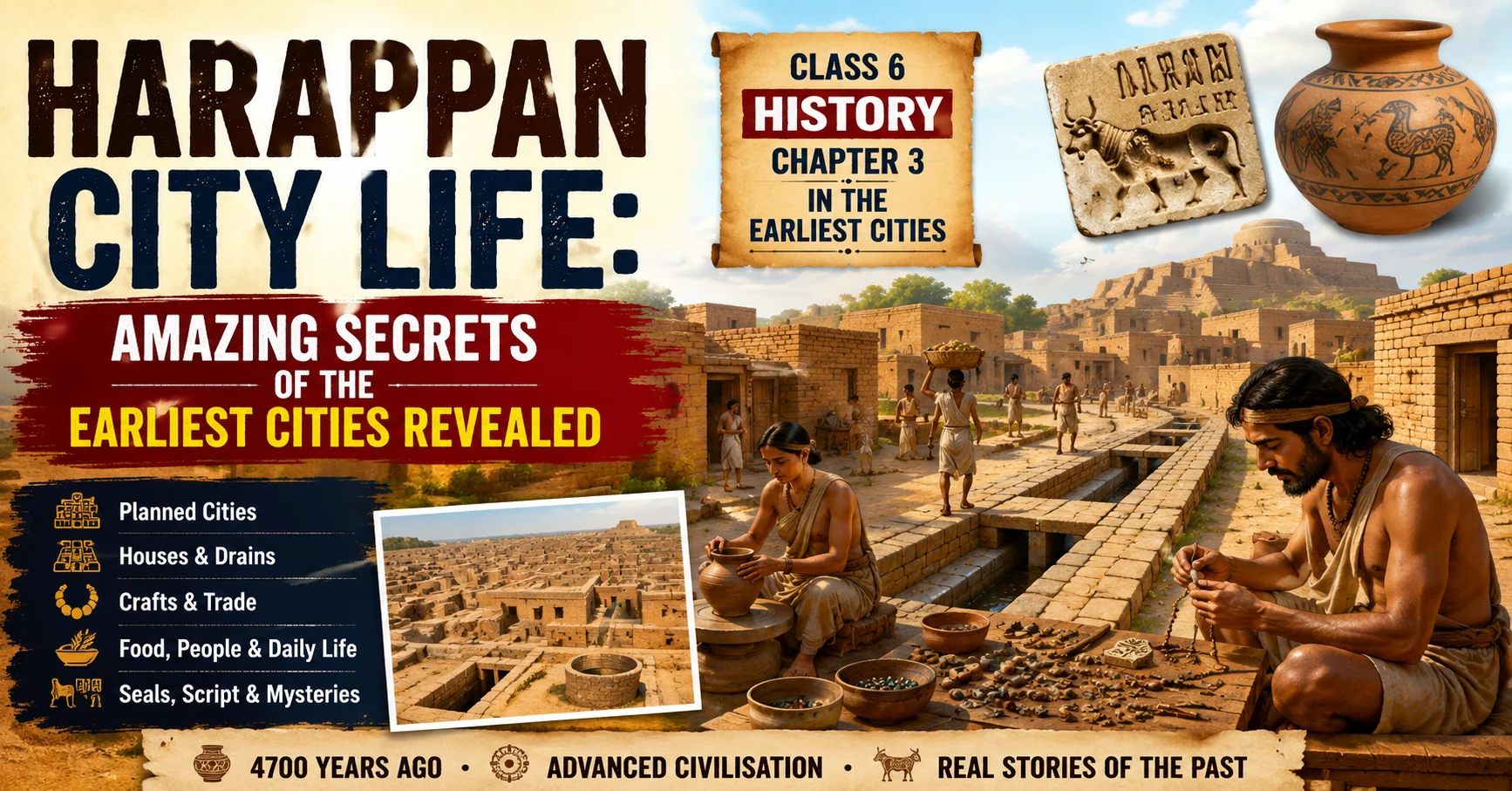
Imagine waking up around 4,700 years ago in a city where the roads are carefully planned, houses are built around courtyards, drains run beneath the streets, craftsmen are busy making beads and tools, and traders are bringing raw materials from distant places.
This was not a modern city. There were no cars, electricity, mobile phones or skyscrapers. Yet the organisation of these ancient settlements can still surprise us.
This is the fascinating world of Harappan city life.
The Harappan cities were among the earliest cities of the Indian subcontinent. Archaeologists have found evidence of carefully planned buildings, baked-brick walls, covered drains, wells, workshops, seals, pottery, beads, tools and other objects. These discoveries allow historians to reconstruct parts of Harappan city life, even though many questions about these people remain unanswered.
So instead of memorising a list of facts, let’s take a journey through a typical Harappan city and understand how the city actually worked.
What Was Harappan City Life Like?
The term Harappan is used because Harappa was the first site of this kind to be recognised by archaeologists. Similar cities and settlements were later discovered in several parts of the subcontinent.
These cities developed about 4,700 years ago.
A typical Harappan settlement could have different sections, houses, streets, drains, wells, workshops and special buildings. People had different occupations and depended on one another.
Farmers and herders supplied food. Craftspeople produced useful and decorative objects. Scribes knew how to write. Rulers may have organised construction and obtained materials from distant areas.
This means Harappan city life was not simply about people living together. It involved a network of workers, resources, food, buildings and transportation.
How Was a Harappan City Planned?
One of the most interesting features of Harappan city life was careful planning.
Many Harappan cities were divided into two or more parts.
The Citadel
The western part was generally smaller but higher. Archaeologists call this area the citadel.
Citadel = a high and fortified part of a city
Walls of baked bricks were often built around these sections.
The Lower Town
The eastern part was generally larger but lower. We refer to this as the lower town.
So, when imagining Harappan city life, don’t picture a randomly developed settlement. The available archaeological evidence suggests that many cities were deliberately planned and constructed.
The bricks themselves were also carefully made. They were baked well and arranged in an interlocking pattern, making walls strong and durable.
The Great Bath: A Special Building
One of the most famous structures connected with Harappan city life is the Great Bath at Mohenjo-daro.
The Great Bath was a large tank built in the citadel area.
It had:
- brick lining,
- plaster,
- a waterproof layer,
- steps leading into the tank,
- rooms around it.
Water was probably brought in from a well and drained out after use.
But here is an important historical detail: we cannot say with certainty exactly why the Great Bath was used. The textbook suggests that important people may have taken a dip there on special occasions.
This is a good example of how historians work. They distinguish between what archaeological evidence shows and what researchers infer from that evidence.
A Morning in a Harappan House
Now let’s move from public buildings into an ordinary home.
Many houses were one or two storeys high. Rooms were often arranged around a courtyard.
Courtyard = आँगन
Many houses had a separate bathing area, and some had wells for obtaining water.
This tells us something important about Harappan city life: water management was not an afterthought.
People needed water for daily activities, and the city had structures to manage it.
But the really impressive part was what happened to wastewater.

The Harappan Drainage System
The Harappan drainage system is one of the best-known features of these cities.
Many drains were covered and laid out in straight lines. They had a gentle slope so that water could flow through them.
Drains from houses could connect with drains along the streets. Smaller drains joined larger ones.
There were also inspection holes at intervals so that the drains could be cleaned.
In other words, Harappan city life included an organised approach to wastewater management.
Important English Words
Drainage = जल निकासी व्यवस्था
Wastewater = गंदा/इस्तेमाल किया हुआ पानी
Inspection = जाँच
Slope = ढलान
Covered drain = ढकी हुई नाली
The textbook also suggests that houses, streets and drains were probably planned and built together.
That is a remarkable example of urban planning for such an ancient period.
Who Worked in a Harappan City?
A city cannot function without people performing different jobs.
This is particularly clear when we examine Harappan city life.
There were likely:
Rulers
The people who planned the construction of special buildings may have been rulers.
The evidence does not give us a complete picture of how Harappan rulers governed, so it is better to say “probably rulers” rather than presenting every interpretation as a proven fact.
Scribes
Scribes were people who knew how to write.
They may have helped prepare seals and perhaps wrote on other materials that have not survived.
Craftspeople
Men and women made many different objects, either in their homes or in specialised workshops.
Farmers and Herders
People living in the countryside produced food and reared animals that supported the cities.
This shows that Harappan city life depended heavily on the surrounding countryside.
What Did Harappan Craftspeople Make?
Craft production was an important part of Harappan city life.
Archaeologists have found objects made from:
- stone,
- shell,
- copper,
- bronze,
- gold,
- silver,
- terracotta,
- faience.
Craftspeople made tools, weapons, ornaments, vessels, beads and seals.
Some crafts required considerable skill.
For example, beads made from carnelian, a beautiful red stone, were cut, shaped, polished and drilled through the centre so that they could be strung.
A person who specialised in one type of work could be called a specialist.

Specialist = किसी विशेष काम में प्रशिक्षित व्यक्ति
A specialist might cut stone, polish beads or carve seals.
This tells us that Harappan city life included specialised occupations rather than everyone producing everything they needed.
Where Did Harappans Get Their Raw Materials?
Here’s where the story becomes even more interesting.
A city needs resources.
But many important raw materials were not available locally.
Raw Material = कच्चा माल
For example:
- copper,
- tin,
- gold,
- silver,
- precious stones
had to be obtained from distant places.
The textbook suggests that copper may have come from present-day Rajasthan and Oman, tin from areas corresponding to Afghanistan and Iran, gold from Karnataka, and precious stones from places including Gujarat, Iran and Afghanistan.
These long-distance connections reveal another important part of Harappan city life: people and goods travelled between different regions.
What Did People Eat?
No city can survive without a food supply.
While many people lived in cities, farmers and herders living in the countryside produced food for craftspeople, scribes and rulers.
Archaeological evidence shows crops such as:
- wheat,
- barley,
- pulses,
- peas,
- rice,
- sesame,
- linseed,
- mustard.
Harappans also reared:
- cattle,
- sheep,
- goats,
- buffalo.
They also collected fruits, caught fish and hunted some wild animals.
So Harappan city life depended on a close relationship between urban settlements and rural communities.

How Were Goods Transported?
Think about this problem.
If copper, tin, gold or precious stones came from distant places, someone had to transport them.
The exact transportation systems were not completely recorded for us, but archaeological finds include evidence such as wheeled-vehicle models.
This gives us clues about how goods may have moved.
At Lothal, the archaeological evidence is particularly interesting. Lothal was located near the Gulf of Khambat and was an important centre for producing objects from stone, shell and metal.
A large structure there has been interpreted as a possible dockyard, although archaeological interpretations should always be treated carefully.
Dholavira and Lothal: Two Important Harappan Cities
Harappan city life was not exactly identical everywhere.
Dholavira
Dholavira was located on Khadir Beyt in the Rann of Kutch.
Unlike many other Harappan cities divided into two sections, Dholavira was divided into three parts, each surrounded by massive stone walls with gateways.
There was also a large open area that may have been used for public ceremonies.
Another unusual discovery was large Harappan script signs carved from white stone.
Lothal
Lothal was situated near a tributary of the Sabarmati and close to the Gulf of Khambat.
It was an important centre for working with stone, shell and metal.
Archaeologists also found a storehouse containing many seals and sealings.
These discoveries give us a more detailed picture of regional differences within Harappan city life.
What Were Seals Used For?
Seals are among the most recognisable objects from Harappan sites.
Many were rectangular and had animals carved on them. They also carried signs belonging to the Harappan script.
The textbook suggests that seals may have been used to stamp bags or packets containing goods.
A piece of wet clay could be placed over a tied bag, and a seal could be pressed into the clay. The resulting impression was called a sealing.
If the sealing remained intact, it could indicate that the goods had arrived safely.
So a small seal may have played a practical role in trade.
The Mystery of the Harappan Script
There is one major puzzle connected with Harappan city life.
The Harappans used writing, but scholars still do not know exactly what their signs mean.
Harappan signs have been found on objects such as seals.
This means we know that writing existed, but we cannot confidently read the entire script today.
That limitation is important.
When studying history, we should not turn guesses into facts.
Archaeologists can study buildings, tools, pottery, bones, seeds, beads and other remains, but some aspects of Harappan society remain uncertain because their written records have not been fully understood.
Why Did Harappan Cities Decline?
Around 3,900 years ago, major changes began.
People stopped living in many of the cities.
Writing, seals and weights were no longer used in the same way. Long-distance raw materials became less common.
At Mohenjo-daro, archaeologists found evidence of garbage accumulating in streets, the drainage system breaking down and less impressive houses being built, sometimes even over streets.
But what caused this change?
There is no single confirmed answer.
Some scholars have suggested:
- rivers drying up,
- deforestation,
- flooding,
- pressure on vegetation caused by large herds,
- other environmental and social changes.
The textbook specifically cautions that none of these explanations alone can account for the end of all Harappan cities.
This uncertainty is an important lesson in understanding history.
What Does Harappan City Life Teach Us?
When we step back from individual objects and look at the entire picture, Harappan city life becomes much more than a chapter about old bricks and ruins.
It tells us about the development of cities.
We see:
- planned settlements,
- specialised workers,
- food-producing communities,
- long-distance movement of raw materials,
- craft production,
- water management,
- drainage,
- writing,
- trade,
- public structures.
At the same time, the archaeological evidence reminds us that historians don’t know everything.
Some questions about Harappan society, government, writing and the reasons for urban decline remain open.
And that is exactly what makes ancient history so interesting.
Quick Revision: Harappan City Life in 10 Points
- Harappan cities developed about 4,700 years ago.
- Harappa was the first major site of this type to be identified.
- Many cities had a citadel and a lower town.
- Houses were often built around courtyards.
- Many settlements had carefully planned covered drains.
- Mohenjo-daro had the famous Great Bath.
- Craftspeople produced beads, pottery, tools, ornaments and seals.
- Many raw materials came from distant regions.
- Harappan writing has not yet been completely deciphered.
- Around 3,900 years ago, many Harappan cities began to change and decline.
Important English Words from Chapter 3
| English Word | Hindi Meaning |
|---|---|
| Citadel | ऊँचा किलेबंद भाग / दुर्ग |
| Lower Town | निचला नगर |
| Archaeologist | पुरातत्वविद् |
| Excavation | खुदाई |
| Drainage | जल निकासी व्यवस्था |
| Courtyard | आँगन |
| Crafts person | कारीगर |
| Specialist | विशेषज्ञ |
| Raw Material | कच्चा माल |
| Precious | कीमती |
| Seal | मुहर |
| Sealing | मुहर की छाप |
| Scribe | लेखक / लिपिक |
| Irrigation | सिंचाई |
| Script | लिपि |
| Decline | पतन / गिरावट |
| Settlement | बस्ती |
| Workshop | कार्यशाला |
| Evidence | प्रमाण / सबूत |
Final Takeaway
The best way to understand Harappan city life is not to memorise isolated facts such as “Great Bath,” “drains,” “seals” and “beads.”
Instead, connect them.
Farmers produced food → food reached cities → craftspeople made goods → raw materials came from distant regions → seals helped manage goods → houses and streets were planned → drains managed wastewater → specialised workers supported urban life.
That interconnected system is what made the earliest cities remarkable.
And when that system began to change around 3,900 years ago, Harappan city life also changed dramatically.
The ruins may look silent today, but the bricks, drains, beads, seals, tools, food remains and buildings allow archaeologists to reconstruct pieces of a city that existed thousands of years ago.
That is the real story behind Harappan city life: not just ancient cities, but an early experiment in organised urban living.
Source basis: NCERT Our Pasts–I, “In the Earliest Cities” chapter. The article keeps the textbook’s distinction between archaeological evidence and interpretations—for example, the exact purpose of the Great Bath and the reasons for the decline of the cities are presented as possibilities rather than established facts.

My name is Ankit Yadav, and I am a passionate digital journalist and content creator. I write about technology, entertainment, sports, and current affairs with the aim of delivering unique, accurate, and engaging information to my readers.
I believe news should not only inform but also provide clear insights and fresh perspectives. That’s why I focus on making my articles easy to read, reliable, and meaningful.
📌 I specialize in Tech Trends, Latest News, Cybersecurity, Digital Media, Sports, and Entertainment.
📌 My mission is to share fast, authentic, and valuable updates with every article I publish.