Renewable Energy India: Ethanol Revolution or Costly Gamble?
For years, India has searched for ways to reduce its dependence on imported crude oil. Rising fuel prices, concerns about energy security, and climate commitments have all pushed policymakers toward cleaner alternatives. One of the biggest solutions promoted in recent years is ethanol-blended fuel.
At first glance, the idea sounds practical. Produce more fuel domestically, support farmers, and reduce pollution at the same time. But recent debates around ethanol have raised an important question: Is this truly a step forward for renewable energy India, or are we overlooking some difficult trade-offs?
The answer isn’t as simple as choosing one side.
Why the Ethanol Debate Matters
The majority of people only come into contact with ethanol when they pull into a petrol station. They rarely think about where that fuel comes from or why it contains ethanol in the first place.
However, behind every litre of blended fuel lies a much larger conversation about agriculture, economics, environmental sustainability, and national energy policy. (Renewable Energy India)
India imports a significant portion of its crude oil requirements. Every increase in global oil prices directly affects transportation costs, inflation, and household budgets. By producing ethanol from crops like sugarcane and maize, the government hopes to replace part of these imports with domestically produced renewable fuel.
In theory, this strengthens renewable energy India while reducing dependence on foreign energy sources.
The challenge begins when theory meets reality.
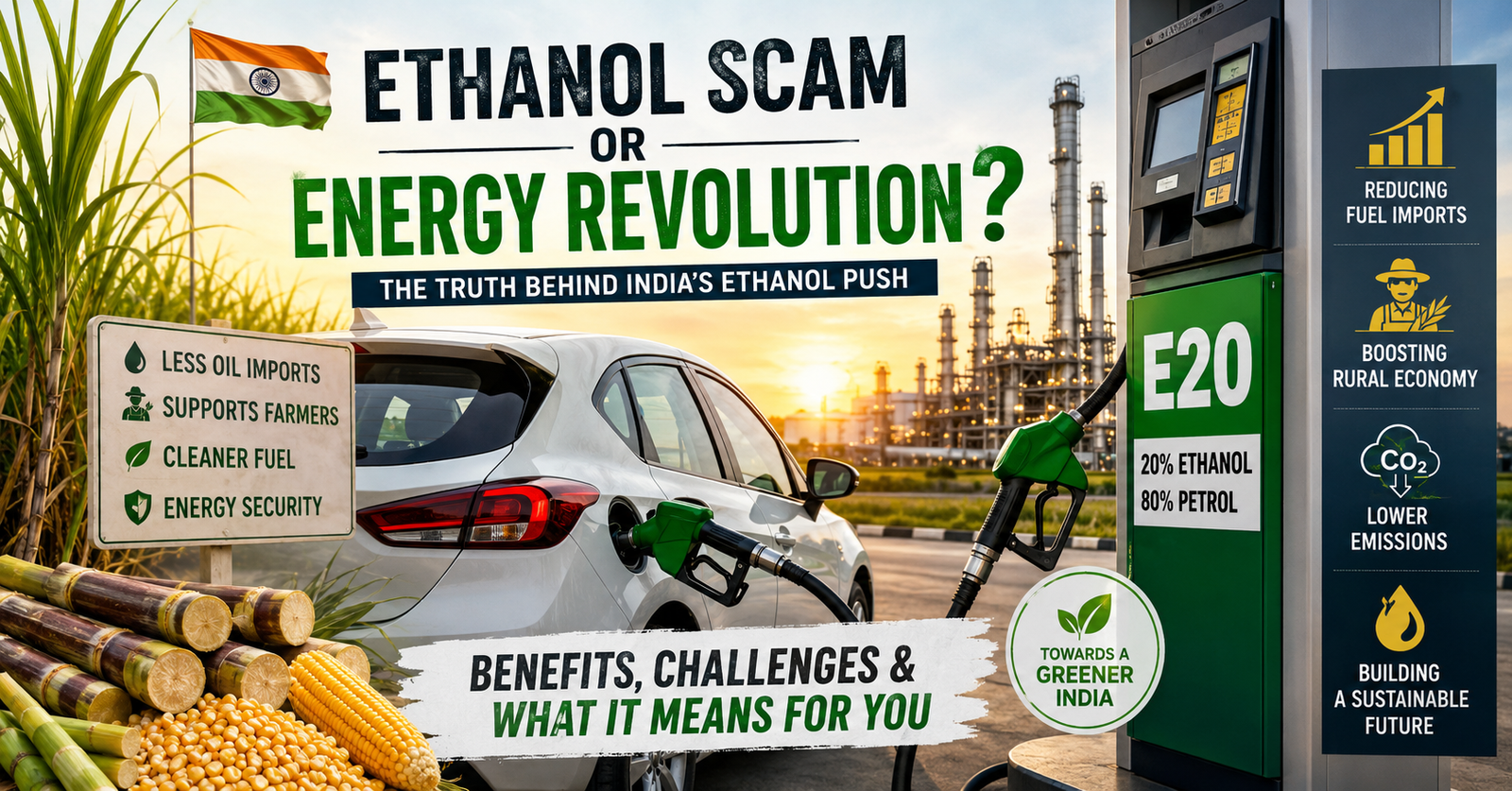
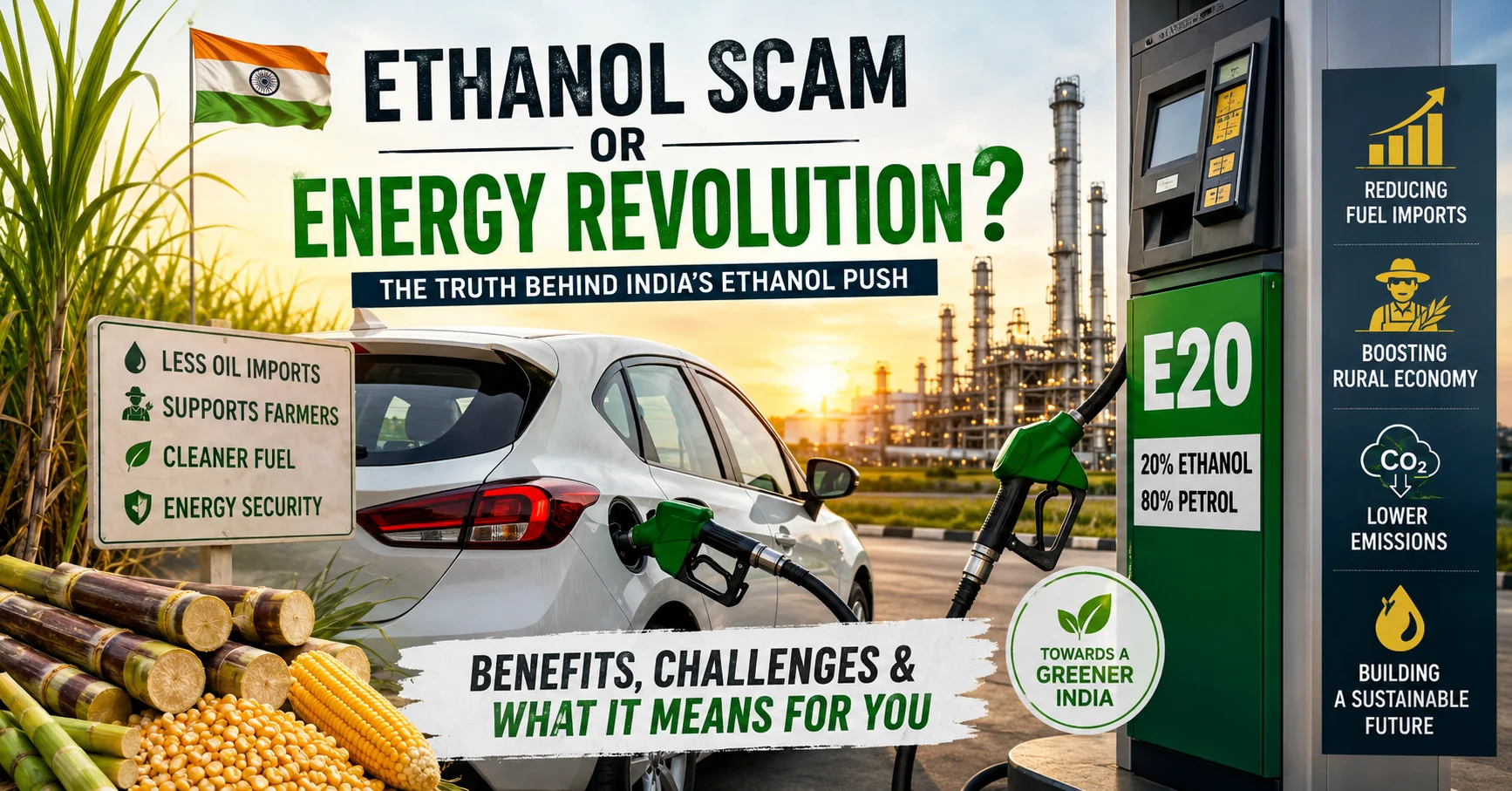
How Ethanol Supports India’s Energy Goals
Ethanol offers several genuine advantages that deserve recognition.
First, it gives India another source of transportation fuel instead of relying entirely on petroleum. Even replacing a small percentage of imported fuel can save billions of dollars over time.
Second, ethanol creates additional income opportunities for farmers. Sugar mills and maize producers gain another market for their crops, helping stabilize agricultural demand during certain seasons.
Third, ethanol burns cleaner than conventional petrol in several respects, contributing to lower emissions from compatible vehicles. (Renewable Energy India)
Taken together, these benefits explain why many experts view ethanol as an important piece of the renewable energy India strategy rather than just another fuel additive.
Where the Controversy Begins
The recent public debate did not emerge because ethanol itself is new. It gained attention after discussions surrounding court proceedings and questions about fuel blending, vehicle performance, and policy implementation.
While political arguments often dominate headlines, the bigger issue for consumers is much more practical. (Renewable Energy India)
People want to know:
- Will my vehicle perform the same?
- Will fuel efficiency decrease?
- Will maintenance costs increase?
- Is the environmental benefit worth the trade-off?
These are reasonable questions because drivers experience the policy directly every day.
A Real-World Example
Imagine two families.
One lives in Delhi and owns a modern car designed for E20-compatible fuel.
The other lives in a smaller town and drives a vehicle purchased more than ten years ago.
The newer vehicle may experience little difference because manufacturers increasingly design engines to handle higher ethanol blends.
The older vehicle, however, could experience lower fuel economy or require additional maintenance if it was never designed for higher ethanol concentrations.
Both families are using the same fuel policy, but their experiences can be quite different.
This explains why public opinion on ethanol often depends on individual circumstances rather than ideology. (Renewable Energy India)
Is Ethanol Really a Renewable Energy Solution?
Calling ethanol either a complete success or a complete failure ignores the complexity of the issue.
Renewable energy isn’t only about replacing fossil fuels.
It is also about ensuring that the replacement remains economically practical, environmentally sustainable, and socially beneficial.
Ethanol performs well in some of these areas but raises concerns in others.
For example, sugarcane cultivation requires significant amounts of water in many regions. Expanding ethanol production without improving agricultural efficiency could increase pressure on already stressed water resources.
Similarly, diverting large quantities of food crops toward fuel production may create new economic challenges if not carefully balanced. (Renewable Energy India)
These concerns do not automatically make ethanol a poor policy.
They simply highlight that every energy transition involves trade-offs.
The Bigger Picture: Ethanol and Electric Vehicles
One of the most interesting observations in this debate is that ethanol and electric vehicles are often presented as competitors.
In reality, they solve different problems.
Electric vehicles reduce dependence on liquid fuels over the long term but require charging infrastructure, battery manufacturing, and affordable vehicle prices.
Ethanol works within the existing fuel distribution network and can be adopted more quickly across conventional vehicles that are designed for higher blends.
Instead of asking which technology will win, India may achieve better results by using both together.
A diversified energy strategy is usually more resilient than depending entirely on a single solution.
What Should Consumers Watch?
For ordinary vehicle owners, the debate is less about politics and more about practical outcomes.
Consumers should pay attention to:
- Whether their vehicle manufacturer recommends E20 fuel.
- Actual fuel efficiency after switching.
- Maintenance requirements over time.
- Future fuel pricing.
- Government support for compatible vehicles.
Making informed decisions is far more useful than reacting only to political headlines.
An Important Observation
One interesting pattern has emerged during the recent discussion.
Most conversations focus on whether ethanol is “good” or “bad.”
Very few ask whether India is building the supporting systems needed for ethanol to succeed.
Fuel quality standards, compatible vehicles, efficient crop management, and responsible water use may ultimately determine whether ethanol becomes a lasting success. (Renewable Energy India)
The fuel itself is only one part of a much larger ecosystem.
Looking Ahead
India’s energy future is unlikely to depend on a single technology.
Solar power, wind energy, electric vehicles, green hydrogen, and ethanol all have different roles to play.
Rather than viewing ethanol as either an energy revolution or a national mistake, it may be more accurate to see it as one experiment within a much broader transition.
Success will depend less on the fuel itself and more on how responsibly the policy evolves over the coming years.
If implemented with careful planning, transparent regulation, and continued investment in cleaner technologies, ethanol could strengthen renewable energy India while reducing dependence on imported oil.
If these supporting factors are ignored, the current debate is likely to continue long after today’s headlines disappear.

My name is Ankit Yadav, and I am a passionate digital journalist and content creator. I write about technology, entertainment, sports, and current affairs with the aim of delivering unique, accurate, and engaging information to my readers.
I believe news should not only inform but also provide clear insights and fresh perspectives. That’s why I focus on making my articles easy to read, reliable, and meaningful.
📌 I specialize in Tech Trends, Latest News, Cybersecurity, Digital Media, Sports, and Entertainment.
📌 My mission is to share fast, authentic, and valuable updates with every article I publish.