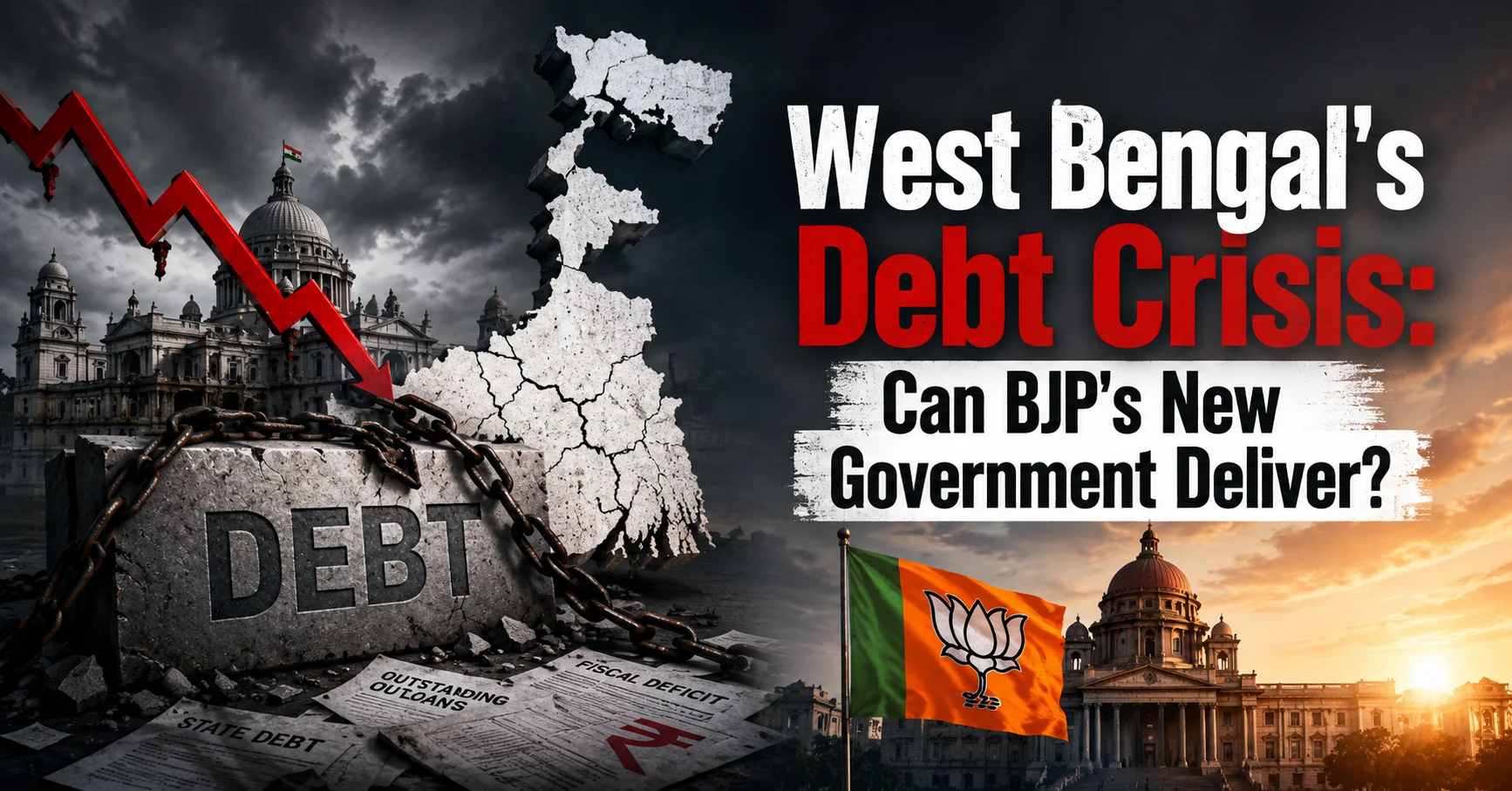
West Bengal’s Debt Crisis: Can BJP’s New Government Deliver?
When Suvendu Adhikari took oath as West Bengal’s Chief Minister on May 9, 2026, it was a historic moment — the state’s first-ever BJP government after 15 years of Mamata Banerjee’s rule. The celebrations were loud. But inside the state secretariat at Nabanna, the paperwork told a very different story.
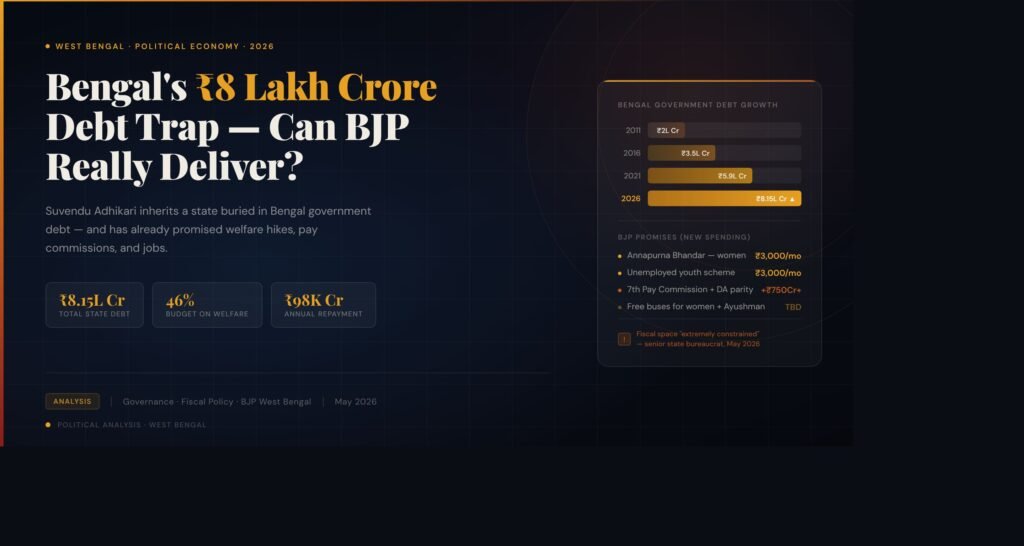
West Bengal’s accumulated Bengal government debt is projected to cross ₹8.15 lakh crore by the end of this fiscal year. That’s not a typo. The state that BJP just won is, by any measure, one of the most financially stressed large states in India. And the new government has already promised to spend more — not less.
So the real question isn’t whether BJP won. It’s whether they can actually govern, given the financial hole they’ve inherited. (West Bengal)
How Did Bengal End Up Here?
To understand the challenge, you have to look at what happened over the last 15 years.
When Mamata Banerjee came to power in 2011, she inherited a debt of roughly ₹2 lakh crore from the Left Front. That was already significant. But over the next 15 years, her government launched over 90 welfare schemes — Lakshmir Bhandar, Swasthya Sathi, Kanyashree, Yubasathi, and dozens more. These weren’t bad schemes. Many genuinely helped poor households. But the cost was enormous.
By 2025, the state’s annual welfare spending had reached around ₹1.8 lakh crore — nearly 46% of the total state expenditure, and roughly 7.5–7.8% of the state’s GDP. Meanwhile, spending on roads, factories, and infrastructure quietly dropped from 5.3% of GDP in 2019 to just 3% by 2025. The state was essentially paying its people to survive while slowly starving its own economy of investment.
The result: Bengal government debt quadrupled in 15 years. Debt repayment obligations alone are projected at nearly ₹98,000 crore in 2026–27. That’s close to one lakh crore just to service existing loans — before a single school is built or a single job is created. (West Bengal)
What BJP Has Already Promised
Here’s where it gets complicated. BJP didn’t win by promising austerity. They won by promising more.
In their election manifesto, they committed to:
- ₹3,000/month for eligible women under the new Annapurna Bhandar scheme (up from ₹1,500 under TMC’s Lakshmir Bhandar)
- ₹3,000/month for unemployed youth
- ₹3,000/month for the elderly and widowed
- Implementation of the 7th Pay Commission for State Government Workers
- DA parity with central government employees
- Free bus rides for all women from June 1, 2026
- Joining Ayushman Bharat health insurance scheme
- Hiring freeze reversal and reopening of government recruitment
All of this was announced within the first cabinet meeting on May 11 — just two days after taking office. The speed was impressive. The fiscal math, less so.
Take Annapurna Bhandar alone. Under TMC, Lakshmir Bhandar cost the state around ₹42,000 crore per year. BJP has doubled the payout to ₹3,000/month, which economists estimate could push that figure to roughly ₹76,000 crore annually — a jump of over ₹34,000 crore on a single scheme.
Now layer on the 7th Pay Commission. Implementing DA parity alone is estimated to add at least ₹750 crore in additional burden for every 4% hike. A full salary revision across all state employees, allied bodies and educational institutions? That number runs into tens of thousands of crores. (West Bengal)
The Real Squeeze: Where Does the Money Come From?
Bengal’s own tax revenue for 2026–27 is projected at around ₹1.18 lakh crore. Even if GST collections grow optimistically, that revenue is nowhere near enough to cover existing commitments — let alone the new ones.
A senior state bureaucrat, speaking anonymously to a national publication, summed it up plainly: “The fiscal space is extremely constrained. If the government simultaneously expands welfare schemes, implements DA parity, increases recruitment and raises infrastructure spending, the deficit could widen sharply unless there is a significant increase in revenue generation.”
That’s not a political statement. It’s arithmetic. (West Bengal)
The Double-Engine Promise: Real Help or Political Rhetoric?
BJP has long talked about a “double-engine sarkar” — the idea that having the same party in power at the Centre and in the state leads to faster release of central funds. Now that West Bengal has a BJP government aligned with Delhi, this theory gets tested for real.
There’s some substance to it. The previous TMC government had reportedly strained relations with the Centre over scheme implementation, and central dues under rural employment and housing schemes were estimated to be in the thousands of crores. Some estimates from the previous government suggested total pending dues could be as high as ₹2 lakh crore — though that figure was disputed.
If the Suvendu Adhikari government can unlock even a portion of those stalled central funds, it would meaningfully ease the fiscal pressure. Joining Ayushman Bharat is one visible step in this direction — the Centre co-funds the scheme, reducing the burden on the state exchequer compared to running Swasthya Sathi entirely on state funds. (West Bengal)
Still, central transfers alone won’t solve a structural problem that took 15 years to build.
The Industrial Revival Question
The longer-term bet that BJP and its supporters in the business community are making is this: a stable, investor-friendly government will attract private investment, revive Bengal’s industrial base, generate tax revenue, and gradually reduce dependence on borrowing.
West Bengal is currently India’s sixth-largest state economy, with a GSDP of over ₹20 lakh crore. It has ports, a large workforce, and proximity to Southeast Asian markets. Between 2012 and 2022, it grew at just 4.3% annually — well below the national average of 5.6%. That gap represents enormous unrealized potential.
Industrialist Harsh Goenka was among the first to publicly respond to the BJP’s Bengal win, writing that “development will be back on the agenda, jobs and investments will follow.” Whether that optimism translates into actual factory floors and employment is the test the new government will face over the next two to three years.
The BJP government has already instructed departments to prepare a full budget for 2026–27 with greater emphasis on infrastructure and capital expenditure. That’s a signal. Whether budget signals become ground reality is another matter.
What It Means for the Common Bengali
For a government school teacher in Murshidabad waiting on a salary revision — this matters directly.
For a woman in Howrah who was getting ₹1,500 from Lakshmir Bhandar and is now expecting ₹3,000 from Annapurna Bhandar — the promise is live, but the rollout date of June 2026 is what counts.
For a young engineering graduate in Kolkata who voted for change hoping for a government job — the reopening of recruitment processes is the real test.
These aren’t abstract policy debates. They’re kitchen-table concerns for millions of families.
The BJP has made commitments that are genuinely hard to walk back politically. The challenge is that Bengal’s Bengal government debt burden means every rupee spent on welfare is a rupee not spent on the road, factory, or hospital that might reduce the need for welfare in the first place.
Is It Actually Doable?
Honest answer: partially, over time — but not all at once without consequences.
The 7th Pay Commission can be implemented in phases. Annapurna Bhandar can be rolled out with tighter eligibility to control costs. Central scheme integration (Ayushman Bharat, PM Vishwakarma, etc.) shifts some financial burden to Delhi. And if industrial investment does pick up — even modestly — the revenue picture improves over a 3–5 year horizon.
What isn’t realistic is delivering everything simultaneously in year one without widening the deficit. The fiscal space, as the bureaucrat quoted above noted, is genuinely constrained. The BJP government will have to make hard choices about sequencing — what gets delivered first, what gets phased, and what gets quietly scaled back.
Bengal has changed governments. Whether it can change its fiscal trajectory is the harder, slower, more important question.

My name is Ankit Yadav, and I am a passionate digital journalist and content creator. I write about technology, entertainment, sports, and current affairs with the aim of delivering unique, accurate, and engaging information to my readers.
I believe news should not only inform but also provide clear insights and fresh perspectives. That’s why I focus on making my articles easy to read, reliable, and meaningful.
📌 I specialize in Tech Trends, Latest News, Cybersecurity, Digital Media, Sports, and Entertainment.
📌 My mission is to share fast, authentic, and valuable updates with every article I publish.