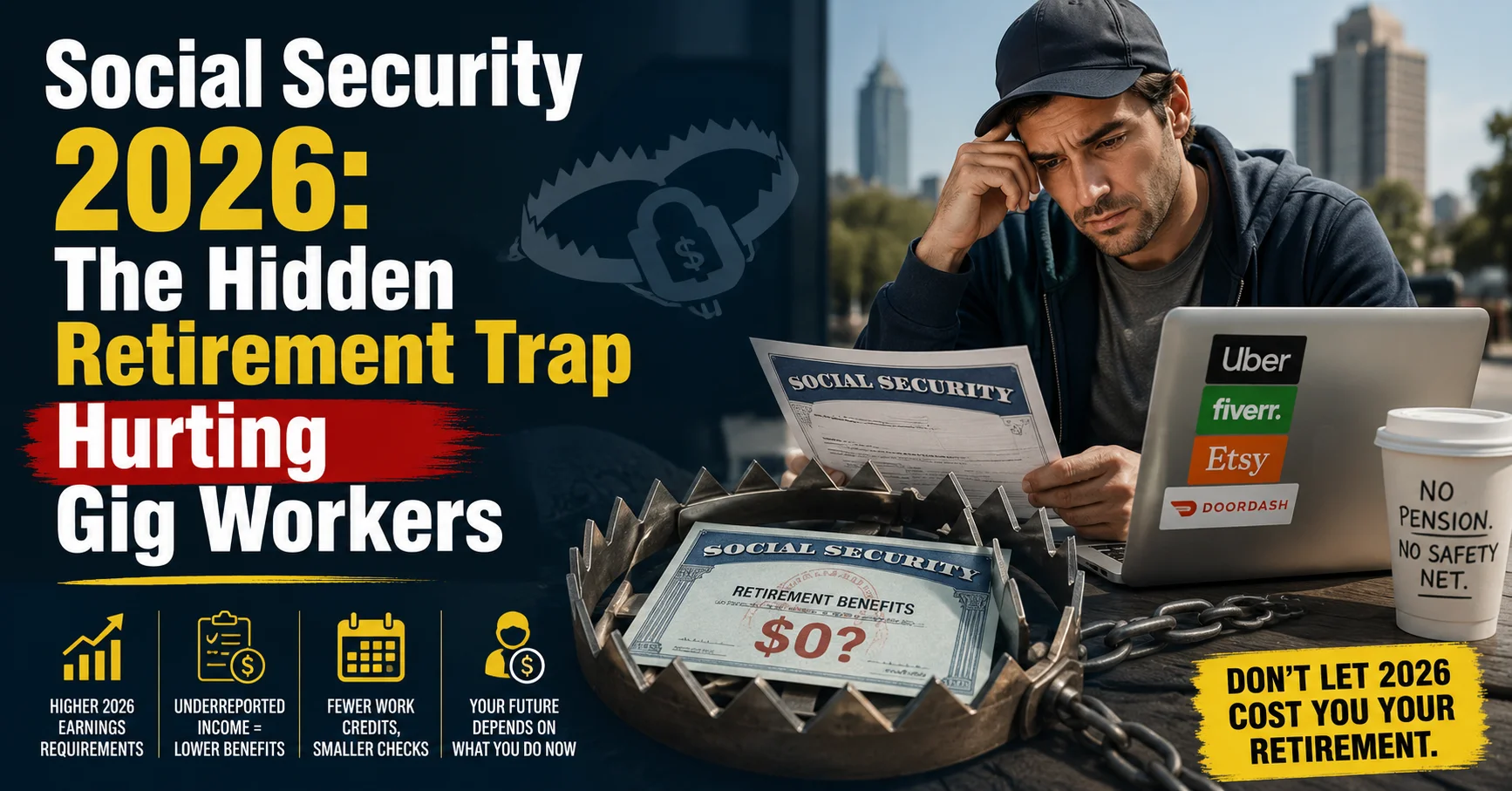
Social Security 2026: The Hidden Retirement Trap Hurting Gig Workers
If you drive for Uber, freelance on Fiverr, or run a one-person consultancy, there’s a good chance you’re quietly building toward a retirement shortfall — and Social Security’s 2026 rules are making it worse, not better. (Social Security 2026)
Every January, the headlines are the same: COLA increase, Medicare premium hike, wage cap update. The usual cast of retirees and financial advisors weighs in. But there’s a massive group that almost never gets mentioned in these conversations — the 73 million Americans working in the gig economy who are either underpaying into Social Security, earning too few work credits, or not paying in at all.
That’s the story nobody is writing about. And in 2026, the problem is quietly getting more serious.
Why gig workers are in a different situation than everyone else
When a traditional employee works a regular job, Social Security taxes are automatic. Their employer withholds 6.2% from every paycheck, matches it with another 6.2%, and sends the whole 12.4% to the IRS. The worker doesn’t have to think about it — it just happens. (Social Security 2026)
Gig workers don’t have that safety net. As self-employed individuals, they owe the full 15.3% self-employment tax themselves (12.4% Social Security + 2.9% Medicare). More importantly, nothing is withheld automatically. If a freelancer doesn’t pay quarterly estimated taxes — or worse, underreports income — they’re not just avoiding taxes. They’re actively shrinking their future Social Security benefits.
Key 2026 rule: To earn one Social Security work credit this year, you need $1,890 in reported earnings. You can earn a maximum of 4 credits per year. To qualify for retirement benefits at all, you need 40 credits total — that’s roughly 10 full years of consistent, reported income. (Social Security 2026)
Here’s where it breaks down. A gig worker earning $8,000 a year from driving apps — money that flows through apps, cash, and Venmo — might report very little of it formally. They may even believe (incorrectly) that as long as they stay under certain IRS reporting thresholds, it doesn’t count. It still counts. And more importantly, what they don’t report doesn’t count toward their future Social Security benefit either.
A real scenario: what this looks like in practice
Meet Marcus, 34, a full-time freelance graphic designer in Austin. He’s been self-employed for six years. He earns about $55,000 a year, files taxes annually (not quarterly), and considers himself financially responsible. But he’s never carefully tracked which of his earnings he’s reported to the SSA through his tax filings.

Marcus is fine — for now. But he has a habit of deducting aggressively to lower his taxable net income, sometimes below the threshold where it fully registers with SSA. In two or three years, he could face a situation where his official earnings record at SSA shows far less than what he actually earned. That gap has a real dollar cost at retirement age.
Your 35 highest-earning years are used by the SSA to determine your retirement payout. Every year that’s missing or underreported is replaced with a zero. Enough zeros, and your monthly check shrinks considerably — even if you worked hard for decades. (Social Security 2026)
The 2026 work credit change makes this worse
In 2025, you needed $1,810 in earnings to get one work credit. In 2026, that threshold went up to $1,890. That might sound small, but for gig workers with irregular or part-time income — think a college student doing weekend DoorDash deliveries, or a parent doing part-time Etsy sales — this increase means they might fall one credit short of the annual maximum of four, something they previously would have cleared without a problem.
It’s a quiet shift. Nobody will send them a warning. The SSA doesn’t send a real-time alert saying “you’re on track for 3 credits, not 4.” You only find out when you log into your my Social Security account — if you ever do. (Social Security 2026)
What Social Security gig workers in 2026 actually need to do
The good news is that this is entirely fixable, as long as you act before the gaps compound. Here’s what makes a real difference:
1. Check your Social Security earnings record now
Go to ssa.gov and create a my Social Security account if you haven’t already. Look at your official earnings history year by year. If any year shows income dramatically lower than what you actually earned, that’s a problem worth investigating — usually a sign of underreported income through your tax filings.
2. Pay quarterly estimated taxes properly
This is the most direct fix. When you pay self-employment tax quarterly, that income gets properly attributed to your SSA record. Skipping quarterly payments or paying a lump sum late in the year can delay how earnings are recorded. The IRS and SSA don’t always sync instantly — consistent quarterly payments reduce the risk of a data gap.

3. Be cautious about aggressive deductions
This one is counterintuitive. Every dollar you deduct to reduce taxable income also reduces your reported Social Security earnings. Some deductions are smart and necessary. But if you’re deducting so aggressively that your net self-employment income drops near zero, you may be inadvertently eliminating work credits you’d otherwise earn. (Social Security 2026)
4. Consider a SEP IRA or Solo 401(k) in addition to Social Security
Social Security alone won’t be enough for most gig workers — even if they contribute consistently. A SEP IRA lets self-employed individuals contribute up to 25% of net self-employment income. A Solo 401(k) has even higher limits. These aren’t replacements for Social Security contributions, but they create a second layer that makes retirement realistic even if your SSA benefit ends up being modest.
The broader picture: why this matters right now
The gig economy isn’t a side hustle anymore — it’s the primary income source for tens of millions of Americans. Yet the Social Security system was designed in an era when most people worked traditional W-2 jobs with automatic tax withholding. The structural mismatch hasn’t been fixed.
Combine that with the 2026 news that the Social Security trust fund’s insolvency timeline has moved closer (with CBO projecting potential benefit cuts of up to 23% around 2033), and gig workers face a double risk: smaller benefits at retirement from undercontributing, plus potentially reduced payouts from the system itself. (Social Security 2026)
The people writing “6 Social Security changes for 2026” articles are mostly writing for retirees already collecting benefits. But the gig workers who are 30, 35, 40 years old today? The decisions they make right now — whether to report income properly, pay quarterly, and track their earnings record — will determine whether Social Security is a meaningful safety net for them or nearly nothing at all.
It’s a quiet crisis. And 2026 is a good year to stop ignoring it. (Social Security 2026)

My name is Ankit Yadav, and I am a passionate digital journalist and content creator. I write about technology, entertainment, sports, and current affairs with the aim of delivering unique, accurate, and engaging information to my readers.
I believe news should not only inform but also provide clear insights and fresh perspectives. That’s why I focus on making my articles easy to read, reliable, and meaningful.
📌 I specialize in Tech Trends, Latest News, Cybersecurity, Digital Media, Sports, and Entertainment.
📌 My mission is to share fast, authentic, and valuable updates with every article I publish.