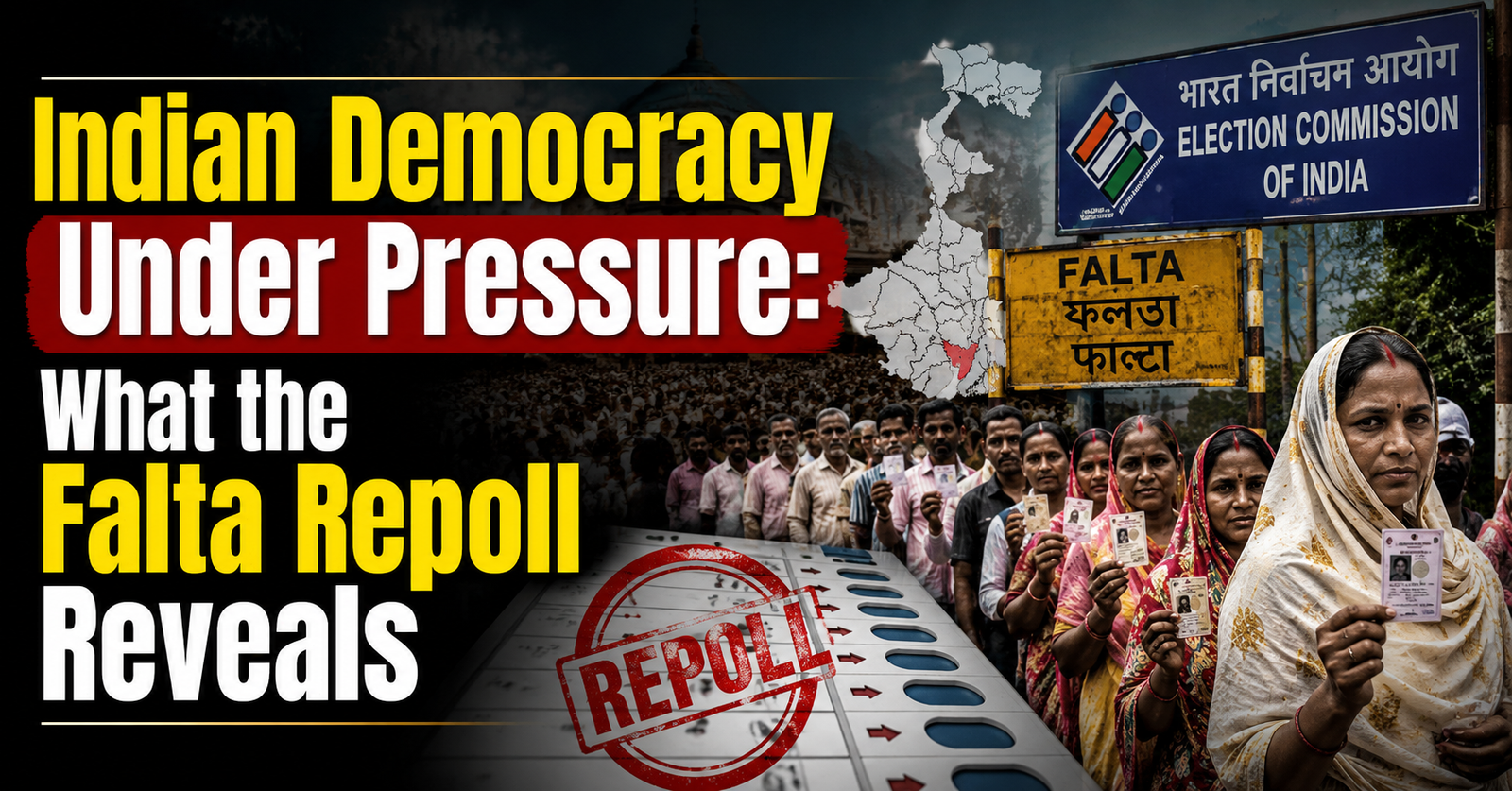
Indian Democracy Under Pressure: What the Falta Repoll Reveals
For most people outside West Bengal, Falta was just another constituency name that suddenly appeared in news headlines. But over the last few weeks, this small Assembly seat became part of a much larger national conversation — one that goes beyond party politics and election results.
The repoll ordered in Falta was not routine. Following claims of anomalies and worries about the voting process, the Election Commission made the unusual decision to cancel polling at every booth in the constituency. That single decision changed the narrative completely. The story was no longer only about BJP, TMC, or who was leading in vote counts. It became a conversation about trust, accountability, and the strength of Indian Democracy.
In a country where elections happen almost constantly at some level, people often assume the system will somehow continue working regardless of what happens on the ground. But Falta reminded everyone that public trust is not automatic. It has to be protected repeatedly.
Why the Falta Repoll Felt Different
Election controversies are not new in India. Complaints about violence, booth capturing, intimidation, or EVM concerns have surfaced in different states for decades. Usually, such incidents create temporary outrage before the news cycle moves on.
Falta felt different because of the scale of the response.
Instead of ordering limited re-voting in a few booths, authorities decided to conduct fresh polling across the constituency. That sent a strong signal that the issue was being treated seriously. For many voters, the repoll itself became more important than the final winner.
This is where the conversation connects directly to Indian Democracy. Vote counting is not the only aspect of elections. They are also about whether people believe the process is fair enough to accept the outcome.
A system loses credibility when citizens start thinking results are predetermined or manipulated. In that sense, restoring confidence can sometimes matter more than political victory.
The Human Side of Election Trust
It is easy to discuss elections in terms of percentages and seat counts, but ordinary voters experience these situations very differently.
Imagine a first-time voter walking into a polling booth after hearing days of allegations about tampering or political pressure. Even if nothing goes wrong during voting, doubt already exists in the mind. Once trust weakens, participation also begins to weaken over time.
That is why repolls matter psychologically.
In Falta, voter turnout reportedly remained high during the fresh polling process. That itself tells an important story. Many people still believed their vote was worth casting again. In a way, voters were not just participating in an election — they were participating in a test of the system.
This is one of the less discussed aspects of Indian Democracy. Election dates and constitutional regulations are not the only indicators of a democracy’s strength. It is also measured by whether ordinary citizens still feel involved in the process.
Why This Matters Beyond West Bengal
One constituency cannot define the future of Indian politics. But certain events become symbolic because they reveal deeper tensions inside the system.
Falta exposed three important realities.
Public Trust Is Becoming More Fragile
Political polarization has increased across India over the last several years. Supporters of almost every party now question election processes whenever results go against them. Social media amplifies suspicion much faster than before.
In that environment, institutions like the Election Commission face enormous pressure. Every decision is examined politically.
The Falta repoll showed that restoring confidence now requires visible action, not just official statements.
Voters Expect Greater Transparency
Today’s voters are more informed and more vocal than earlier generations. People follow election news in real time through YouTube, WhatsApp, X, and regional media channels.
That means election management cannot operate quietly in the background anymore. Transparency itself has become part of democratic legitimacy.
The Falta situation reflected this shift clearly. Citizens were not satisfied with generic assurances. They wanted corrective action they could actually see.
Local Elections Now Carry National Meaning
Even relatively small elections are quickly framed as indicators of larger political momentum. The Falta result was immediately connected to broader discussions about Bengal politics and future national elections.
This creates additional pressure because every local controversy becomes nationally visible within hours.
Indian Democracy Is More Powerful Than Its Detractors Believe
One interesting thing about the Falta controversy is that both critics and supporters of the system used the same event to make opposite arguments.
Some said the controversy proved Indian Democracy is weakening. Others argued the repoll itself showed the system still has self-correction mechanisms.
The truth probably lies somewhere in between.
No democratic system is perfect, especially in a country as large and politically intense as India. Problems will continue appearing. Allegations will continue emerging. But the real test is whether institutions respond effectively enough to maintain public confidence.
In that sense, the Falta repoll may actually strengthen democratic credibility instead of weakening it.
A flawed election process that gets corrected publicly can sometimes inspire more confidence than a flawed process that gets ignored completely.
The Bigger Lesson From Falta
There is also a broader lesson here that often gets missed during political debates.
People usually think democracy survives through speeches, campaigns, or election slogans. In reality, democracy survives through administrative credibility. Small procedural decisions matter more than dramatic political rhetoric.
The average citizen may never read constitutional law or follow parliamentary debates closely. But they do notice whether polling feels safe, whether complaints are heard, and whether authorities respond fairly.
That everyday experience shapes public faith in Indian Democracy far more than television arguments.
Falta became important because it highlighted this reality in a very visible way.
Could This Influence Future Elections?
It is possible that future election controversies in India will now face stronger public pressure for transparency and corrective action.
Political parties across ideologies may increasingly demand repolls, stronger monitoring, live surveillance systems, and faster investigation processes whenever irregularities are alleged.
That could create new challenges for election authorities, but it could also improve accountability standards over time.
The Falta repoll may not change Indian politics overnight. But it has already changed the conversation around election credibility, and that alone makes it significant.
In the end, the story of Falta is not only about one constituency in West Bengal. It is about the ongoing relationship between citizens and institutions. It is about whether people continue believing their participation matters.
And that question sits at the very heart of Indian Democracy.

My name is Ankit Yadav, and I am a passionate digital journalist and content creator. I write about technology, entertainment, sports, and current affairs with the aim of delivering unique, accurate, and engaging information to my readers.
I believe news should not only inform but also provide clear insights and fresh perspectives. That’s why I focus on making my articles easy to read, reliable, and meaningful.
📌 I specialize in Tech Trends, Latest News, Cybersecurity, Digital Media, Sports, and Entertainment.
📌 My mission is to share fast, authentic, and valuable updates with every article I publish.