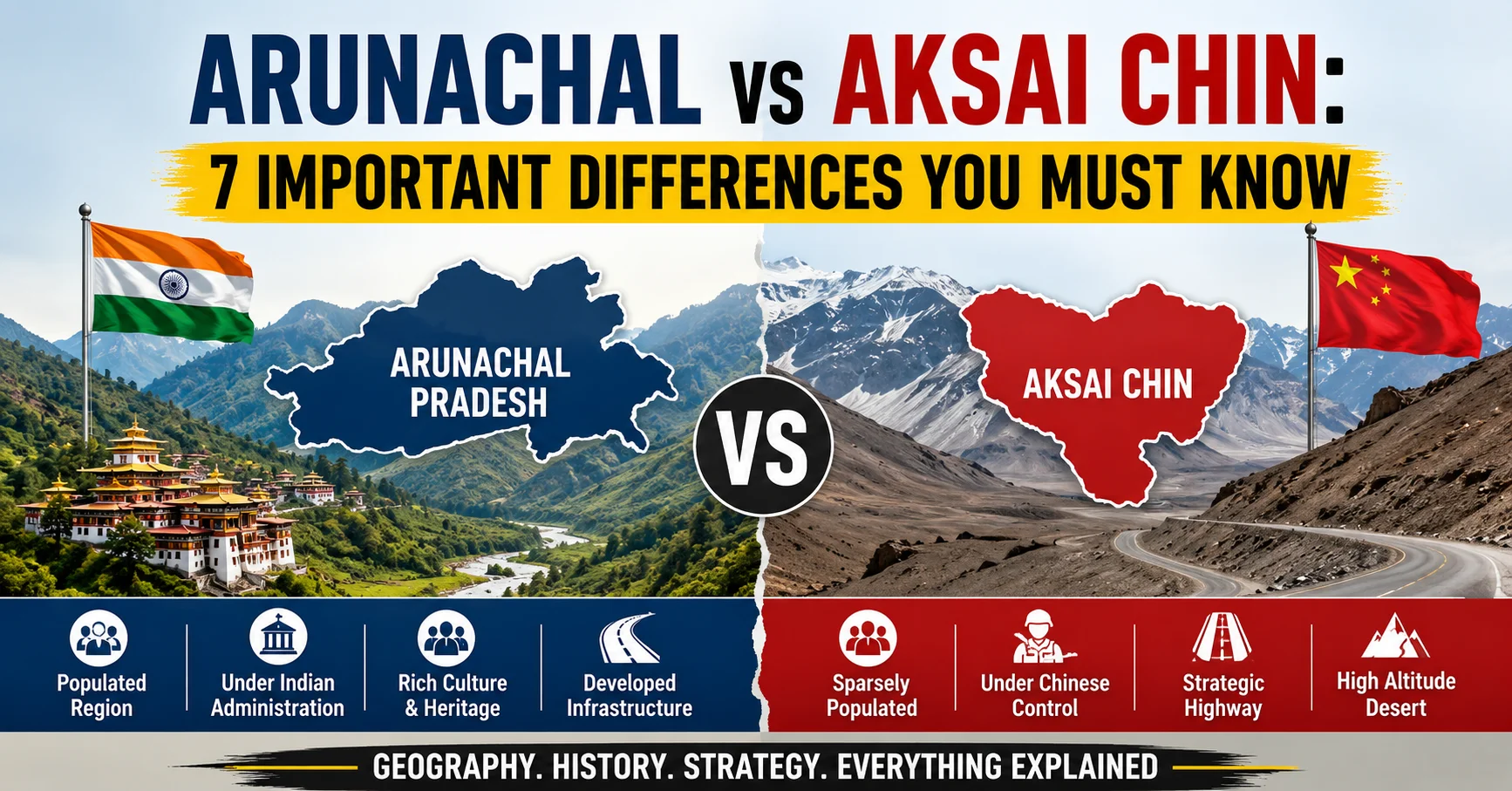
Arunachal vs Aksai Chin: 7 Important Differences You Must Know
When people hear about the India-China border dispute, two names often appear together—Arunachal Pradesh and Aksai Chin. Because both regions are frequently mentioned in the news, many people assume they are part of the same dispute or even located close to each other. In reality, they are very different in terms of geography, history, administration, and strategic importance.
Many readers search for Arunachal vs Aksai Chin because news reports often mention both regions without clearly explaining how they differ. This guide simplifies the confusion through easy comparisons, practical examples, and historical context, helping you understand why both regions continue to shape India-China relations today.
Why Do People Confuse Arunachal Pradesh and Aksai Chin?
The biggest reason is that both regions are linked to the long-running India-China border dispute. Whenever tensions increase along the Himalayan border, news headlines often mention Arunachal Pradesh and Aksai Chin together.
However, they are located on opposite sides of the India-China border.
- Arunachal Pradesh lies in India’s northeast.
- Aksai Chin is located in the western Himalayas near Ladakh.
They are separated by thousands of kilometers and involve different historical, political, and strategic issues. (Arunachal vs Aksai Chin)
Where Are They Located?
Arunachal Pradesh
Arunachal Pradesh is a full-fledged Indian state that shares borders with China, Bhutan, and Myanmar. It has towns, villages, highways, schools, hospitals, and an elected government. India exercises complete administrative control over the state.
China, however, claims almost the entire state as what it calls “South Tibet.”
Aksai Chin
Aksai Chin is a high-altitude cold desert situated east of Ladakh. Unlike Arunachal Pradesh, it has almost no permanent civilian population because of its harsh weather, extreme altitude, and rugged terrain.
China currently controls Aksai Chin, while India considers it an integral part of the Union Territory of Ladakh. (Arunachal vs Aksai Chin)
The Biggest Difference
The easiest way to understand Arunachal vs Aksai Chin is by looking at who controls each region.
| Arunachal Pradesh | Aksai Chin |
|---|---|
| Controlled by India | Controlled by China |
| Claimed by China | Claimed by India |
| Home to more than one million residents | Almost no permanent population |
| Democratic state government | Chinese administrative control |
| Forests, rivers, tourism, and villages | High-altitude cold desert |
The disputes are therefore very different. One concerns an inhabited Indian state, while the other revolves around a sparsely populated but strategically important mountain region.
Arunachal vs Aksai Chin at a Glance
| Feature | Arunachal Pradesh | Aksai Chin |
| Controlled By | India | China |
| Claimed By | China | India |
| Population | More than 1.3 million | Very limited |
| Terrain | Forests and mountains | Cold desert |
| Tourism | Yes | No regular tourism |
| Civilian Settlements | Many | Very few |
| Strategic Value | Border security, culture, rivers | Military logistics and highway |

Why Is Arunachal Pradesh Important?
Arunachal Pradesh is not only strategically important but also culturally rich. It is home to dozens of indigenous communities, dense forests, major rivers, wildlife sanctuaries, and centuries-old monasteries.
One of its most significant locations is Tawang, which is internationally known for its historic Buddhist monastery. Because of its cultural connection with Tibetan Buddhism, Tawang often becomes part of China’s territorial claims.
For India, Arunachal Pradesh is much more than a border state. It has functioning democratic institutions, expanding infrastructure, educational institutions, tourism, and growing economic opportunities.
Why Arunachal Pradesh Matters to Ordinary Indians
Beyond geopolitics, Arunachal Pradesh plays an important role in India’s environment, economy, and cultural diversity. The state has enormous hydropower potential, rich biodiversity, and contributes significantly to eco-tourism. Thousands of families depend on agriculture, horticulture, handicrafts, and tourism for their livelihoods.
This is why discussions about Arunachal Pradesh are not just about maps—they directly affect people, development, and regional growth. (Arunachal vs Aksai Chin)
Why Is Aksai Chin Important?
At first glance, Aksai Chin appears to be an empty mountain desert. Yet it remains one of the most strategically sensitive regions in Asia.
China constructed a major highway through Aksai Chin that connects Tibet with Xinjiang. This route greatly improves transportation, military mobility, and logistical support across western China.
India continues to regard Aksai Chin as part of Ladakh, making it an important element of the broader territorial dispute.
Why Does Aksai Chin Receive So Much Attention?
Although Aksai Chin has almost no permanent civilian population, it receives global attention because of its military importance. Control over mountain passes, transportation routes, and strategic infrastructure makes it highly valuable for both India and China.
As a result, infrastructure projects or troop movements in this region often become international news despite its remote location. (Arunachal vs Aksai Chin)
A Real-World Example
Imagine two neighboring families disagreeing over different pieces of land.
One dispute involves a fully developed neighborhood where families have lived for generations, built homes, schools, and businesses.
The other concerns a remote mountain area with almost no residents but containing the only road connecting two major regions.
Both disputes are important, but for entirely different reasons.
This comparison closely reflects Arunachal vs Aksai Chin. Arunachal Pradesh represents an inhabited state with established communities, while Aksai Chin is strategically important because of geography and military logistics rather than civilian life.
How Did These Disputes Begin?
The disagreement dates back to the colonial period when different maps proposed different border alignments.
India accepts the McMahon Line as the international boundary in the eastern sector, while China rejects it.
In the western sector, India and China inherited different interpretations of the border surrounding Aksai Chin.
These disagreements eventually contributed to the 1962 India-China War. After the conflict, China retained control of Aksai Chin, while India continued administering Arunachal Pradesh.
Although diplomatic negotiations continue, the border dispute remains unresolved.
Timeline of Major Events
- 1914 – McMahon Line proposed.
- 1950s – China builds a strategic road through Aksai Chin.
- 1962 – India-China War changes ground realities.
- 1993 – Border peace agreements signed.
- 2020 – Border tensions increase in Ladakh.
- Present – Diplomatic and military talks continue while both countries maintain their respective claims.
Why This Difference Matters Today
Understanding Arunachal vs Aksai Chin makes it much easier to understand current news reports.
For example:
- When China announces new names for places in Arunachal Pradesh, it relates to its territorial claim over an Indian-administered state.
- When news reports discuss roads, military bases, or troop movements in Aksai Chin, they usually concern China’s strategic control of the western sector.
Without understanding these differences, many headlines can appear confusing.
Common Misconceptions
A common misconception is that Arunachal Pradesh and Aksai Chin are neighboring regions facing the same type of dispute.
In reality, they are located in different parts of the India-China border and involve different historical backgrounds, administrative control, and strategic priorities. (Arunachal vs Aksai Chin)
Knowing this distinction helps readers interpret border developments far more accurately.
An Interesting Observation
One noticeable pattern is how public attention shifts depending on current events.
When military tensions rise in Ladakh, discussions focus on Aksai Chin.
When China releases new maps or renames locations in what it calls “South Tibet,” attention shifts toward Arunachal Pradesh.
Although both regions are part of the larger India-China border dispute, they represent two different territorial situations with unique historical and strategic contexts.
Frequently Asked Questions
Is Arunachal Pradesh controlled by India?
Yes. Arunachal Pradesh is administered by India as a full-fledged state, although China claims most of it as “South Tibet.”
Who controls Aksai Chin today?
China currently administers Aksai Chin, while India continues to claim it as part of Ladakh.
Why are Arunachal Pradesh and Aksai Chin different?
The primary difference is administrative control. India governs Arunachal Pradesh, whereas China controls Aksai Chin. Their geography, population, and strategic roles are also very different.
Can tourists visit Aksai Chin?
No. Aksai Chin is not open to regular tourism because of its sensitive military and geopolitical significance.
Why is Tawang important?
Tawang is strategically and culturally significant because of its historic Buddhist monastery and its location near the India-China border.
Key Takeaways
- Arunachal Pradesh and Aksai Chin are separate disputed regions.
- India administers Arunachal Pradesh as a full-fledged state.
- China currently controls Aksai Chin.
- Arunachal Pradesh has a large civilian population, while Aksai Chin is largely uninhabited.
- Both regions are strategically important, but for different reasons.
- Understanding the distinction helps readers better interpret developments related to the India-China border dispute.
Final Thoughts
The discussion around Arunachal vs Aksai Chin is far more than a comparison between two places on a map.
Arunachal Pradesh is a vibrant Indian state with established communities, democratic institutions, growing infrastructure, and rich cultural heritage. Aksai Chin, by contrast, is a remote high-altitude region whose significance lies primarily in its strategic geography and transportation routes.
Rather than viewing Arunachal Pradesh and Aksai Chin as identical disputes, it is more accurate to understand them as two separate regions with different histories, different administrative realities, and different strategic roles.
Recognizing these differences helps readers better understand India-China relations, follow border developments with greater clarity, and separate facts from common misconceptions. As diplomacy, infrastructure development, and regional security continue to evolve, knowing the difference between these two regions will remain essential for anyone interested in South Asian geopolitics.

My name is Ankit Yadav, and I am a passionate digital journalist and content creator. I write about technology, entertainment, sports, and current affairs with the aim of delivering unique, accurate, and engaging information to my readers.
I believe news should not only inform but also provide clear insights and fresh perspectives. That’s why I focus on making my articles easy to read, reliable, and meaningful.
📌 I specialize in Tech Trends, Latest News, Cybersecurity, Digital Media, Sports, and Entertainment.
📌 My mission is to share fast, authentic, and valuable updates with every article I publish.