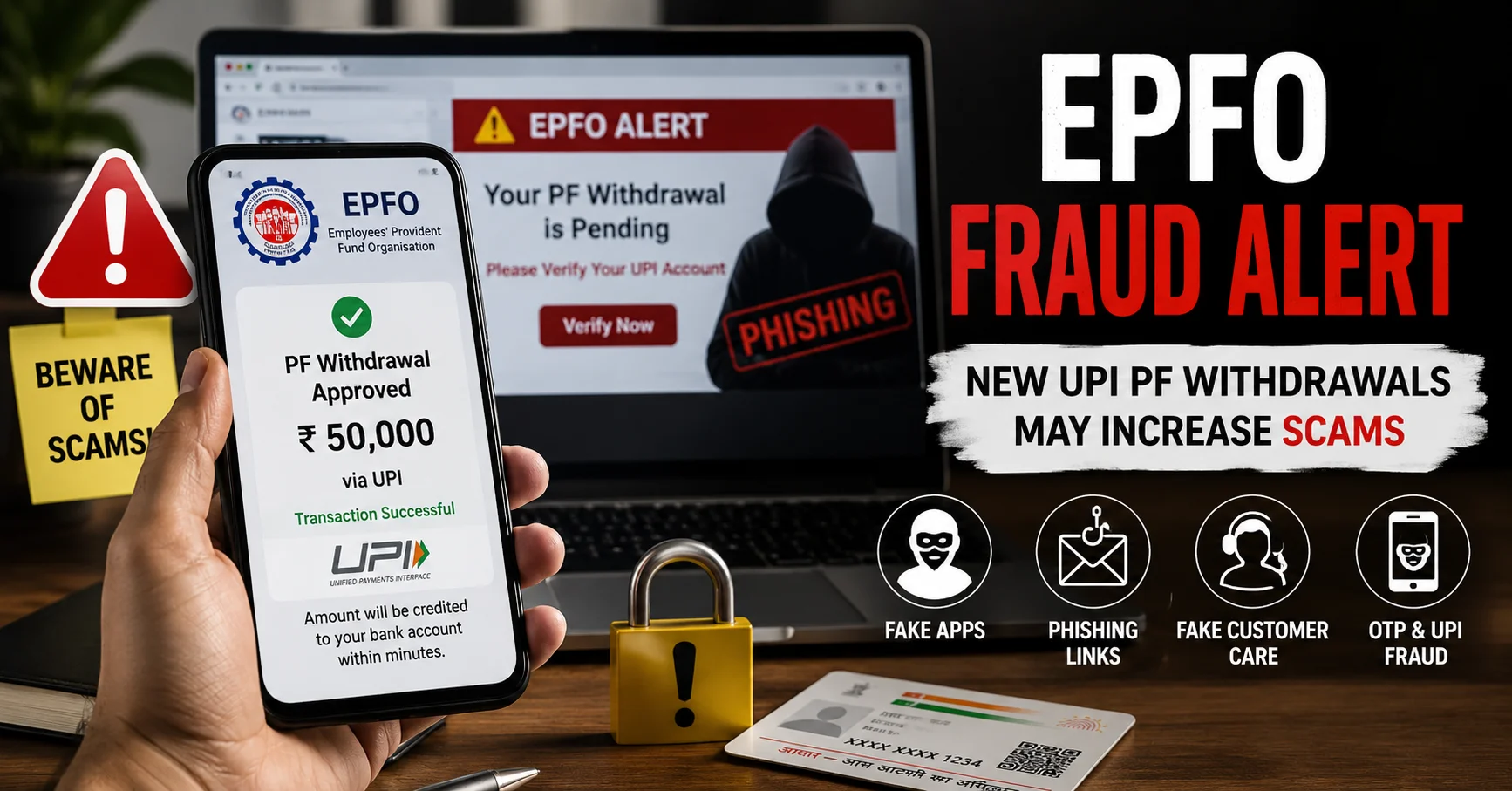
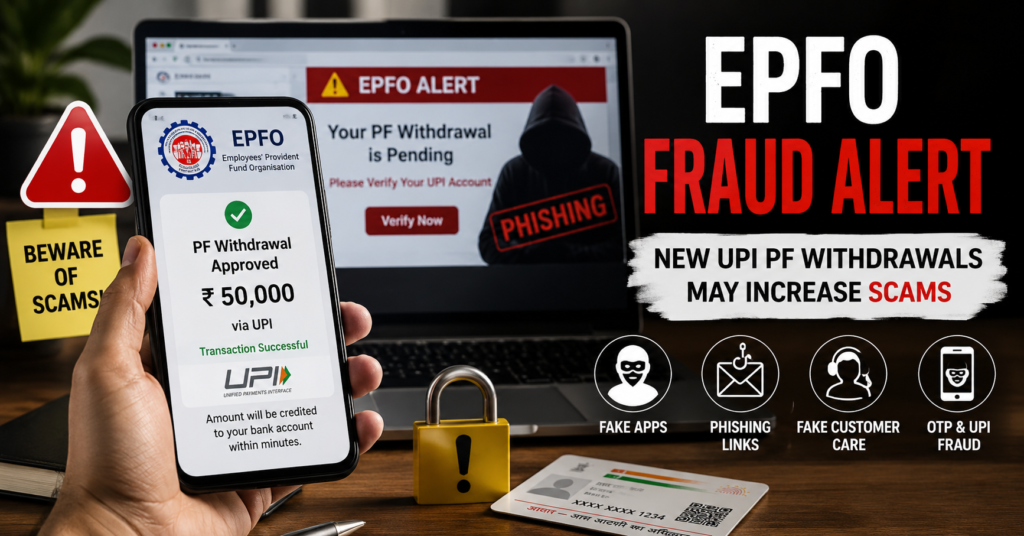
EPFO Fraud Alert: New UPI PF Withdrawals May Increase Scams
The Employees’ Provident Fund Organisation (EPFO) is preparing to introduce UPI-based PF withdrawals, a move that could completely change how salaried employees access their provident fund money. Instead of waiting several days for claim processing, users may soon be able to transfer eligible PF amounts directly into their bank accounts within minutes using UPI.
For millions of workers, this sounds like a major upgrade. Faster access to emergency funds is always welcome, especially during medical situations, job loss, or urgent financial needs.
But while most discussions around this update focus on convenience, there’s another side that isn’t getting enough attention. (EPFO Fraud Alert)
Cybercriminals are watching this shift very closely.
And that’s exactly why this EPFO fraud alert matters.
Why Faster PF Withdrawals Could Attract Scammers
Whenever a financial system becomes faster and more digital, fraud attempts usually rise alongside it. India has already seen this pattern with online banking, digital wallets, and UPI payments.
PF accounts are especially attractive targets because they often contain large balances accumulated over years. Many salaried employees don’t regularly check their EPFO accounts, which makes them easier to exploit compared to active bank accounts. (EPFO Fraud Alert)
Now imagine combining:
- Instant withdrawals
- UPI-based transfers
- Aadhaar-linked verification
- Mobile-based access
That creates convenience for users — but also new entry points for scammers.
A fake message saying “Your PF withdrawal is pending” may sound believable to many people once instant PF transfers become common. (EPFO Fraud Alert)
That’s where the real risk begins.
The Most Likely Frauds We Could See
Cybercrime rarely starts with sophisticated hacking. Most scams begin with panic, urgency, or confusion.
With UPI-enabled PF withdrawals, fraudsters could use several methods to trick users.
Fake EPFO Apps
This is probably the biggest threat.
Scammers may create apps that look almost identical to official EPFO services. A user searching “EPFO withdrawal app” on social media or unofficial websites could accidentally install malware instead of the real platform. (EPFO Fraud Alert)
Once installed, these apps may steal:
- UAN details
- Aadhaar-linked data
- OTPs
- Banking information
- UPI credentials
India has already seen similar scams involving fake banking apps and counterfeit payment portals.
PF accounts could become the next target.
Phishing Links and SMS Fraud
A common trick used in banking scams is sending fake SMS alerts.
For example:
“Your PF withdrawal request has been approved. Verify UPI account immediately.”
A person who clicks the link may land on a fake website that looks official. From there, scammers can collect login credentials or trigger unauthorized transactions. (EPFO Fraud Alert)
Since many users are not deeply familiar with EPFO systems, fake messages can easily appear genuine.
Fake Customer Care Numbers
Another growing problem in India is fake support numbers.
Scammers often list fake “customer care” contacts online. Once users call, they are asked to:
- install remote access apps,
- share OTPs,
- approve UPI requests,
- or reveal banking details.
As EPFO services become more digital, fake support scams could rise rapidly.
Why Salaried Employees Are More Vulnerable Than They Think
One interesting thing about PF accounts is that people usually trust them blindly.
Most employees think:
“PF must be safe because it is under government control.”
But cyber fraud doesn’t always attack the institution itself. It attacks the user.
And many salaried workers are not cyber-aware enough to detect digital scams.
Unlike younger users who actively monitor banking apps and UPI notifications, some employees only log into EPFO portals once every few years. That lack of familiarity creates confusion — and scammers thrive on confusion. (EPFO Fraud Alert)
There’s also a psychological factor here.
When people hear “instant withdrawal,” they become less cautious because speed creates urgency. Fraudsters understand this very well.
A Realistic Scenario That Could Easily Happen
Imagine a private employee named Rohit who recently heard news about instant PF withdrawals through UPI.
A few days later, he receives a WhatsApp message:
“EPFO 3.0 Update: Your account is eligible for instant PF transfer. Complete verification now.”
The message includes an official-looking logo and a link.
Rohit clicks it because the feature was recently in the news. He enters his UAN number and receives an OTP. Within minutes, unauthorized access is granted to his account-linked services.
This kind of fraud doesn’t require advanced hacking.
It only requires timing and trust.
And major financial updates often give scammers both.
The Bigger Concern Nobody Is Talking About
There’s another issue that deserves attention.
As PF withdrawals become easier, users may start treating EPF like a savings account instead of retirement protection.
That shift could create two long-term problems:
- More frequent withdrawals
- More exposure to fraud attempts
The more often users interact with digital PF systems, the more opportunities scammers get.
This is similar to what happened during the early UPI boom. Digital payments became incredibly convenient, but fraud cases also increased because millions of first-time users entered the ecosystem too quickly. (EPFO Fraud Alert)
The same pattern could repeat with EPFO.
What EPFO Needs to Do Before Full Rollout
The success of this feature will depend heavily on user awareness and security infrastructure.
EPFO should prioritize:
- multi-layer verification,
- fraud alerts,
- official communication channels,
- app verification systems,
- withdrawal notifications,
- and strong awareness campaigns.
Even a simple rule like “EPFO will never ask for OTPs on calls” should be repeatedly promoted.
Most fraud prevention starts with communication, not technology.
How Users Can Protect Themselves
The good news is that most cyber fraud attempts can be avoided with basic precautions.
Never install unofficial EPFO apps
Only use official government portals or verified app store listings.
Avoid links sent through SMS or WhatsApp
Even if the message looks genuine, visit the official website manually.
Never share OTPs or UPI PINs
No legitimate EPFO officer will ask for them.
Verify customer support numbers carefully
Search results and social media comments may contain fake helplines.
Enable banking alerts
Instant SMS and email notifications can help detect suspicious activity early.
Convenience Shouldn’t Come at the Cost of Security
There’s no doubt that instant PF withdrawals could genuinely help millions of employees. Faster financial access is a positive step, especially during emergencies.
But every digital upgrade also creates new risks.
This EPFO fraud alert is not about fear. It’s about awareness.
The convenience of instant withdrawals will only work if users become equally aware of the scams that may follow. Otherwise, the same feature designed to simplify financial access could become another opportunity for cybercriminals.
As India moves deeper into digital finance, awareness may become just as important as innovation itself.

My name is Ankit Yadav, and I am a passionate digital journalist and content creator. I write about technology, entertainment, sports, and current affairs with the aim of delivering unique, accurate, and engaging information to my readers.
I believe news should not only inform but also provide clear insights and fresh perspectives. That’s why I focus on making my articles easy to read, reliable, and meaningful.
📌 I specialize in Tech Trends, Latest News, Cybersecurity, Digital Media, Sports, and Entertainment.
📌 My mission is to share fast, authentic, and valuable updates with every article I publish.