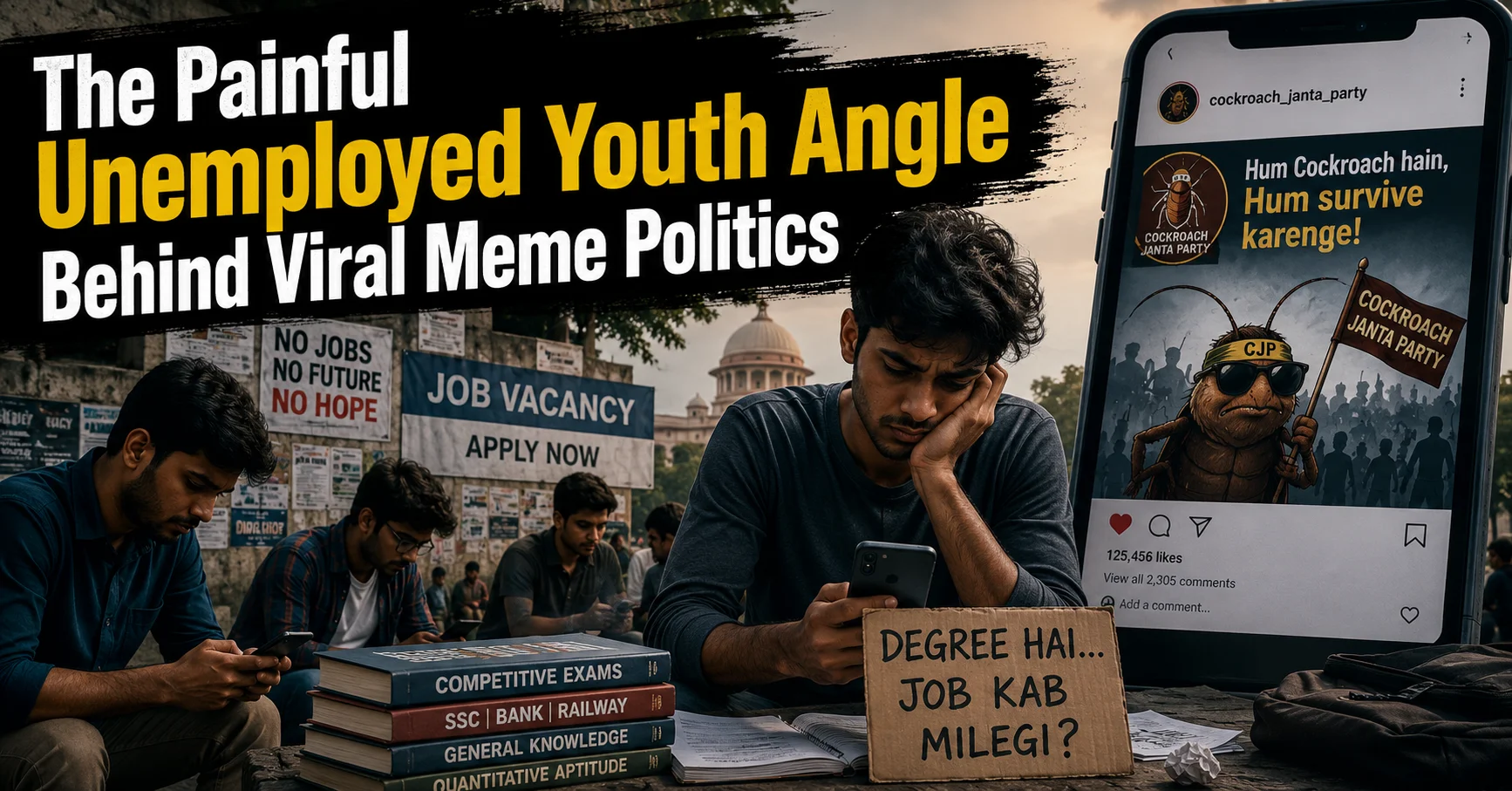
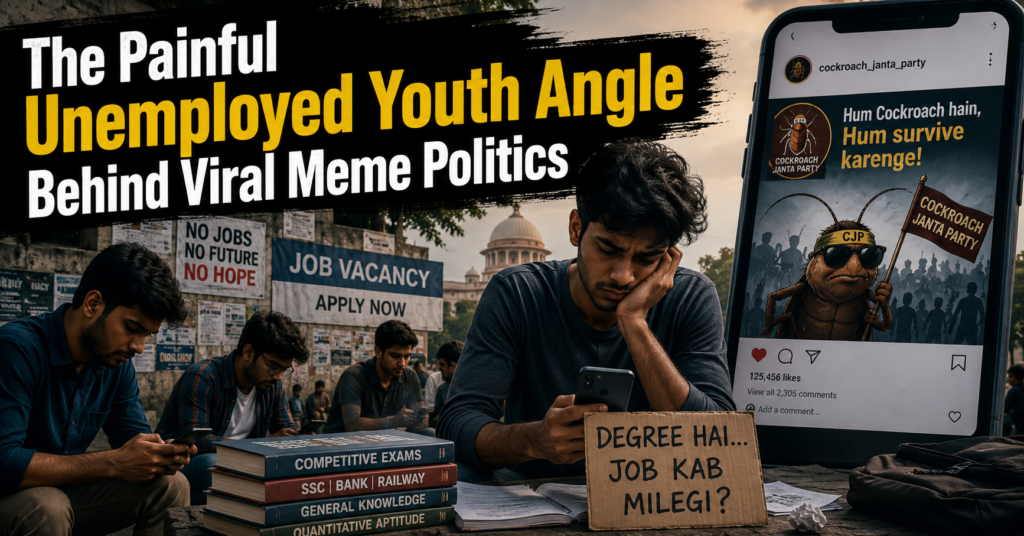
The Painful Unemployed Youth Angle Behind Viral Meme Politics
For a few days, Indian Instagram looked less like a social media app and more like a political meme battlefield. Reels, comments, profile pictures, parody manifestos — everything suddenly revolved around one strange name: Cockroach Janta Party.
At first glance, it looked like another internet joke. A meme trend that would disappear in two days, replaced by the next viral topic. But the reason this movement exploded so quickly has less to do with comedy and more to do with frustration.
The real story behind the Cockroach Janta Party is not about cockroaches at all. It is about a generation of young Indians who feel ignored, unemployed, overstimulated, and increasingly disconnected from traditional politics. (Unemployed Youth Angle)
And that is exactly why this trend matters.
A Meme That Accidentally Became a Mirror
Most viral trends survive because they are funny. This one survived because people related to it.
The page used sarcasm, exaggerated humor, and chaotic meme culture, but underneath the jokes were topics many young Indians deal with every day — unemployment, exam pressure, rising living costs, and a feeling that nobody in power is listening. (Unemployed Youth Angle)
That combination is powerful online.
A college student preparing for government exams may spend years studying without job security. Another graduate may have degrees but still struggle to find stable work. Instead of discussing these frustrations through long political debates, people are now expressing them through memes, reels, and comment sections.
That is what made Cockroach Janta Party different from a normal meme page.
It gave internet frustration a recognizable identity.
Why Young Users Connected With It So Fast
Traditional political communication often feels distant to younger audiences. TV debates look repetitive. Political speeches feel scripted. Most official campaigns speak like advertisements.
But meme culture works differently.
It is fast, emotional, relatable, and brutally honest.
When users saw unemployment jokes mixed with political satire, they immediately understood the message without needing detailed explanations. A 15-second reel can sometimes communicate more emotion than a 30-minute debate show. (Unemployed Youth Angle)
This is where the unemployed youth angle becomes important.
Many young people online are not necessarily politically active in the traditional sense. They are not attending rallies or joining parties. But they are deeply aware of economic pressure in their own lives.
Memes have become their way of talking about it publicly without sounding overly serious.
Humor makes frustration easier to share.
The Internet Has Changed Political Expression
Ten years ago, political influence mostly came from television, newspapers, and large political rallies. Today, Instagram pages can shape conversations faster than prime-time news.
That shift is bigger than people realize.
A meme page does not need a newsroom, studio, or spokesperson. It only needs content people emotionally react to. And right now, frustration spreads quickly online because many users already feel exhausted by career uncertainty and constant competition. (Unemployed Youth Angle)
This is why the Cockroach Janta Party trend gained momentum so quickly among students and young working professionals.
It felt less polished and more real.
One interesting thing about the movement is how casually people participated in it. Users changed bios, shared memes, and followed the page almost like joining an online inside joke. But underneath that humor was a serious message: people wanted their struggles acknowledged. (Unemployed Youth Angle)
That emotional connection is difficult for traditional political campaigns to create.
A Real-World Example of Digital Frustration
Imagine a 24-year-old graduate in Delhi or Pune.
He spends years preparing for exams, applies for dozens of jobs, watches recruitment delays happen repeatedly, and constantly hears motivational advice online. At the same time, Instagram feeds are full of luxury influencers, startup success stories, and unrealistic productivity content.
Eventually, humor becomes a coping mechanism.
So when a meme page openly jokes about unemployment, political chaos, and youth frustration, people instantly engage with it because it reflects their reality more honestly than polished campaigns do.
This is one reason meme politics is growing globally, not just in India.
People connect more with content that feels emotionally familiar than content that feels professionally produced. (Unemployed Youth Angle)
Why This Trend Matters Beyond Instagram
It would be easy to dismiss Cockroach Janta Party as temporary internet entertainment. But doing that misses the larger shift happening online.
Young users are increasingly turning social media into a space for political identity, emotional release, and collective frustration.
The dangerous part is not the memes themselves. The real issue is what happens when large groups of young people feel unheard for too long.
Internet humor often looks unserious on the surface, but many viral movements start as jokes before evolving into larger conversations. We have seen this happen repeatedly across global internet culture.
The unemployed internet generation is not asking for perfect political solutions through memes. Most of them are simply trying to express anxiety in a language their generation understands.
And today, that language is short-form content. (Unemployed Youth Angle)
The Rise of “Relatable Politics”
One reason this trend spread faster than many official campaigns is because it understood relatability.
People no longer want robotic messaging online. They want communication that feels human, imperfect, and emotionally honest.
That is why meme creators often outperform professional political communication teams on engagement.
Relatable politics works because it feels participatory. Users are not just consuming content — they are remixing it, commenting on it, and turning it into part of internet culture.
In many ways, the Cockroach Janta Party trend showed how political communication is evolving.
The future may not belong entirely to speeches and manifestos. It may belong to creators who understand internet emotion better than institutions do. (Unemployed Youth Angle)
An Important Observation Most People Missed
One surprising thing about this movement is that many users participating in it were not necessarily supporting a political ideology.
They were supporting a feeling.
That feeling was exhaustion.
Exhaustion from competition, instability, online comparison, and uncertainty about the future.
The memes became popular because they transformed frustration into entertainment. And entertainment spreads faster online than anger alone.
This is why the trend resonated so deeply with Gen Z audiences.
Not because they believed a meme page would solve unemployment, but because the page acknowledged emotions they already carried.
Final Thoughts
Cockroach Janta Party may eventually fade like most internet trends do. But the emotions behind its popularity are unlikely to disappear anytime soon.
India’s unemployed internet generation is growing louder online, and meme culture has become one of its most visible languages.
That is what makes this trend important.
Not the jokes.
Not the follower count.
Not the viral reels.
But the fact that millions of young people saw themselves reflected in it.

My name is Ankit Yadav, and I am a passionate digital journalist and content creator. I write about technology, entertainment, sports, and current affairs with the aim of delivering unique, accurate, and engaging information to my readers.
I believe news should not only inform but also provide clear insights and fresh perspectives. That’s why I focus on making my articles easy to read, reliable, and meaningful.
📌 I specialize in Tech Trends, Latest News, Cybersecurity, Digital Media, Sports, and Entertainment.
📌 My mission is to share fast, authentic, and valuable updates with every article I publish.