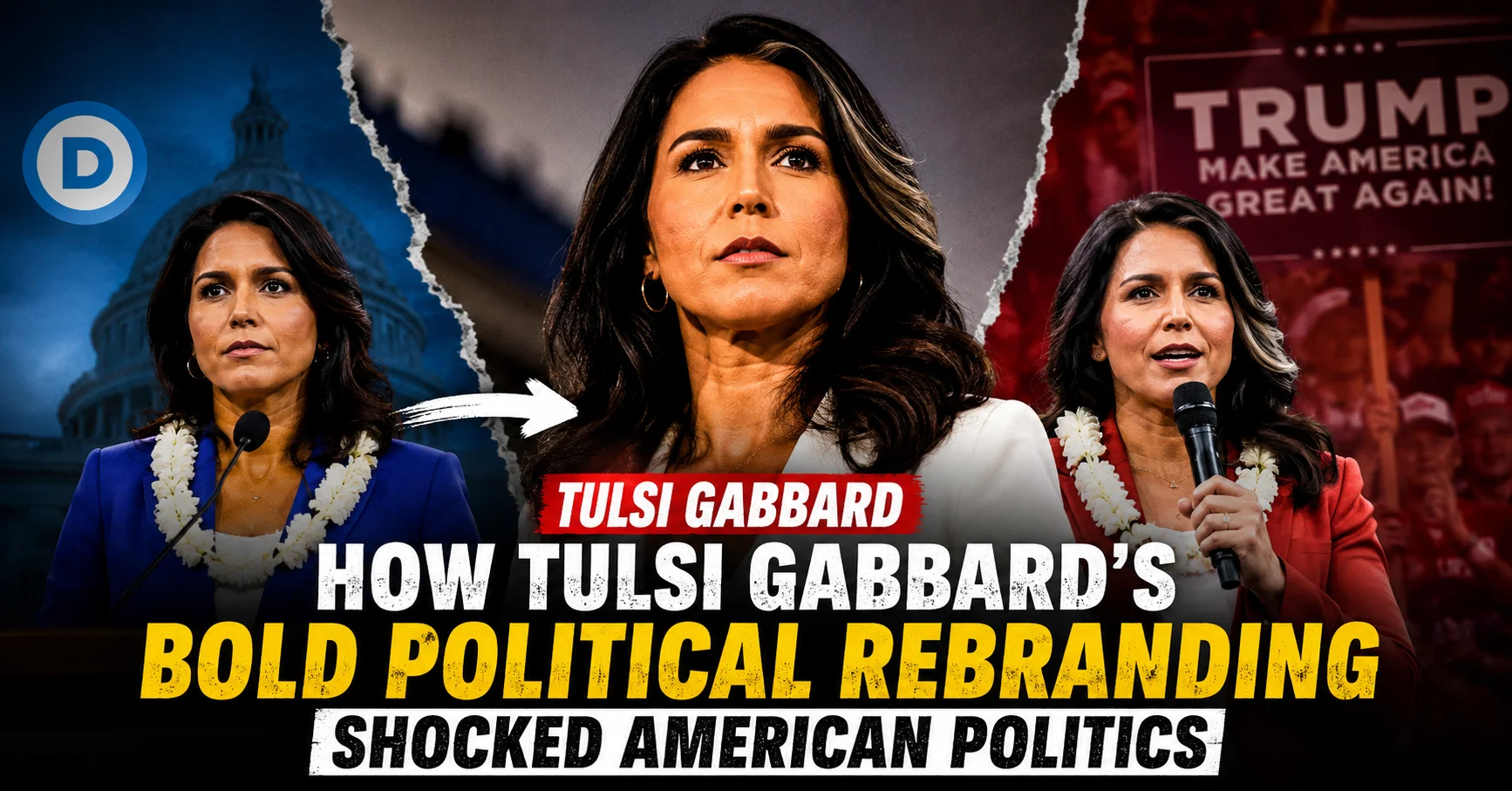
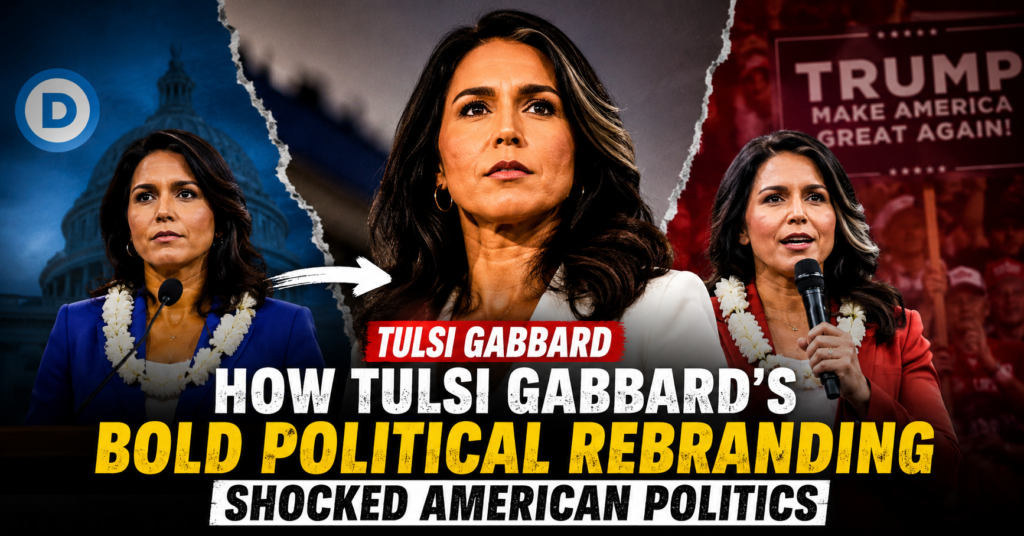
How Tulsi Gabbard’s Bold Political Rebranding Shocked American Politics
A few years ago, Tulsi Gabbard was mostly known as a Democratic congresswoman from Hawaii who supported progressive causes and openly criticized U.S. military interventions overseas. Today, many Americans associate her with conservative media appearances, anti-establishment messaging, and support for Donald Trump’s political movement.
Such a change does not occur by coincidence.
What makes Tulsi Gabbard’s journey interesting is not just the political switch itself. Politicians change parties all the time. What stands out is how effectively she managed her political rebranding during a time when public trust in traditional institutions was already weakening.
Her rise among conservative audiences says a lot about how modern political influence works in America today. (Political Rebranding)
The Beginning of Her Political Identity
Tulsi Gabbard first gained national attention as a Democrat with a very different image from the party mainstream. She was young, a military veteran, and often willing to challenge leaders from her own side.
During the 2016 Democratic primary season, she resigned from a Democratic National Committee position to support Bernie Sanders. At the time, that move helped build her reputation as someone willing to go against party leadership when she believed it was necessary.
She was frequently characterised as independent-minded even by those who disagreed with her political views.
That image became the foundation of her later political rebranding.
Why Her Message Started Changing
One reason Gabbard slowly connected with conservative audiences is that her criticism increasingly focused on issues that Republicans and independents already cared about.
She questioned foreign military involvement, criticized media institutions, and spoke frequently about censorship and political polarization. These topics gained huge attention after the 2020 election cycle, especially among voters who felt disconnected from traditional political messaging.
Instead of trying to compete with mainstream Democratic figures, Gabbard positioned herself outside the usual political structure.
That shift mattered more than a formal party label.
In many interviews and podcast appearances, she presented herself less like a conventional politician and more like someone challenging an entrenched system. That style worked particularly well in the modern media environment, where audiences often respond more strongly to authenticity than polished political messaging.
The Media Strategy Behind the Shift
One of the smartest parts of Tulsi Gabbard’s political rebranding was her media strategy.
Rather than relying heavily on traditional press coverage, she appeared on podcasts, independent news platforms, YouTube channels, and long-form interviews. Those formats allowed her to explain her positions without short television sound bites controlling the conversation.
This is something many modern political figures now understand: people trust long-form conversations more than scripted political appearances.
A simple example is how often clips from podcasts spread across social media platforms. A single interview can reach millions of viewers without needing support from traditional television networks.
Gabbard adapted to that reality earlier than many politicians did.
That helped her build a new audience that was less connected to party identity and more connected to shared frustrations about media bias, government institutions, and foreign policy decisions.
Why Conservatives Responded to Her
Some conservatives did not initially agree with Tulsi Gabbard on every issue. But they respected certain qualities that felt increasingly rare in politics.
She had military experience. She criticized interventionist wars. She challenged establishment figures publicly. And unlike many politicians, she often sounded comfortable speaking in unscripted conversations.
That combination gave her credibility among voters who were already skeptical of mainstream political narratives.
Her criticism of Democratic leadership also made her more visible in conservative media circles. Over time, appearances on networks like Fox News and conversations with right-leaning commentators helped strengthen her new political identity.
This was not just about ideology. It was also about audience alignment.
Modern politics is heavily influenced by media ecosystems. Once a political figure becomes trusted within a particular media space, audience loyalty can grow very quickly.
Political Rebranding Is Becoming More Common
Tulsi Gabbard’s transformation reflects a larger trend happening in American politics.
Party identity is no longer as fixed as it once was. Voters increasingly follow personalities, independent creators, podcasts, and online communities instead of relying only on traditional political institutions.
That environment creates opportunities for political rebranding.
A politician today can reshape public perception faster than before because social media and digital platforms allow direct communication with audiences.
Donald Trump used this strategy effectively. So did figures like Robert F. Kennedy Jr. in different ways. Gabbard followed a similar path by building influence outside conventional party structures.
The interesting part is that political success now depends less on party approval and more on audience trust.
That is a major shift from how politics traditionally worked.
Why This Matters Beyond One Politician
It would be easy to treat Tulsi Gabbard’s political evolution as just another political story, but it reflects something much bigger happening in public life.
People are increasingly drawn to figures who appear independent from institutional control. Whether or whether that perception is entirely true, it has gained political clout.
That creates both opportunities and risks.
On one side, it allows outsiders to challenge political systems more easily. On the other, it can deepen polarization because audiences start trusting personalities more than institutions.
Gabbard’s rise among conservative audiences shows how political identities are becoming more flexible and media-driven.
A Democrat from Hawaii becoming popular among Trump supporters would have sounded unlikely a decade ago. Today, it feels completely possible because the political landscape itself has changed.
One Important Observation
Perhaps the most interesting part of Tulsi Gabbard’s political rebranding is that she never fully presented herself as a traditional Republican figure.
Instead, she positioned herself as anti-establishment first.
That distinction matters.
Many of her supporters see her less as someone who “switched sides” and more as someone who rejected political systems they already distrusted.
That is why her message resonates beyond strict party lines.
And in the current media environment, that type of positioning can be incredibly powerful.

My name is Ankit Yadav, and I am a passionate digital journalist and content creator. I write about technology, entertainment, sports, and current affairs with the aim of delivering unique, accurate, and engaging information to my readers.
I believe news should not only inform but also provide clear insights and fresh perspectives. That’s why I focus on making my articles easy to read, reliable, and meaningful.
📌 I specialize in Tech Trends, Latest News, Cybersecurity, Digital Media, Sports, and Entertainment.
📌 My mission is to share fast, authentic, and valuable updates with every article I publish.