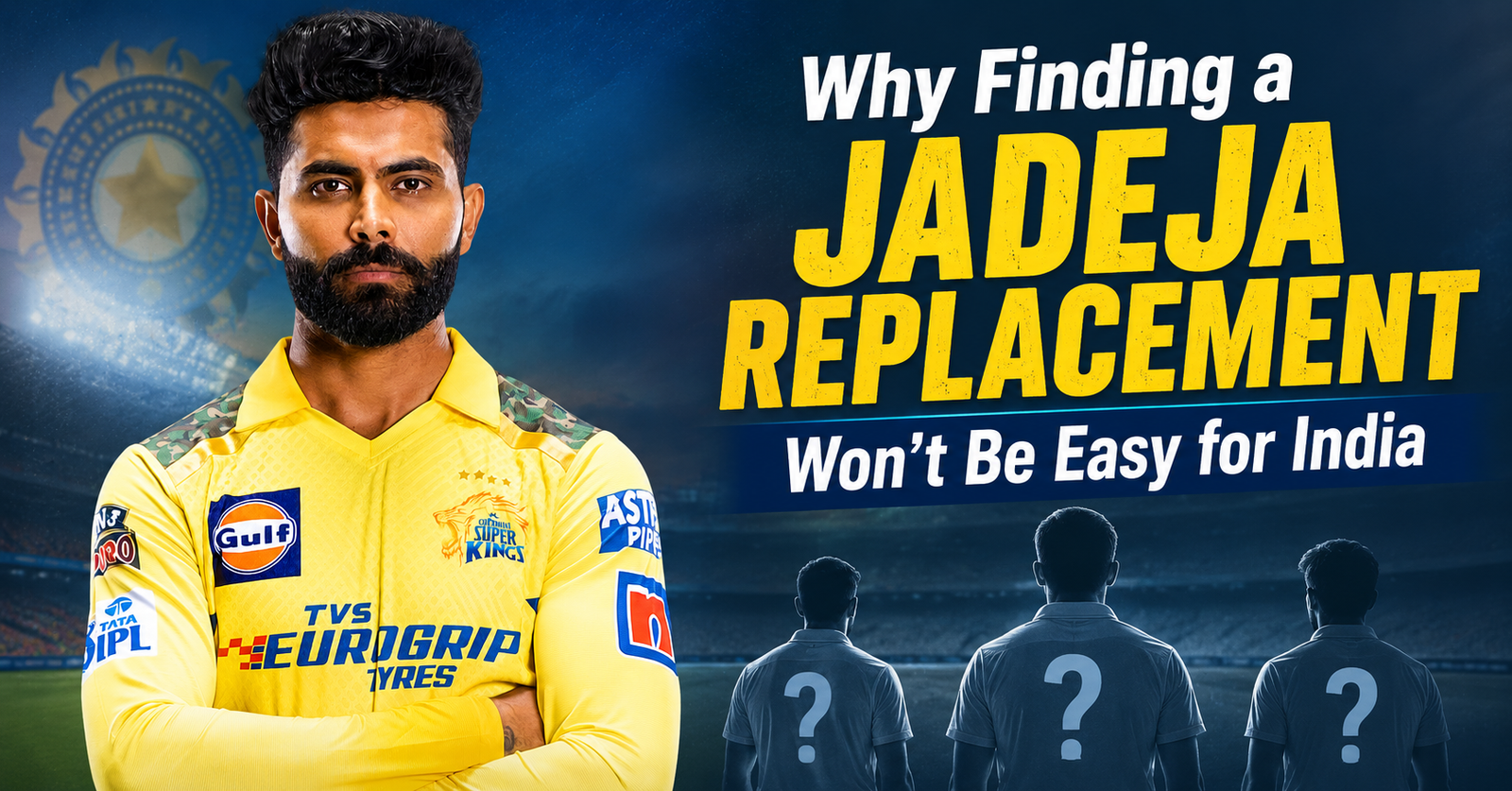
Why Finding a Jadeja Replacement Won’t Be Easy for India
For more than a decade, Ravindra Jadeja has been one of those players Indian cricket quietly depended on without always giving him the spotlight he deserved. He was never just a spinner. Additionally, he was never merely a lower-order hitter. And that’s exactly why the current jadeja replacement discussion feels more complicated than most fans realise.
India has produced great batters, world-class fast bowlers, and plenty of spin options over the years. But players who can genuinely balance all three departments — bowling, batting, and fielding — are rare. Jadeja happens to be one of them.
Now that conversations around workload management, injuries, and long-term planning have started, the bigger question is slowly entering mainstream cricket discussions: who replaces Ravindra Jadeja when the time finally comes?
The simple answer is that nobody can replace him directly. The more realistic answer is that India may need multiple players to cover what Jadeja brought to the side.
Why Jadeja’s Role Was Different From Other All-Rounders
A lot of all-rounders contribute in phases. Some are bowling-heavy. Others mainly provide batting depth. Jadeja became valuable because he could influence an entire Test match even on days when he wasn’t dominating headlines.
There have been overseas tours where his control with the ball helped India slow down scoring. In home conditions, he often turned matches within a session. Then there’s the batting. Time after time, India recovered from difficult situations because Jadeja could bat responsibly with the tail.
One recent example was India’s lower-order resistance in pressure situations during Test cricket over the last few years. Jadeja frequently turned scores like 180/6 into competitive totals. That changes matches more than flashy fiftys sometimes do.
And then comes fielding — probably the most difficult thing to replace. Jadeja saved runs in ways scorecards never fully captured.
That combination is why the jadeja replacement debate matters more than a simple squad selection issue.
India Has Good Players, But Not the Same Profile
The interesting part is that India already has talented all-rounders. The problem is role balance.
Axar Patel is probably the closest comparison because he offers left-arm spin and dependable batting. But Axar’s bowling style is slightly different. Jadeja’s speed through the air, accuracy, and ability to attack rough patches consistently gave India a different tactical option.
Washington Sundar offers calm batting and intelligent bowling, but injuries have interrupted his growth repeatedly.
Then there are younger names entering conversations like Manav Suthar. Domestic cricket watchers have praised his control and temperament, and selectors are clearly paying attention. But stepping into Jadeja’s role immediately would be unrealistic pressure for any young cricketer.
That’s the hidden challenge with a jadeja replacement. India isn’t just searching for statistics. They’re searching for reliability.
The Bigger Problem Is Test Cricket Experience
India’s domestic system still produces strong spin bowlers, but modern Test cricket demands much more from an all-rounder.
A player today has to survive in overseas conditions, contribute under pressure with the bat, and remain athletic in the field for long sessions. Jadeja improved steadily in every one of those areas over time.
That development didn’t happen overnight.
Earlier in his career, many people viewed Jadeja mainly as a limited-overs cricketer. There were even periods when his Test place faced criticism. But over the years, he evolved into one of India’s most dependable red-ball players.
That journey itself is an important reminder. The next player may also need time before becoming a complete package.
Fans usually expect instant replacements in Indian cricket. Reality is slower.
Why This Transition Could Change India’s Team Balance
One overlooked part of this conversation is how Jadeja allowed India to build balanced playing XIs.
Because he could comfortably bat at No. 6 or No. 7, India often played an extra bowler without weakening the batting too much. That flexibility gave captains more tactical freedom.
Without a player like him, selectors may have to rethink combinations completely.
For example, if India chooses a bowling-heavy spinner who cannot bat reliably, the lower order suddenly looks fragile. If they choose a batting all-rounder with weaker bowling, overseas bowling attacks may lose control during long spells.
This is why the jadeja replacement issue is not really about replacing one player. It’s about protecting team balance.
Could India Use Multiple Players Instead?
There’s also a realistic possibility that India never finds a direct replacement.
Instead, they may divide responsibilities across players.
One cricketer may contribute more with batting. Another may become the primary spin option. A third player may strengthen fielding standards.
This approach already exists in some international teams. Modern cricket has become specialised, especially with packed schedules and workload concerns.
But India traditionally benefited from multi-dimensional players. Kapil Dev gave balance in one era. Ravichandran Ashwin changed tactical bowling discussions. Jadeja brought versatility across departments.
Replacing that type of cricketer is never straightforward.
The Pressure of Being Called “The Next Jadeja”
Young players entering this conversation face another challenge — expectations.
The moment someone performs well in domestic cricket, social media quickly labels them “the next Ravindra Jadeja.” While that creates excitement, it can also become unfair pressure.
Every major Indian cricketer developed differently.
Jadeja himself needed years to become the player people now consider irreplaceable. His batting matured gradually. His confidence overseas improved over time. Even his leadership presence evolved quietly.
That’s why India’s management should avoid rushing comparisons.
The smarter approach would be allowing younger all-rounders to develop naturally while giving them clear roles instead of expecting instant perfection.
India’s Next Phase May Already Be Starting
One interesting observation from recent squad selections is that selectors appear more willing to experiment with spin-bowling all-rounders than before.
That usually signals long-term planning.
Whether it’s Axar Patel getting more opportunities, Washington Sundar returning into discussions, or younger domestic names earning attention, India clearly understands the importance of preparing for the post-Jadeja phase early.
And honestly, they probably have to.
Players like Jadeja don’t disappear suddenly from Indian cricket. Their absence is usually felt gradually — first through workload management, then selective appearances, and eventually through changing team combinations.
That transition may already be underway.
Final Thoughts
The jadeja replacement conversation is not really about finding another player with the same statistics. It’s about replacing a style of cricketer Indian teams relied on for years without always noticing how much balance he provided.
India will likely produce talented all-rounders in the coming years. Some may even become match-winners across formats. But expecting a carbon copy of Ravindra Jadeja may be unrealistic.
The more practical question is this: can India build a new system that recreates the stability Jadeja gave the team?
That answer may shape India’s Test future more than people currently realise.

My name is Ankit Yadav, and I am a passionate digital journalist and content creator. I write about technology, entertainment, sports, and current affairs with the aim of delivering unique, accurate, and engaging information to my readers.
I believe news should not only inform but also provide clear insights and fresh perspectives. That’s why I focus on making my articles easy to read, reliable, and meaningful.
📌 I specialize in Tech Trends, Latest News, Cybersecurity, Digital Media, Sports, and Entertainment.
📌 My mission is to share fast, authentic, and valuable updates with every article I publish.